
By Coptic Solidarity –
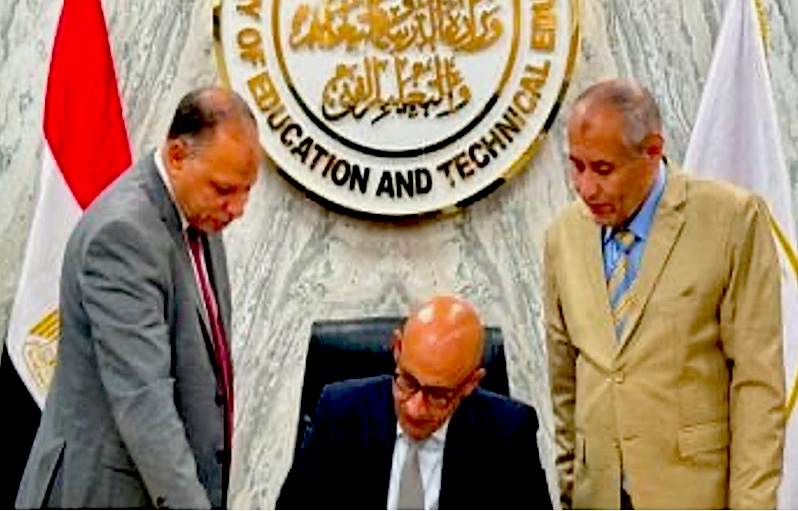
The Egyptian Ministry of Education has announced on Wednesday the names of the top ten students in each of the country’s three General Secondary Certificate (Thanaweya Amma) branches for the 2025–2026 academic year.
The official lists comprise 30 students—all of them Muslims, with not a single Coptic Christian among the country’s highest-ranked graduates.
The outcome is particularly striking because, in previous years, the published lists generally included at least one Coptic student among the top achievers in one or more branches. This year, however, Coptic students have disappeared entirely from the official honor rolls.
Although unrelated to this year’s examination results, the Ministry’s latest cooperation agreement with Al-Azhar is the most recent manifestation of a broader policy that has progressively expanded the Islamic institution’s influence over Egypt’s public education system. Rather than remaining confined to its own network of religious schools, Al-Azhar increasingly shapes curriculum development, teacher training, and the religious orientation of public education.
State-owned and pro-government media have also devoted extensive coverage to the country’s top-ranked students. A recurring theme throughout these reports is the attribution of academic success to religious devotion: students describe constant prayer, memorization of the Qur’an, divine blessing, and Qur’anic memorization as central factors behind their achievements. One of the first-place students in the mathematics branch explicitly credits memorizing the Qur’an as “the greatest secret” behind her success, while other featured students similarly attribute their achievements primarily to faith and prayer.

The exclusion of Coptic students from the official lists, coupled with the state’s growing tendency to frame academic excellence in explicitly Islamic terms, can only deepen long-standing concerns that educational achievement is becoming increasingly intertwined with Sunni Islamic identity
Some pbservers are wondering whether the Ministry of Education should perhaps commission a study into the apparent collapse of Coptic intellectual abilities. After all, if over ten percent of Egypt’s population has suddenly become incapable of producing a single student among the nation’s top thirty, this would represent a remarkable educational phenomenon requiring urgent scientific explanation.