
By Coptic Solidarity –
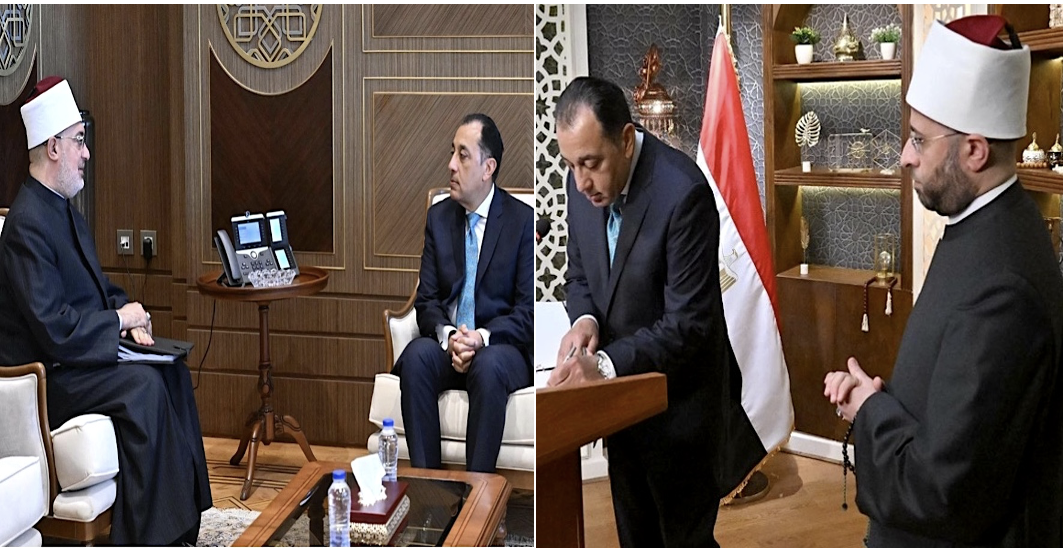
On November 2, Egyptian Prime Minister Mostafa Madbouly devoted part of his official schedule to two of the country’s three principal Islamic authorities. He inaugurated an artificial-intelligence and digital-media center at the Ministry of Awqaf and separately met Grand Mufti Nazir Ayyad to discuss Dar al-Ifta’s expansion and its new international digital platform.
These were more than ceremonial encounters. The prime minister personally endorsed two major programs intended to extend state-approved Islamic guidance into social media, family life, education, public attitudes and what officials described as citizens’ “worldly matters.” Together, they reveal another stage in the state-managed Islamization of Egyptian public life.
The development should not be mistaken for independent religious institutions encroaching upon a reluctant civil state. The Ministry of Awqaf is an arm of the executive government, while Dar al-Ifta operates under state supervision. What is taking place is the government’s increasing incorporation of Islamic institutions and doctrine into its administration, communications strategy and regulation of society.
Mass-Produced Islamic Messaging for the Entire Population
Madbouly inaugurated the Ministry of Awqaf’s new Center for Digital and Media Production in the presence of several cabinet ministers, the governor of Cairo and representatives of Al-Azhar and Dar al-Ifta. The center will use artificial intelligence to produce religious, cultural and “awareness” content for domestic and international audiences.
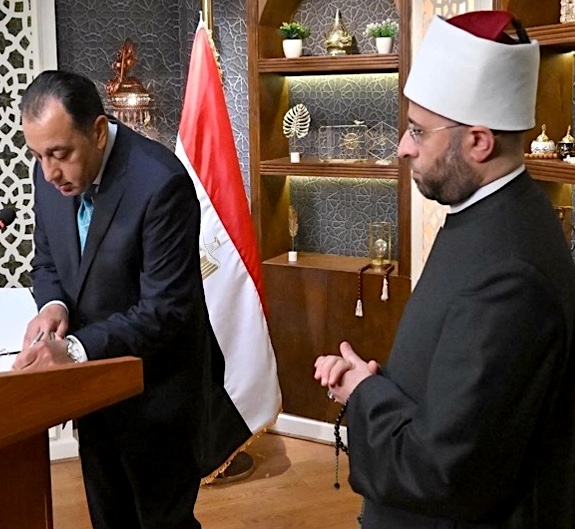
The prime minister described “renewing religious discourse” as one of the Egyptian state’s principal objectives. He said the new technology would enable the government to provide society with religious and supposedly scientific interpretations of the concerns of everyday life.
The center is designed to address older people, young adults and children separately, adapting its language and presentation to each group. It will produce material in formal Arabic, simplified Egyptian Arabic and English, with additional formats intended specifically for children, young people and social-media audiences.
The government’s official account says the center already has the capacity to produce approximately 1,000 films a month and intends to increase this to 3,000 films and video clips every month. Its workforce is expected to grow from about 40 to 150 artificial-intelligence, design and digital-media specialists.
Madbouly instructed the Ministry of Awqaf to produce this material “abundantly” and ensure that it reaches every segment of Egyptian society. He said the purpose was to “immunize society” against challenges encountered on social media.
The prime minister warned against leaving Egyptians to social-media platforms that, he claimed, are directed in ways that create negative impressions of events in the country. Islamic content is therefore being enlisted not only to promote religious instruction, but also to counter criticism, influence public perceptions and reinforce the state’s narrative.
The result is a government-funded religious media apparatus targeting the entire population, including children, whether or not its members are Muslim or wish to receive Islamic interpretations of their daily concerns.
Ten Million Fatwas for Religious and “Worldly” Matters
On the same day, Madbouly met Grand Mufti Nazir Ayyad at the government headquarters in the New Administrative Capital. He praised Dar al-Ifta’s “pivotal role” in promoting religious awareness and answering citizens’ questions concerning both religious and worldly matters.
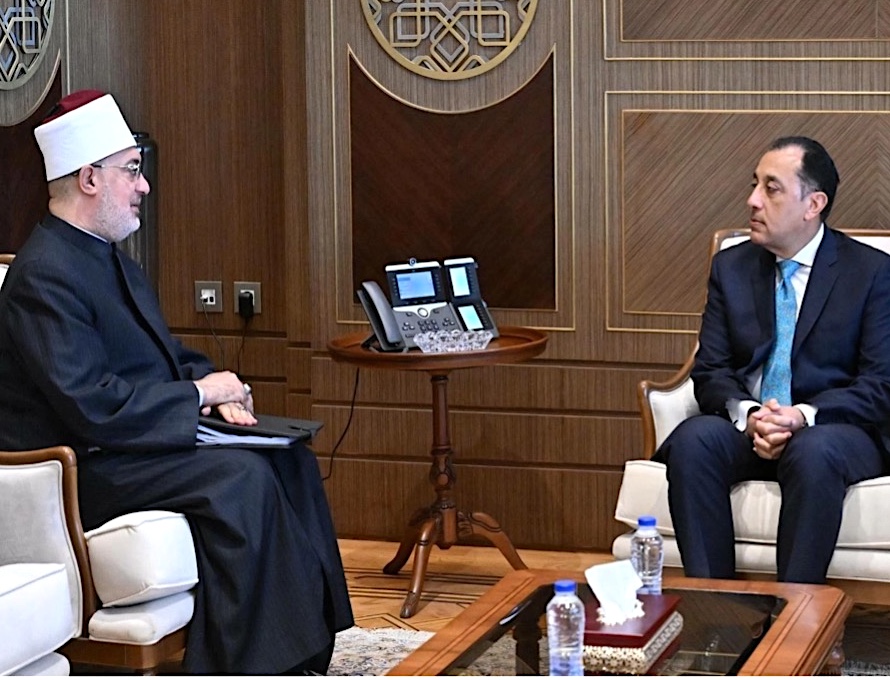
That phrase is particularly significant. It grants an Islamic institution a state-endorsed role extending well beyond worship or voluntary religious observance into the ordinary social and personal affairs of citizens.
The grand mufti briefed Madbouly on plans to establish new Dar al-Ifta branches in North Sinai, South Sinai and Port Said. These offices are intended to bring officially approved Islamic rulings closer to citizens, identify their “fatwa needs” and address their concerns in ways said to reflect local realities.
Ayyad also presented HASIN—the International Fatwa Reference, a digital platform and mobile application designed to establish Egyptian Dar al-Ifta as an international Islamic authority. The platform reportedly incorporates more than 10 million approved fatwas into a database containing over 30 million entries drawn from the Quran, hadith, Islamic jurisprudence, principles of jurisprudence and Arabic-language studies.
Using artificial intelligence, HASIN will allow users to ask questions in natural language and search for answers in nine languages. Although artificial intelligence will retrieve and organize the material, Dar al-Ifta stresses that religious scholars and muftis will retain authority over the answers.
The platform arose from a September 2026 international conference held under President Abdel-Fattah el-Sisi’s patronage. Its title explicitly framed family protection and the “preservation of identity” as matters requiring a fatwa-based approach. The project therefore extends Islamic jurisprudential authority into family relations, identity and social policy while using advanced technology to make that authority immediate and pervasive.
A Civil State Receding Behind Religious Governance
Egyptian officials will describe these initiatives as efforts to combat extremism, promote moderation and prevent unregulated religious opinions. But the issue is broader than whether the Islamic content is labeled “moderate.”
The state is constructing an integrated system in which the Ministry of Awqaf produces mass religious media, Dar al-Ifta supplies millions of authoritative rulings, Al-Azhar provides doctrinal legitimacy and the executive government directs and finances their expansion. Artificial intelligence greatly increases the speed, volume and reach of this system.
The absence of any counterpart efforts towards other faiths is neither accidental nor an omission awaiting correction. Islam is constitutionally established as the religion of the state, and the institutions receiving this vast public support are intended to reinforce its authority over national identity and public life. The project addresses Egyptian society as though it were uniformly Muslim, reducing millions of Christians to an invisible and subordinate presence. Within this framework, Islamic guidance is not offered merely as a voluntary service to Muslims; it is projected as the state-approved moral and intellectual reference for the entire population. Its underlying logic is hegemonic and potentially proselytizing: Islam supplies the “correct” answers, while non-Muslims are expected to live within the religious environment it creates—and, ultimately, may be encouraged toward what its institutions present as the “right path.”
The events of November 2 are therefore important not simply because a busy prime minister met two senior Islamic figures in one day. Their significance lies in the policies he endorsed: thousands of religious videos every month, content specifically targeting children and young people, new provincial fatwa offices, artificial-intelligence answers to personal and social questions, and the use of religious messaging to defend the state’s public narrative.
This is not merely religion occupying a larger place in society. It is the Egyptian government embedding state-approved Islam more deeply into the machinery through which it educates, communicates with and directs the population. In a country whose citizens are not all Muslim, that expansion further erodes the principle of equal citizenship and pushes the civil state deeper into the shadow of institutional religious governance.
________________
Sources: