
By Coptic Solidarity –
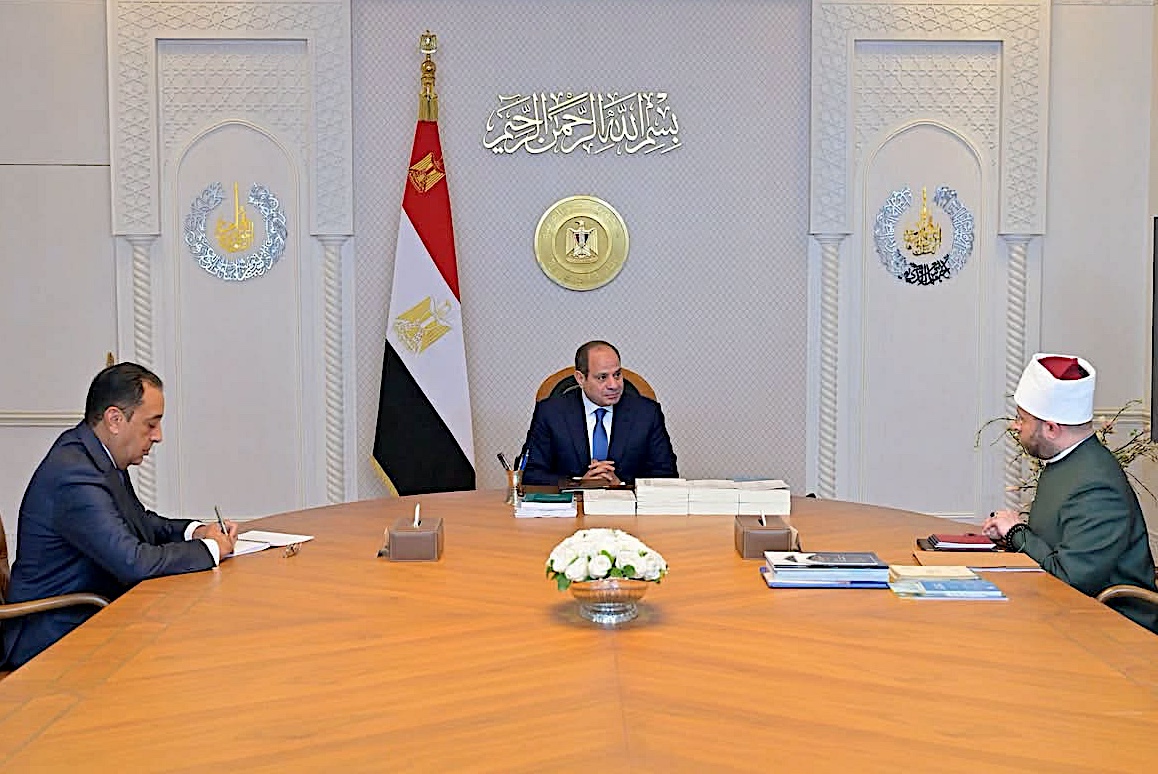
President Abdel Fattah el-Sisi met on November 12 with Prime Minister Mostafa Madbouly and Minister of Awqaf Osama al-Azhari to review a range of Islamic religious initiatives, including the Ministry’s expanding digital activities and preparations for the second season of Dawlat al-Tilawa (“State of Recitation”), scheduled to begin November 13.
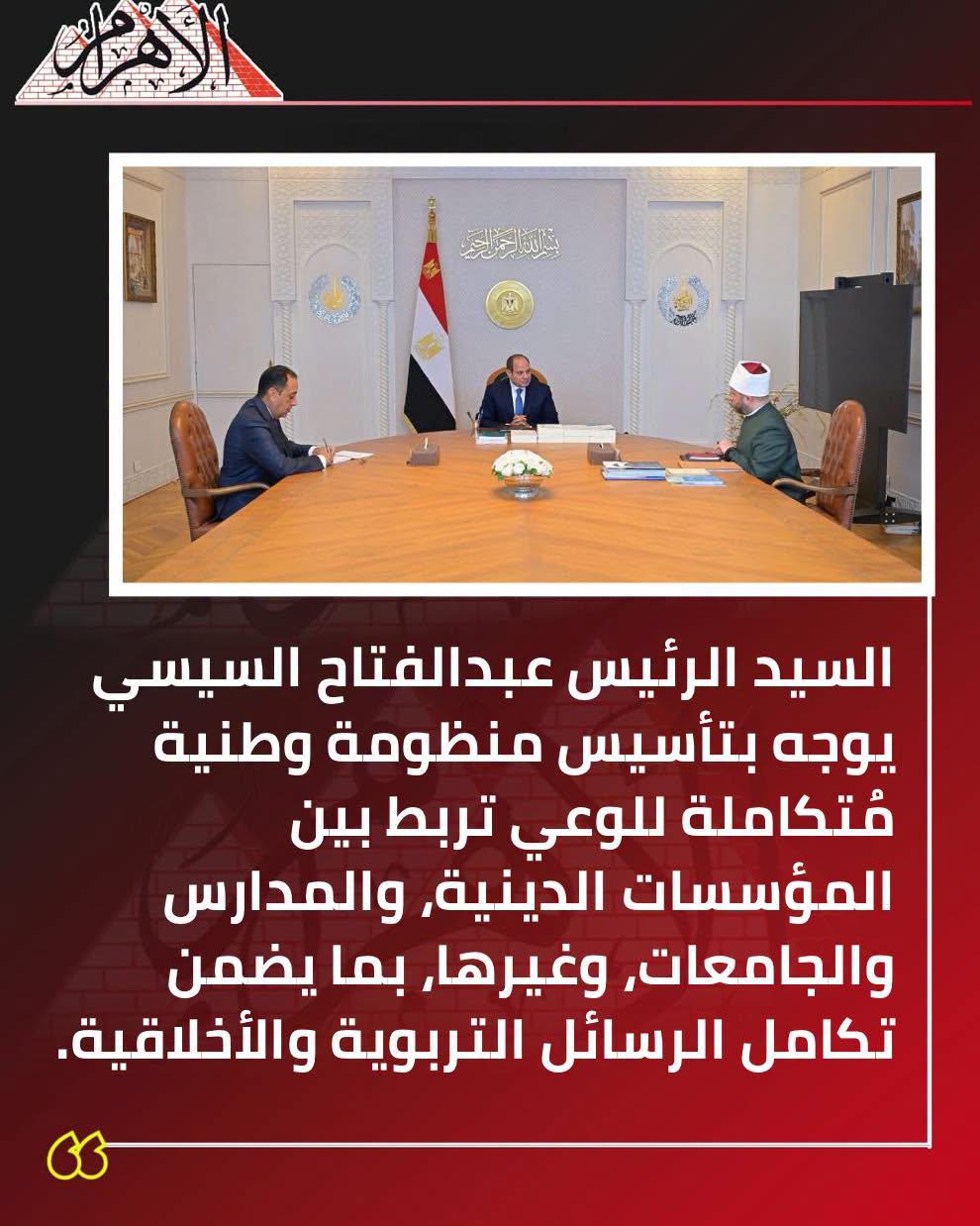
The meeting underscored the president’s continuing personal involvement in shaping and supervising the state’s Islamic religious agenda. He also instructed the establishment of an integrated national system of religious and moral guidance linking religious institutions, schools, universities, and other public bodies
According to the presidential spokesman, Ambassador Mohamed el-Shennawy, the meeting addressed the Ministry’s efforts to “correct misconceptions,” reinforce values and morals, and confront extremist thinking. President Sisi stressed the importance of renewing religious discourse to address contemporary societal challenges and correct what the authorities consider erroneous ideas and behavior.
The directive is particularly significant because it seeks to coordinate religious, educational, and moral messaging across institutions serving the entire population, effectively extending the Ministry’s religious mission into the broader sphere of public education and social governance.
The announcement illustrates the extent to which religious guidance has become a matter of direct presidential supervision, extending beyond the traditional responsibilities of the Ministry of Awqaf.
Dawlat al-Tilawa: A Second Season of State-Sponsored Qur’anic Promotion
Among the initiatives reviewed at the meeting were the final preparations for the second season of Dawlat al-Tilawa, a state-sponsored program devoted to Qur’anic recitation.
The program’s continuation is significant not merely as a religious broadcasting initiative but as part of a wider government effort to increase the visibility and reach of Islamic religious content through modern media.
The president was also briefed on preparations for the second season of the Ministry’s Sahhih Mafahimak (“Correct Your Concepts”) initiative and the digital dissemination of weekly Friday sermons, intended particularly to reach younger audiences through electronic platforms.
These initiatives form part of an increasingly coordinated system in which religious messaging is developed, disseminated, and reinforced through multiple state-supported channels.
The meeting also highlighted the Ministry’s rapidly expanding digital infrastructure. Minister al-Azhari reported the inauguration, the previous week, of the Ministry’s artificial intelligence center, following the launch of a comprehensive electronic platform containing approximately 80,000 pages of authenticated religious content. Plans are underway to introduce an AI-powered audio version.
These developments illustrate the growing integration of conventional religious preaching with a technologically sophisticated infrastructure capable of disseminating Islamic teachings on a much broader scale.
Education and Social Institutions
Another major subject of the meeting was the establishment of a legal framework encouraging educational and healthcare waqf (Islamic endowments), in accordance with previous presidential directives.
Minister al-Azhari described the president’s initiative as opening a new phase in using endowments to serve society. He reported that coordination had begun with the Prime Minister’s Office and relevant ministries to develop the necessary legal and institutional mechanisms.
President Sisi also called for reviving the historical role of Islamic endowments in ways consistent with the developmental objectives of the modern Egyptian state.
While educational and healthcare endowments can serve legitimate public purposes, their promotion through the Ministry of Awqaf further illustrates the expanding intersection between Islamic religious administration and public services, particularly when combined with the president’s directive to integrate religious and educational messaging.
The central issue is not simply the funding of schools or healthcare facilities. It is the increasing involvement of state religious institutions in areas traditionally associated with general public administration.
Religious Guidance as an Instrument of State Governance
The significance of the November 12 meeting lies above all in the president’s direct involvement. Rather than leaving religious programming to the Ministry of Awqaf, the head of state personally reviewed its media initiatives, digital infrastructure, religious campaigns, endowment policies, and plans for coordination with educational institutions.
Far from being an isolated intervention, the president’s personal involvement reflects an established pattern in which Islamic religious affairs receive sustained attention and direction at the highest level of the Egyptian state.
The presidential statement presents these measures as efforts to modernize religious discourse, strengthen moral values, and combat extremism. Yet their cumulative effect also raises questions about the boundaries between state administration and religious authority.
In a country where Islam is constitutionally the religion of the state, such initiatives have particular implications for the millions of Egyptian citizens who are not Muslim. The proposed integration of religious institutions with schools and universities raises the question of how the state intends to distinguish religious instruction from the educational and civic responsibilities of institutions serving all citizens.
The second season of Dawlat al-Tilawa, the AI-powered religious platform, the digitization of Friday sermons, and the proposed national awareness system are therefore not isolated developments. They illustrate the expansion of state-managed Islamic guidance across media, education, technology, and public institutions.
What is especially noteworthy is that this expansion is not simply being pursued by religious officials. It is being reviewed, coordinated, and explicitly directed at the highest level of the Egyptian state.
The implications for equal citizenship extend well beyond religious broadcasting or digital modernization. As state institutions increasingly coordinate the dissemination of Islamic teachings across education, media, and public services, the distinction between the state’s responsibilities toward all citizens and its promotion of the majority religion becomes progressively less clear. For Egypt’s non-Muslim citizens, this raises fundamental questions about the place of equal citizenship within a system in which Islamic religious guidance remains a continuing presidential priority.
___________________