
By Coptic Solidarity –
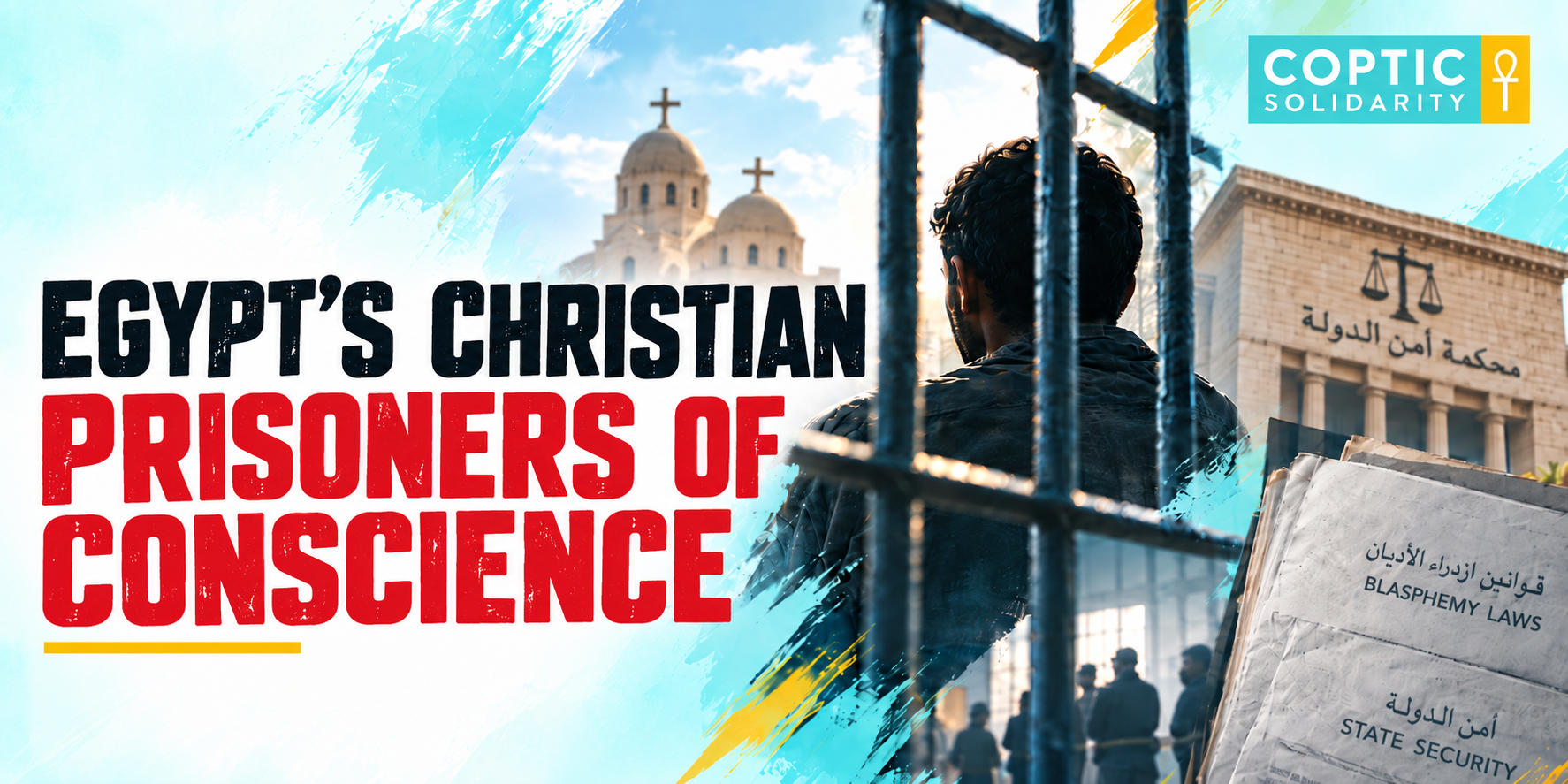
On October 21, Christian convert Said Abdelrazek will return to an Egyptian terrorism court. He is not alone. Augustinos Samaan is serving five years with hard labor for “contempt of religion”; Romany Gharib Adly Azer remains in State Security detention after criticizing police treatment and posting political satire; and on October 5, National Security forces arrested Sherif Wagih Fahmi, reportedly over Facebook posts and accusations of “contempt of Islam.” Now, six young Christians in Minya—including a child under 18—have been detained by Supreme State Security prosecutors after recreating a comedy scene from an Egyptian film.
Together, their cases show how Egypt’s blasphemy provisions and national-security system increasingly converge against peaceful expression. Religious discussion becomes “contempt,” conversion becomes a threat to national unity, criticism or satire can be treated as evidence in terrorism cases, and even comedy can lead to State Security detention
For Egypt’s international partners, expressions of concern are no longer enough.
Said Abdelrazek: From Illegal Refoulement to a Terrorism Court
Said’s case illustrates the extraordinary consequences facing an Egyptian who leaves Islam and seeks recognition as a Christian.
After converting in 2016, Said faced National Security harassment, detention, and forced divorce and separation from his wife and young son. He fled to Russia, sought asylum, and joined the Russian Orthodox Church. Yet in 2024, despite being recognized by UNHCR as needing international protection and a July 17 Russian court order prohibiting his deportation, he was wrongfully refouled to Egypt.
Upon his return, Said was detained and reportedly tortured and threatened over his Christian faith. He later described being suspended with his hands tied to a wall in a “crucified position” for hours at a time, subjected to painful procedures to remove a Christian tattoo, and warned that he could consider himself Christian only if he remained silent about it. Authorities pressured Said to return to Islam, use his social-media accounts to denigrate Christianity, and provide information about other converts and the priests who baptized them.
In July 2025, Said began exploring how to change the religion recorded on his national identity documents from Muslim to Christian—a requirement that itself underscores Egypt’s state regulation of religious identity.
Days later, on July 15, National Security agents arrested him at his Cairo apartment. He now faces charges including joining and financing an unlawful group, promoting beliefs allegedly harmful to national unity and social peace, and showing contempt for Islam and challenging its fundamental principles. His case was referred to Egypt’s terrorism court system.
The progression is stark: Said left Islam, was persecuted, wrongfully returned to Egypt despite documented protection concerns, reportedly tortured and threatened, and then arrested again as he sought legal recognition of his Christian identity.
His effort to have his identity documents reflect his faith has ended in a terrorism prosecution.
Australia Has a Particular Responsibility
Said’s case also creates a direct responsibility for Australia.
His fiancée is an Australian citizen, and Australia’s Department of Home Affairs acknowledged receipt of Said’s humanitarian visa application in May 2024. Coptic Solidarity and partner organizations have called on the Australian government to intervene diplomatically, secure his release, and facilitate his safe relocation to Australia.
With his October 21 hearing approaching, Australia should urgently raise Said’s case at senior diplomatic levels with Cairo and seek access to or observation of his proceedings. His pending humanitarian application cannot be treated in isolation from the persecution that now prevents him from reaching Australia.
Blasphemy and Terrorism: Two Paths to the Same Prison Cell
Other recent cases show how broadly these mechanisms can be applied.
Augustinos Samaan, a Coptic researcher in comparative religion and Christian apologist, was arrested in October 2025 after publishing online discussions of Christianity and Islam. He was initially confronted with terrorism-related allegations before being prosecuted under Article 98(f), Egypt’s “contempt of religion” provision. He received five years’ imprisonment with hard labor after proceedings in which his lawyers say they were not notified that his trial was taking place and were denied timely access to the case file. His cassation challenge is scheduled for November 15.
Romany Gharib Adly Azer demonstrates the extraordinary elasticity of terrorism accusations. After publicly complaining that a police officer at Cairo International Airport had confiscated his documents following a dispute, Azer was arrested and eventually placed in Supreme State Security Case No. 4832/2026. Investigators also questioned him over an older satirical post showing him riding a donkey and joking that rising gasoline prices would make it his new form of transportation. That post was reportedly treated as material related to accusations involving terrorist ideas. On October 5, prosecutors renewed his detention for another 15 days.
And now Sherif Wagih Fahmi has joined this growing list. National Security forces arrested the Coptic engineer at his Alexandria home on October 5. He has reportedly been accused of “contempt of Islam,” apparently in connection with Facebook material he shared. His case is still developing, but it follows an increasingly familiar trajectory: peaceful online expression followed by National Security intervention and a blasphemy accusation.
Six young Christians from Minya—Kyrillos Boulos Aziz, a minor; Basem Youssef Ramzy; Kyrillos Magid Malak; George Alfy Aziz; Mina Magid Attia; and Shenouda Ezzat Mounir (ages 18-22)—were recently detained in Supreme State Security Case No. 8430/2026 after recreating a comedy scene from the 2018 Egyptian film Khalawis.
The video was deleted from social media within hours, but after it was reposted, inflammatory comments and threats targeted the young men, their families and local Christians. Families and church representatives reportedly handed five of them over to police to prevent sectarian tensions from escalating, following assurances that they would be released once the situation calmed. Instead, they were transferred to Supreme State Security Prosecution and accused of promoting extremist ideas, contempt of religion and blasphemy.
The case is especially striking because the original scene appeared in a commercially released film approved by Egyptian censors, while EIPR reports that hundreds of similar recreations remain online. Rather than protecting those facing sectarian threats, the authorities have placed six young Christians—including a child—in State Security detention over a comedy video.
These are different men, engaged in different activities. What links their cases is the state’s ability to move easily between the language of religious offense, national unity and terrorism.
International Treaties Have Not Protected Converts
Egypt is a party to the International Covenant on Civil and Political Rights (ICCPR), which protects the right to adopt or change one’s religion. Yet Egypt ratified it with a declaration explicitly “taking into consideration the provisions of the Islamic Sharia.” The practical consequences were demonstrated in the case of Maher El-Gohary, a Muslim-born Christian who sought to change the religion on his national ID. As Coptic Solidarity has previously documented, an Egyptian court rejected his request; USCIRF reported that the court held that Sharia takes precedence where it conflicts with the ICCPR. (USCIRF)
That precedent is directly relevant to Said Abdelrazek: international law recognizes his freedom to change religion, while Egyptian law and judicial practice have denied Muslim-born converts the ability to have that choice legally recognized.
That is why merely reminding Cairo that it has signed international treaties is insufficient. Foreign governments must confront the legal and institutional structures that make those guarantees unenforceable for converts and religious dissenters.
Why Has Washington Failed to Act?
The United States has significant leverage with Egypt, yet concrete consequences for religious-freedom abuses remain limited.
Coptic Solidarity’s Egypt’s Access Machine in Washington investigation helps explain part of that gap. Egypt has well-funded lobbying, diplomatic and religious networks with direct access to policymakers. Coptic victims of persecution and their families have nothing comparable.
This imbalance matters. Egyptian officials and allies can repeatedly present a narrative of religious-freedom progress in Washington, while those imprisoned, threatened or discriminated against often struggle simply to have their cases heard.
Those claims should now be placed beside the prison cells of Said Abdelrazek, Augustinos Samaan, Romany Gharib Adly Azer, Sherif Wagih Fahmi, and the most recent detention of six young Copts
October 21 Requires Action
Said Abdelrazek’s October 21 hearing provides an immediate opportunity for governments to demonstrate that religious prisoners of conscience will not simply disappear into Egypt’s courts and prisons.
Australia should intervene urgently on Said’s behalf, raise his case directly with Egyptian authorities, and pursue a pathway for his safe relocation and reunification with his Australian fiancée.
The United States should raise raise the case of each prisoner of conscience individually and by name, seek diplomatic observation of relevant proceedings, and press for the release of those imprisoned for peaceful belief and expression. Congress should demand meaningful implementation of religious-freedom protections and scrutinize Egypt’s use of terrorism and blasphemy provisions as part of its broader oversight of U.S.-Egypt relations.
And policymakers should ask a harder question when they are told that Egypt is becoming a model of religious tolerance:
If that transformation is real, why are Christians still being imprisoned for discussing their faith, converts prosecuted for attempting to change their identity documents, peaceful speech treated as evidence of terrorism, and even comedy and satire used as grounds for State Security detention?
Said Abdelrazek has already been failed once by the international system when he was returned to Egypt despite the danger he faced. His case now stands alongside those of other Copts whose liberty, religious freedom, and basic rights have been stripped away through blasphemy charges, terrorism accusations, and prolonged State Security detention.
He should not be failed again on October 21- and neither should the other Coptic prisoners of conscience whose freedom depends on meaningful international action.