
By Coptic Solidarity –
An extraordinary notice published by the Facebook page of Nagaa Saeed Preparatory School offers a disturbing glimpse into how increasingly restrictive religious norms can be imposed on children through Egypt’s education system—not through legislation or even formal national policy, but through the everyday authority exercised by individual schools.
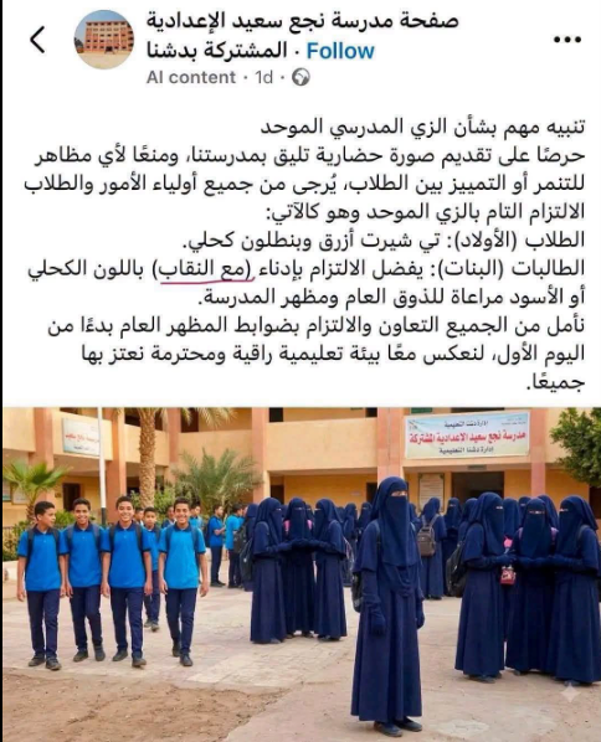
Under the seemingly innocuous heading “Important Notice Regarding the Standard School Uniform,” the school informs parents that adherence to a unified dress code is required in order to preserve the school’s “civilized appearance” and prevent “ostentation or differentiation among students.”
For boys, the instructions are straightforward: a navy-blue T-shirt and navy-blue trousers.
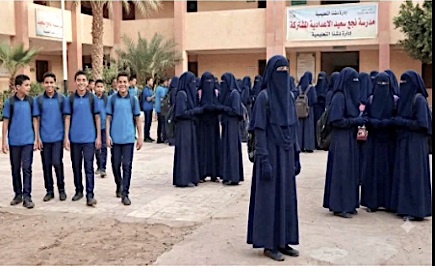
For girls, they are strikingly different. The school says that female students should preferably wear a navy-blue isdaal “with niqab.” It further stipulates that their clothing should be loose, “modest,” and cover the entire body. The accompanying photograph reinforces the message visually: while boys appear in ordinary blue shirts and trousers, the girls are shown enveloped from head to foot in dark garments, with their faces covered.
Obscurantism Presented as a “Civilized Appearance”
The language is almost as revealing as the requirement itself. Full-body covering and the niqab are presented not simply as one possible religious choice but as components of the school’s desired “civilized appearance.” Compliance, the notice says, will help create a “refined and respectable educational environment.”
The implication is difficult to miss. Girls who do not conform to this exceptionally restrictive conception of Islamic dress risk being implicitly placed outside the standards of modesty and respectability established by the school.
The distinction between the treatment of boys and girls is equally stark. Boys are asked merely to wear a uniform. Girls’ bodies, by contrast, become objects of institutional regulation: their clothes must be loose, their entire bodies covered, and even their faces are expected to disappear behind the niqab.
This goes considerably beyond requiring the hijab. The niqab represents one of the most restrictive forms of female Islamic dress. Its introduction into a preparatory school, where pupils are generally adolescents, is therefore especially significant.
When Religious Radicalization Comes from Below
The notice also illustrates a broader problem in Egyptian education: religious conservatism does not have to be formally decreed by the Ministry of Education to reshape the environment experienced by pupils.
Indeed, the wording “preferably” is important. On the evidence of this notice alone, it would be inaccurate to say that the school has formally made the niqab compulsory. But the distinction should not obscure what is happening. When a school administration announces an officially preferred mode of dress to parents and students, depicts girls wearing it, associates compliance with modesty and respectability, and asks everyone to conform from the first day of school, institutional pressure can operate without the word “mandatory” ever appearing.
That mechanism deserves attention. Obscurantism can advance through administrative expectations, social pressure and normalization just as effectively as through explicit regulations.
It also raises obvious questions for the Ministry of Education. Who authorized a state school to recommend that adolescent girls cover their faces? Is this compatible with the Ministry’s official uniform regulations? Are provincial education authorities aware of such instructions? And how widespread are similar practices in schools outside Egypt’s major urban centers?
The document itself cannot answer those questions. But the fact that a school could publicly issue such a notice—and apparently regard the accompanying image as an advertisement for a “refined and respectable educational environment”—is revealing in itself.
Education as Agent of Religious Indoctrination
Schools do much more than transmit academic knowledge. They teach children, explicitly and implicitly, what society expects of them. A school that presents ordinary uniforms for boys while encouraging girls to conceal everything down to their faces is teaching a powerful lesson about gender long before any textbook is opened.
It teaches boys that they may occupy public space visibly and normally. It teaches girls that respectability is associated with concealing themselves.
This is precisely why the incident should not be dismissed as an eccentric dress-code announcement from one provincial school. There is no evidence in the document that this is a nationwide Ministry of Education policy, and it would be wrong to present it as such. But that makes the episode, in another sense, more troubling: it demonstrates how deeply restrictive religious ideas can penetrate educational institutions through local administrators and prevailing social norms, even without an explicit order from Cairo.
At a time when the Egyptian government repeatedly speaks of modernization, educational reform and combating extremist thought, a preparatory school publicly encouraging girls to attend classes in isdaal and niqab presents a starkly contradictory reality.
The issue is not whether an individual woman or girl chooses religious dress. It is whether a school can use its institutional authority to impose—or effectively coerce—adolescent girls into an extreme religious code that requires their bodies and even their faces to disappear from public view. Calling the niqab “preferable” hardly makes the pressure benign when the recommendation comes from the school itself, is presented as the standard of modesty and respectability, and is reinforced by an image showing virtually every girl completely covered.
This is not education. It is the institutionalization of obscurantism. A school that teaches girls that being “civilized,” “refined” and “respectable” means covering themselves from head to toe is not merely regulating a uniform. It is inculcating in children a radical vision of women’s place in society and giving that vision the authority of the educational institution. That such a notice can be publicly issued by an Egyptian preparatory school should raise a far larger question: what meaning can official claims of educational modernization and the fight against extremism possibly have when obscurantist ideas are allowed to enter the school gates, dress the pupils, and define respectability for the next generation?
Update
Days after the incident, some confused messages were published by the ministry of education, stating respect for “freedom of dress” and that niqab was not obligatory in schools..