
Gunmen opened fire during a funeral in a historic Christian village; King Abdullah vows severe retaliation as authorities pursue the attackers.
At least seven people were killed and 34 wounded on Friday when armed men attacked a Greek Orthodox church during a funeral in the village of Hamoud, in Jordan’s southern Karak governorate, approximately 120 kilometers (75 miles) south of Amman.
Jordanian authorities described the assault as an act of terrorism, while King Abdullah II pledged a forceful response and warned that attempts to divide Jordanians would fail.
The shooting, one of the deadliest attacks in Jordan in recent years, struck a longstanding Christian community in a country where Christians represent approximately 2 percent of the population.
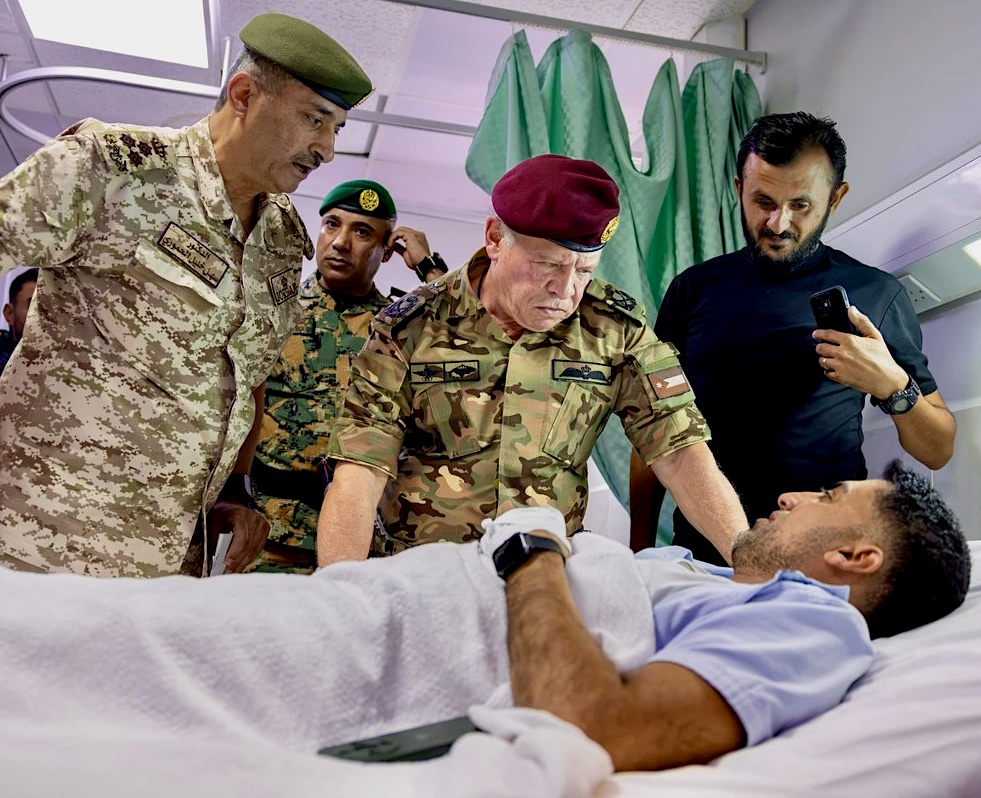
According to Major General Obaidallah al-Maaytah, director of Jordan’s Public Security Directorate, seven people were confirmed dead and 34 injured. Twenty-seven of the wounded were receiving hospital treatment at the time of his announcement.
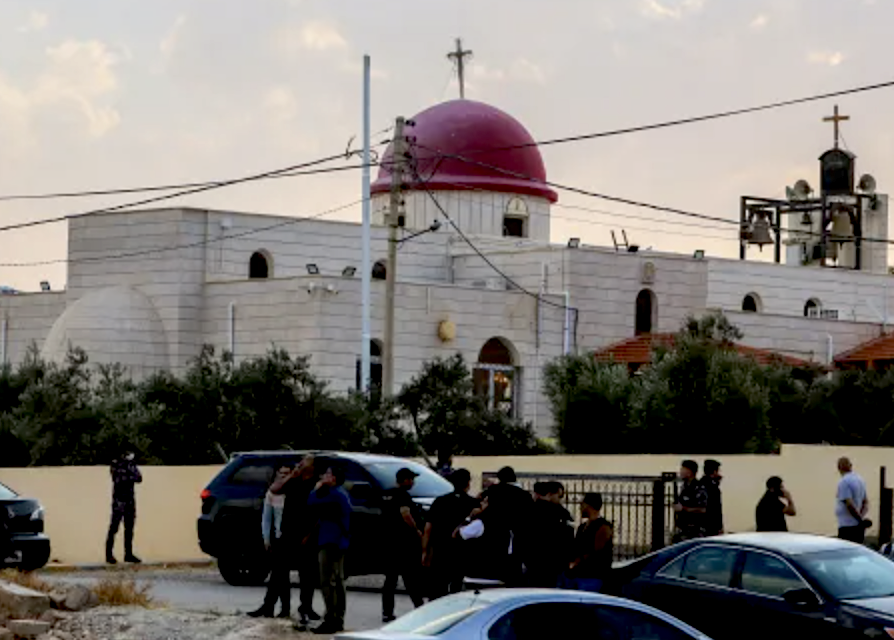
Gunmen Attack During Funeral Service
The attackers reportedly arrived in a vehicle and opened fire as mourners gathered for a funeral at the Greek Orthodox church.
Security-camera footage broadcast by Jordan’s state-owned Al-Mamlaka television appeared to show three armed men firing toward the church from the street before running toward the building.
Survivors described hearing an explosion as the funeral procession began, followed by several minutes of gunfire. Witnesses reported people fleeing or throwing themselves to the ground as shots rang out.
Funeral attendee Khaled Burqan told Al-Mamlaka that dozens of people were attending the procession. According to his account, two masked attackers entered the church, one carrying a pistol and the other a rifle.
Initial accounts differed over the number of attackers. While televised footage appeared to show three armed men, other eyewitness accounts and security reports referred to two suspects. Al-Mamlaka reported that security forces were pursuing two men who had emerged from a vehicle and opened fire.
Jordanian authorities deployed security forces to the area and launched an operation to apprehend the perpetrators.
Major General al-Maaytah pledged that the attackers would be caught, declaring that Jordan’s national unity would not be undermined.
No organization immediately claimed responsibility for the assault.
Interior Minister Mazen al-Faraya described the perpetrators as extremists but did not identify their affiliation, explaining that investigations were continuing.
He called the attack unprecedented and characterized those responsible as a group with “no relationship to humanity.”
“This country will never be dragged into terrorism and violence,” he declared, adding that Jordanians had never witnessed anything like the assault.
King Abdullah Condemns Attack; International Reactions
King Abdullah II condemned the shooting as a terrorist attack and promised the strongest possible response.
“The terrorist attack against Karak will be met with the harshest retaliation,” the King declared.
“Those who delude themselves into thinking that they can divide Jordanians with their bullets have no chance in the face of our unity.”
In another statement, he emphasized that Jordanian lives were precious and pledged to strike with an “iron fist” against anyone threatening the country. He also declared a three-day national mourning.
The attack also drew condemnation internationally.
Mike Waltz, the United States ambassador to the United Nations, condemned the shooting, warning that “attacks on Christians continue to escalate worldwide and must be stopped.”
United Nations Secretary-General António Guterres strongly condemned the assault. His spokesman, Stéphane Dujarric, emphasized the particularly disturbing circumstances of the killings.
“It goes without saying that an attack not only on a place of worship but during a funeral procession is especially heinous,” Dujarric told reporters.
The United Arab Emirates Foreign Ministry likewise condemned what it described as terrorist and criminal acts, reaffirming its rejection of violence intended to undermine security and stability.
Jordan’s Christian Community and the Threat to Coexistence
Jordan’s Christian population, estimated at approximately 300,000 people, constitutes only a small proportion of the kingdom’s roughly 12 million inhabitants. Yet Christianity has deep historical roots in the country, including sites associated with John the Baptist and the baptism of Jesus in the Jordan River.
The Christian presence in Karak dates back more than 1,500 years, to the period when the region formed part of the Eastern Roman, or Byzantine, Empire.
Despite their relatively small numbers, Jordanian Christians have traditionally been integrated into the country’s political and social institutions. They are guaranteed parliamentary representation and have served as cabinet ministers and ambassadors.
Karak itself has long been known for its communities of Christians and Muslims living alongside one another.
Taylor Luck, senior Middle East correspondent for the Christian Science Monitor, told Al Jazeera that Christians and Muslims in Karak had lived together for generations.
“This community prides themselves on its interfaith solidarity and coexistence,” he said.
He suggested that if the attack was intended to provoke divisions, the community might emerge with an even stronger sense of solidarity.
Murad Batal Shishani, founder of the London-based intelligence-monitoring firm Remarks OPV, similarly observed that Jordanian Christians have historically been well integrated into society.
He suggested that militants targeting Christians might seek to undermine social cohesion, weaken confidence in the security authorities, and encourage recruitment or further attacks.
These assessments point to the potential significance of the attack beyond the immediate loss of life, although the perpetrators’ precise motives have not yet been established.
Political analyst Xavier Abu Eid also noted that the assault could have implications for Jordan’s international role as a custodian of Christian and Muslim sacred sites in Jerusalem.
King Abdullah has frequently criticized attacks on religious sites in the occupied Palestinian territories, making the assault particularly damaging to the image of religious coexistence that Jordan seeks to project internationally.
“This is something that goes totally against the message that Jordan wants to give to the world,” Abu Eid told Al Jazeera.
Previous Terrorist Attacks and Jordan’s Regional Position
Although Jordan has generally avoided the sustained violence that has destabilized several neighboring countries, it has experienced serious attacks by extremist organizations.
In 2005, coordinated hotel bombings in Amman carried out by al-Qaeda in Iraq killed dozens of people and wounded more than 100.
In December 2016, Islamic State militants launched an attack in and around Karak, killing ten people, including security personnel and a Canadian tourist. The attackers subsequently took refuge in a medieval Crusader-era castle before being killed by Jordanian security forces.
Jordan has remained a major United States ally and an important security partner in the Middle East, receiving billions of dollars in American military and economic assistance over the years.
The kingdom has also hosted American military forces and served as a base for U.S. operations during the war involving Iran.
The regional conflict has exposed Jordan to Iranian attacks. Reports cited an Iranian strike in July that killed three American soldiers and further attacks in September that damaged U.S. military aircraft.
Jordan has also faced substantial humanitarian pressures, having hosted more than a million refugees from the Syrian civil war at one point.
Against this background, the attack on a Christian funeral represents a serious security challenge for the kingdom and a direct assault on a community whose presence in the region predates the modern Jordanian state by many centuries.
As the investigation continues, Jordanian authorities have pledged to bring those responsible to justice and prevent the violence from undermining relations between the country’s Christian and Muslim communities.
____________________________
Sources: News reports, including accounts attributed to Jordan’s Public Security Directorate, Al-Mamlaka television, eyewitnesses, international officials, and analysts interviewed by Al Jazeera.