
By Coptic Solidarity –
The European Commission has reaffirmed its commitment to monitoring developments concerning St. Catherine’s Monastery in Sinai, particularly following the May 2025 ruling by Egypt’s Ismailia Court of Appeals affecting the Monastery’s legal status.
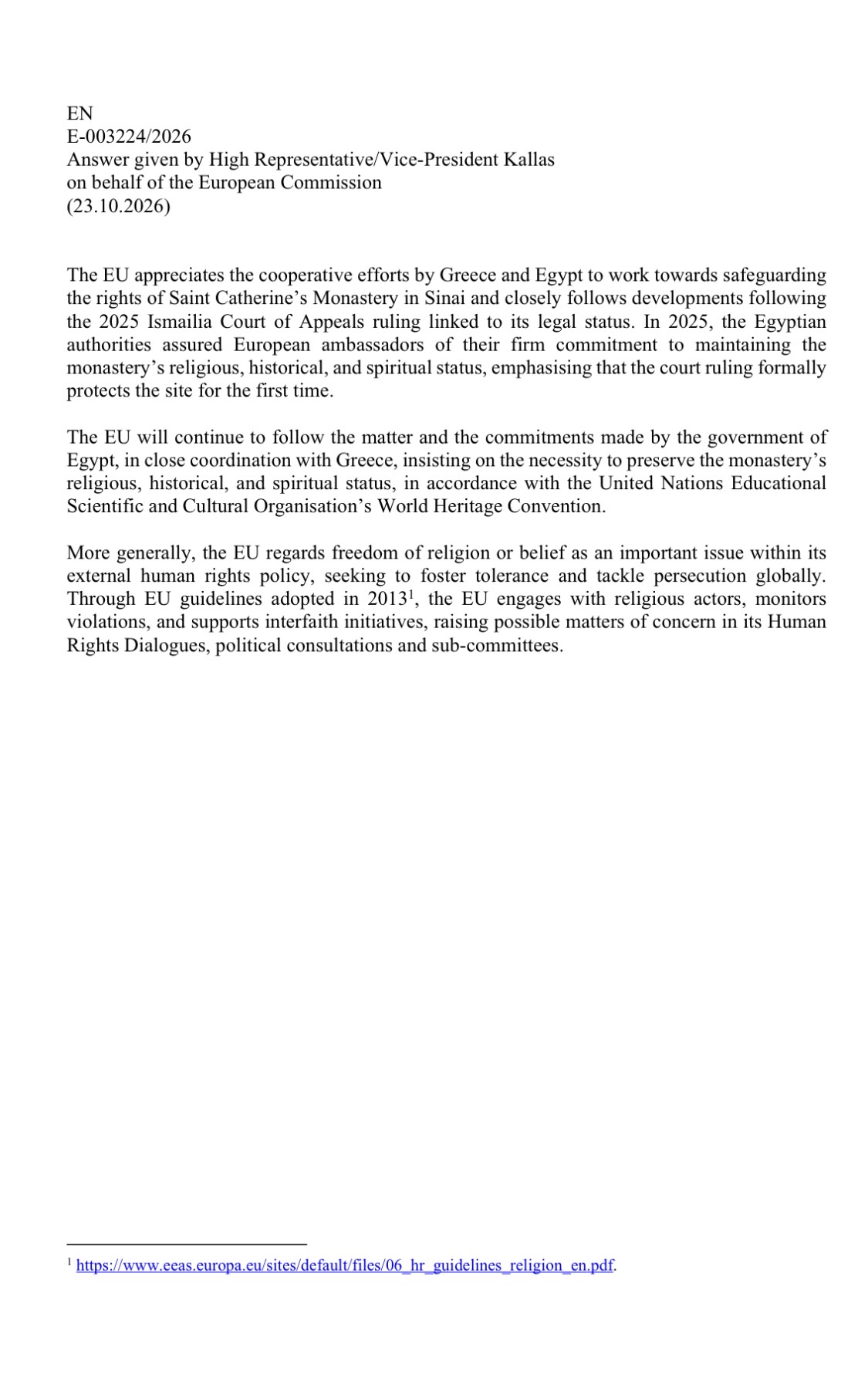
In an official written response dated October 23, 2026, EU Commission Vice-President and High Representative for Foreign Affairs and Security Policy Kaja Kallas emphasized the need to preserve the Monastery’s religious, historical, and spiritual status in accordance with UNESCO’s World Heritage Convention.
The response, issued on behalf of the European Commission under reference E-003224/2026, expresses appreciation for the cooperative efforts of Greece and Egypt to safeguard the Monastery’s rights. It also confirms that the EU is closely following developments arising from the 2025 court ruling.
According to Kallas, Egyptian authorities assured European ambassadors in 2025 of their firm commitment to maintaining the Monastery’s religious, historical, and spiritual status. The Egyptian authorities also emphasized that the court ruling formally protects the site for the first time.
EU to Monitor Egypt’s Commitments
The Commission stated:
“The EU will continue to follow the matter and the commitments made by the government of Egypt, in close coordination with Greece, insisting on the necessity to preserve the monastery’s religious, historical, and spiritual status, in accordance with the United Nations Educational Scientific and Cultural Organisation’s World Heritage Convention.”
This commitment places the preservation of the Monastery’s historic status within the framework of Egypt’s international obligations under the UNESCO World Heritage Convention.
Religious Freedom Within EU Foreign Policy
Kallas reiterated that freedom of religion or belief remains an important component of the EU’s external human rights policy, which seeks to promote tolerance and combat persecution worldwide.
She referred to the EU Guidelines on the Promotion and Protection of Freedom of Religion or Belief, adopted in 2013, under which the EU engages with religious actors, monitors violations, and supports interfaith initiatives.
The Commission also noted that matters of concern can be raised through the EU’s Human Rights Dialogues, political consultations, and subcommittees.