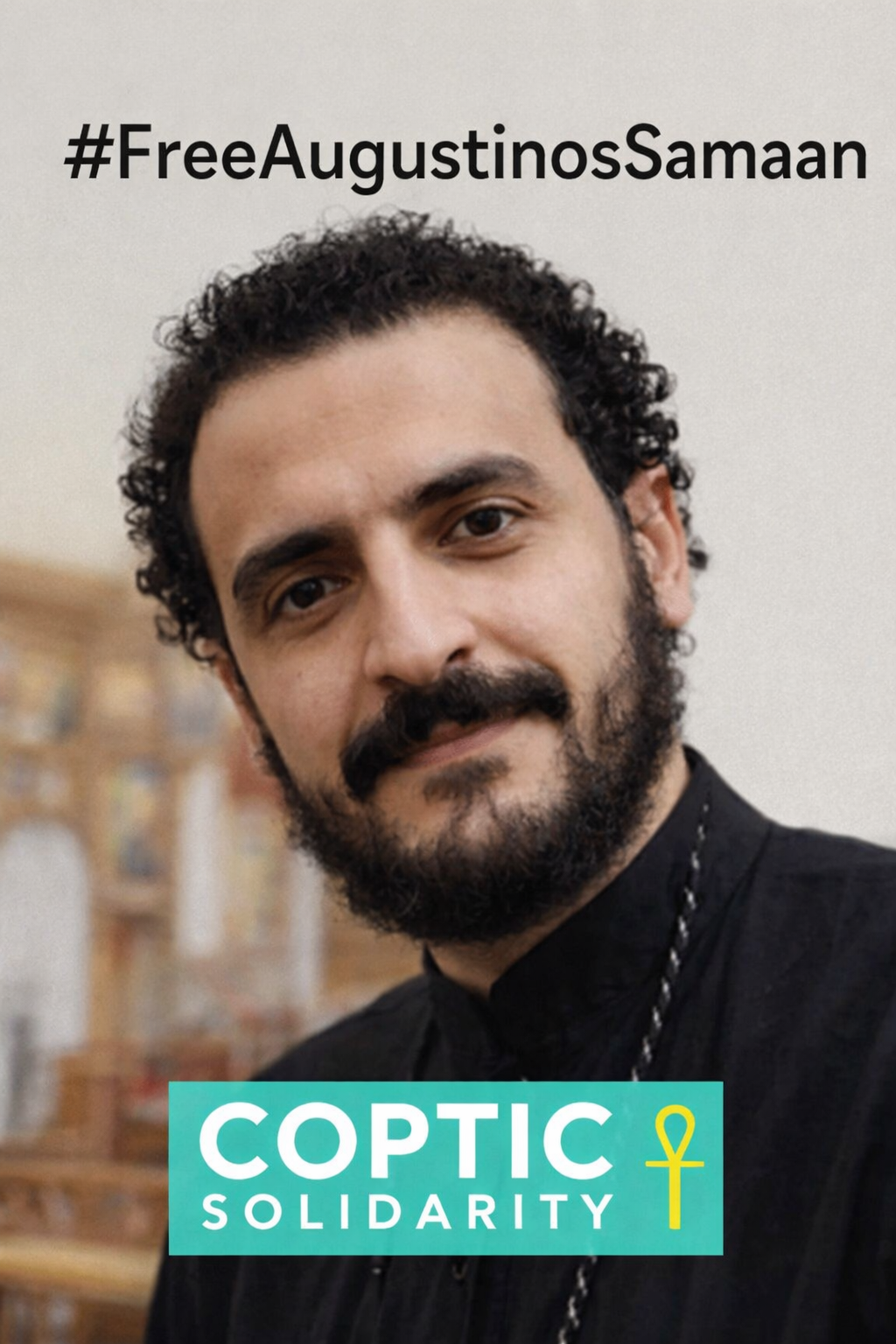

By Coptic Solidarity –
Egypt’s Court of Cassation rejected on November 15, 2026, the legal challenge filed by Coptic Christian researcher Dr. Augustinos Samaan against his five-year prison sentence with hard labor for “contempt of religion.” The ruling leaves the conviction in force despite serious legal and constitutional irregularities documented by his defense team.
According to a statement issued by the law office of Saeed Fayez, the Court examined Cassation Appeal No. 12839 of the 96th Judicial Year, concerning the sentence handed down by the El-Basatin Misdemeanor Court and subsequently upheld on February 23, 2026.
The Court declared the appeal admissible as to form but inadmissible on substantive grounds. In practical terms, while the appeal satisfied the procedural requirements for submission, the Court did not accept the legal grounds advanced by the defense as sufficient to overturn the judgment.
The decision effectively exhausts the ordinary avenues of judicial challenge, leaving Samaan to serve the maximum prison term prescribed under Egypt’s blasphemy provision.
His lawyers stated that they had presented their legal arguments and maintained their objections concerning the application of the law and fair-trial guarantees. Pending the publication of the Court’s written reasoning, they will examine the remaining legal avenues available under domestic law and relevant international conventions.
A Conviction Marred by Serious Procedural Violations
Samaan, a Coptic researcher specializing in comparative religion and a Christian apologist whose YouTube channel attracted more than 100,000 subscribers, was arrested by masked security officers on October 1, 2025.
His scholarly and educational activities included explaining Christian beliefs, responding to anti-Christian arguments, and examining theological and philosophical differences between Christianity and Islam.
Initially confronted with terrorism-related accusations, he was subsequently prosecuted for “contempt of religion” and misuse of social media under Egypt’s legal provisions criminalizing allegedly offensive religious expression.
On January 3, 2026, Samaan was sentenced to five years’ imprisonment with hard labor under Article 98(f) of the Penal Code.
The circumstances surrounding his conviction were particularly alarming. Neither his lawyers nor his family had been notified that his case had been referred to trial. When they arrived at court on January 6 expecting a routine detention-renewal hearing, they discovered that he had already been tried and sentenced.
The defense was also denied timely access to essential case documents, depriving it of a meaningful opportunity to represent Samaan before his conviction.
In its February 25 statement, EIPR, which forms part of Samaan’s defense team, reported that the defense had challenged the authenticity of the official arrest report, which was dated a full week after the actual arrest, as documented by communications sent by Samaan’s family to the Prosecutor General.
The defense also challenged the legality of the security authorities’ monitoring and examination of Samaan’s social media accounts without prior authorization from the prosecution.
In support of this argument, the lawyers cited a previous Court of Cassation ruling (No. 4875 of the 92nd Judicial Year) establishing the requirement for such authorization.
Despite these objections, the Misdemeanor Appeals Court upheld the five-year sentence on February 23. The subsequent cassation challenge represented the remaining ordinary judicial avenue for addressing the legal violations alleged by the defense.
Fundamental Rights Remain at Stake
The significance of the November 15 ruling extends beyond the continued imprisonment of a Christian scholar for peacefully expressing and defending his religious beliefs.
The case raised two fundamental and closely interconnected issues: the criminalization of peaceful religious expression and the denial of basic fair-trial guarantees.
Egypt’s Constitution guarantees freedom of belief under Article 64 and the right to a fair trial and legal defense under Article 96. Egypt is also a party to the International Covenant on Civil and Political Rights, whose Articles 14, 18 and 19 protect fair-trial rights and freedom of religion, belief and expression.
Samaan’s case has attracted international attention, including coverage by ADF International and its inclusion in the British Home Office’s August 2026 country report on the situation of Christians in Egypt.
While the precise grounds for the Court of Cassation’s decision remain to be disclosed, the outcome leaves standing a conviction obtained through proceedings in which the defense has documented alleged violations of some of the most elementary guarantees of justice.
Furthermore, it reinforces concerns about the use of Egypt’s blasphemy legislation to restrict the ability of Christians to explain and defend their own religious beliefs, particularly when doing so involves questioning or criticizing Islamic teachings.
Coptic Solidarity reiterates its call for the immediate and unconditional release of Dr. Augustinos Samaan, the protection of his physical and psychological well-being, and an end to the use of blasphemy laws to criminalize peaceful religious expression.