
By Raymond Ibrahim – Coptic Solidarity –
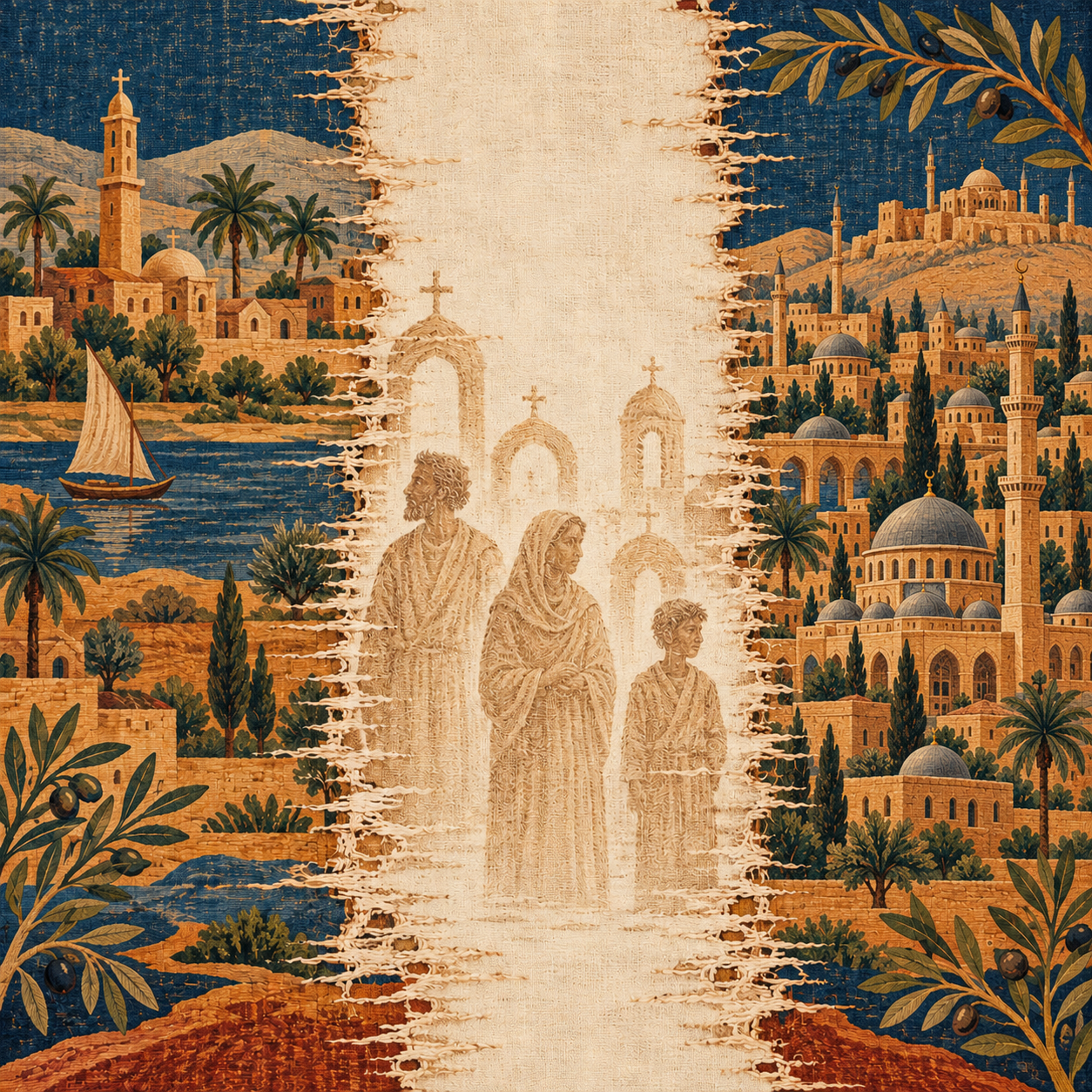
At a recent conference in Cairo, Egypt’s former minister of culture, Helmy El-Namnam, recalled that some twenty years ago he had called for the establishment of a center for Coptic studies at an Egyptian university. Coptic identity, he emphasized, is a fundamental part of Egypt’s national identity, and its study should not be confined to the Church.
Yet, a recent op-ed asks why the Coptic era remains in the background, and why has the study of Coptic history not received institutional support in Egypt? “When an entire era is largely absent from public awareness,” it notes, “it does not disappear from history. It does, however, fade from contemporary memory.”
Moreover, if Egypt’s Christians “cannot see themselves reflected in an honest account of their country’s history, how can they understand who they are—or feel that they truly belong?”
From here, one understands why Egypt’s most indigenous population—the Copts—are often seen and treated by Muslims as little better than guests who should “know their place” in Egypt.
“It sounds absurd,” said Kamal Mougheeth, an educational expert and researcher in Egypt, “but Muslims more or less know nothing about Christians, even though they make up a large part of the population and are in fact the original Egyptians… Egypt was Christian for six or seven centuries [before the Muslim invasion around 640]. The sad thing is that for many years the history books skipped from Cleopatra [30 BC] to the Muslim conquest of Egypt [640 AD]. The Christian era was gone. Disappeared. An enormous black hole.”
A 2023 report agrees:
[T]he education program [in Egyptian public schools] is devoid of any lesson, text, or mention of other faiths or religions, with a total omission of Egyptian Christian or Jewish historical figures, or major non-Muslim religious holidays. The same goes for Coptic history, despite the fact that the Coptic Church played a prominent role…
All this confirms what I recall my parents, Copts from Egypt, telling me of their classroom experiences in the (much more “tolerant”) 1940s-50s: there was virtually no mention of Hellenism, Christianity, or the Coptic Church—one thousand years of Egypt’s pre-Islamic history. History essentially began with the indigenous pharaohs before jumping to the seventh century when Muslims from Arabia “opened” Egypt. (Wherever Muslims conquer non-Muslim territories, Islamic hagiography euphemistically refers to the event as an “opening,” fath, never a “conquest.”)
Incidentally, this extends well beyond Egypt. Christianity’s historical role and presence in Muslim nations in general is being expunged from memory.
Consider the following words spoken by a young Palestinian Christian:
In view of the economic hardships and political instability, the occupation and rising [Islamic] fundamentalism, where we Christians face extreme difficulties and feel unwelcome, why not pack our bags and return to Europe?
“Return”? Is this Christian man unaware that he is already living in the birthplace of Christianity and that history’s earliest Christians originated from the Middle East, not Europe? How could such well-known facts escape him of all people?
Responding to such ignorance, Joseph Hazboun, Regional Director of CNEWA in Jerusalem, said:
This is due to misinformation in the Palestinian curriculum, which cites that Palestinian history begins with the Arab conquest of Palestine, without any indication of the first seven centuries of Christianity in the Holy Land. The religious instruction in Palestinian Christian schools and in local parishes focuses on faith-building rather than Christian history in Palestine. This has led to a lack of awareness among many Palestinian Christians on the history of Christianity and the first Christian communities of the Holy Land in the 1st century AD.
Nor is such “misinformation” limited to Palestinian curriculum. Christian minorities all throughout the Middle East have long maintained that the history taught in public classrooms suppresses the region’s Christian heritage while magnifying (including by whitewashing) Islam.
During a 2016 conference in Amman, Jordan, hosted by the Jerusalem Center for Political Studies, Dr. Hena al-Kaldani said that “there is a complete cancelation of Arab Christian history in the pre-Islamic era,” “many historical mistakes,” and “unjustifiable historic leaps in our Jordanian curriculum…. Tenth grade textbooks omit any mention of any Christian or church history in the region.” Wherever Christianity is mentioned, omissions and mischaracterizations proliferate, including the portrayal of Christianity as a Western (that is, “foreign”) source of colonization, said al-Kaldani.
Such revisionism is not only designed to make indigenous Christians feel “foreign” on their own land. It is designed to make Muslims view the Christians in their midst with suspicion and worse.
According to Sharara Yousif Zara, an influential politician involved in the Iraqi Ministry of Education: “It’s the same situation in Iraq. There’s almost nothing about us [Christians] in our history books, and what there is, is totally wrong. There’s nothing about us being here before Islam. The only Christians mentioned are from the West. Many Iraqis believe we moved here. From the West. That we are guests in this country.”
Similar ignorance and historical revisionism predominates in the West. Although Christians are in fact the most indigenous inhabitants of what is today called the “Arab world,” I am often asked, by educated people, why Christians “choose” to go and live in the Middle East among Muslims, if the latter treat them badly.
At any rate, such revisionism has not only successfully indoctrinated Muslims to suspect and hate Christianity—which is seen as a non-organic parasitic remnant left by Western colonialists—but it has even gotten some indigenous Christians, such as the aforementioned Palestinian who thinks it’s time to “return to Europe,” to believe the same.
This phenomenon is also connected to some bitter ironies: the ancestors of those Muslims who today persecute Mideast Christians were themselves persecuted Christians who converted to Islam to end their own suffering. Thus, Muslim descendants of persecuted Christians are persecuting their Christian cousins. One of the main reasons Christians are seen as “foreign traitors” is precisely because Muslims are kept in the dark about their own Christian ancestry.
In the end, of course, the Muslim world’s pseudo-historical approach to Christianity should be familiar. After all, doesn’t the West engage in the same chicanery? In both instances, Christianity and its history is dismissed or distorted by those two unlikely bedfellows: the “Left” in the West, Islam in the Middle East.