
By Coptic Solidarity –
For years, complaints that Coptic athletes face discrimination in Egyptian football have been routinely dismissed by the authorities as isolated incidents or denied altogether.
Is that about to change?
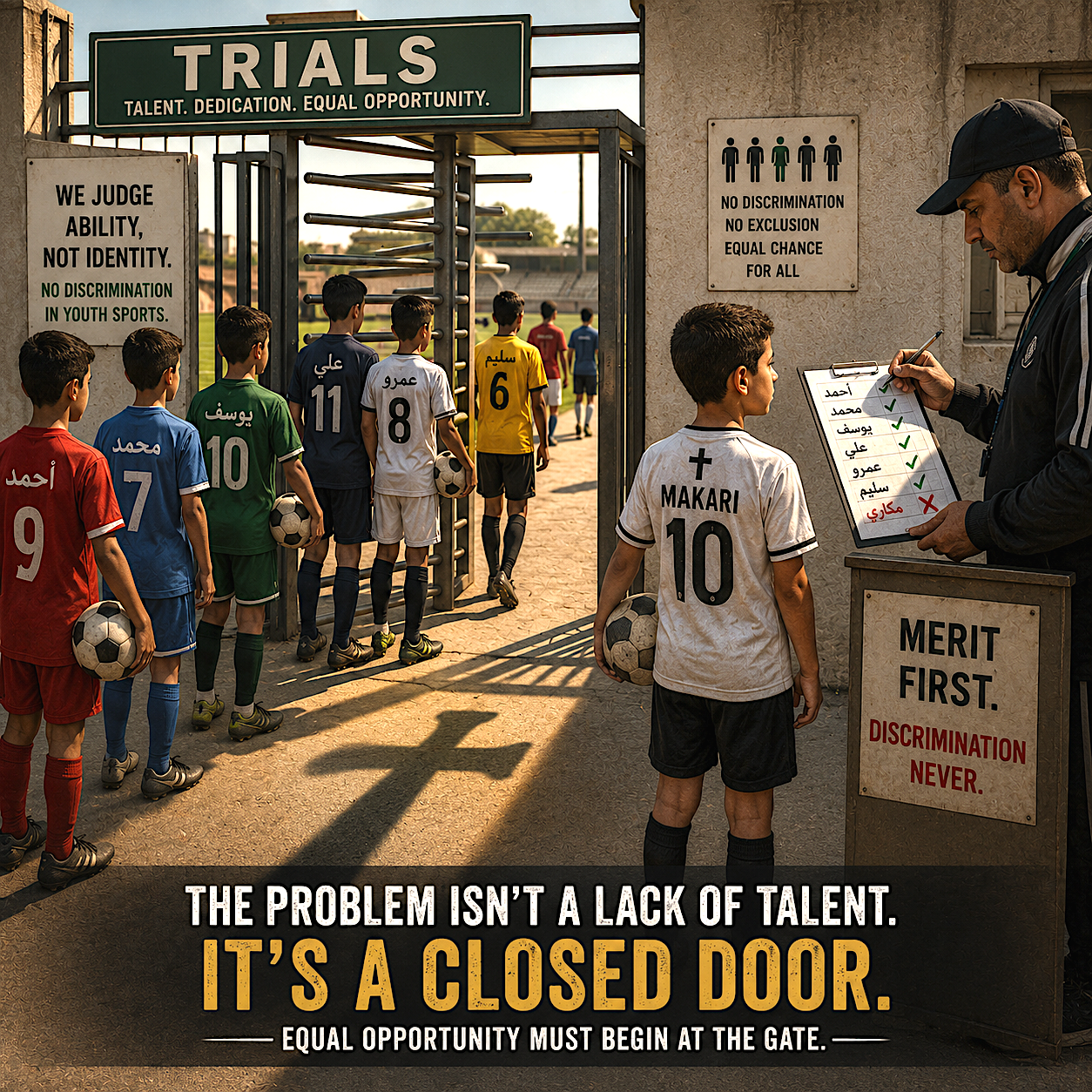
In an unprecedented move, Egypt’s Ministry of Youth and Sports announced that its investigation found sufficient evidence of misconduct by a coach at Alexandria’s Al-Ittihad Club who allegedly excluded a junior football player, Makari Younan, because of his Christian name.
The Ministry ordered disciplinary proceedings, the referral of future cases to the Public Prosecution, and declared that discrimination in youth sports would not be tolerated.
The decision deserves recognition. Whether motivated by public pressure or a genuine policy shift, the Ministry’s response represents a notable departure from the longstanding official tendency to dismiss such allegations.
It appears to be the first official acknowledgment that discrimination against Copts in Egyptian sport is not merely an allegation raised by disappointed families or human rights organizations, but a matter requiring government intervention.
Yet the significance of this case extends far beyond the fate of one coach or one young player.
More Than an Isolated Incident
Almost immediately after the Makari Younan case became public, another complaint emerged. Romany Emad Gad, a talented midfielder from Gharbia Governorate, reportedly passed successive trials at Tanta’s Ghazl El-Mahalla before being rejected shortly after club officials learned that he was Christian. According to the complaint, the atmosphere changed abruptly once his religious identity became known, despite his successful performances during the selection process.
The rapid appearance of another remarkably similar complaint illustrates precisely why many Egyptians refuse to believe that Makari’s experience was an isolated event.
For decades, Coptic families have described comparable experiences at youth academies and club trials. Former international players have voiced similar concerns. The issue has persisted despite repeated public debate, suggesting that the problem lies deeper than the conduct of individual coaches.
The underrepresentation of Copts in Egyptian football has been impossible to ignore.
While Egypt’s Christian community constitutes a significant proportion of the country’s population, Coptic representation in the Premier League and the national team has remained exceptionally limited for decades. Former national team captain Hany Ramzy remains one of the last prominent Coptic footballers to enjoy a sustained international career.
Other leading figures within Egyptian football have publicly questioned this reality. Ahmed Hossam “Mido” has spoken openly about discrimination affecting Christian players, while Hany Ramzy has argued that many talented young Copts abandon football because they lose confidence that merit alone will determine their future. These observations, coming from respected figures within the sport itself, have reinforced long-standing concerns that equal opportunity is not consistently guaranteed.
Nor is football unique. Similar concerns have long been raised about the virtual absence of Coptic athletes from Egypt’s Olympic delegations, reinforcing the perception that exclusion extends beyond a single sport.
The Ministry’s response to the Makari case therefore represents more than disciplinary action against a single individual. It implicitly acknowledges concerns that have circulated for many years but were rarely accepted officially.
Football Reflects a Wider Reality
The significance of these developments extends well beyond sport.
Football is simply one of the few sectors where talent selection occurs publicly enough for patterns to become visible to the public. Similar concerns have long been documented across Egyptian public life, where Copts remain severely underrepresented in numerous areas of governance.
For years, Coptic Solidarity and other observers have documented severe restrictions on the recruitment of Copts across numerous state institutions, including the judiciary, diplomatic corps, military, universities, governorates, and the complete exclusion of Copts from the security agencies. The issue is not simply one of promotion to senior positions. In many institutions, Copts are admitted only in token numbers—or not at all—at the entry level, making their near absence from positions of authority the inevitable outcome.
Against this broader background, it becomes increasingly difficult to regard discrimination in football as an isolated phenomenon unrelated to wider institutional practices.
The Ministry’s decision to investigate the Makari case and discipline the responsible coach is a welcome positive development. Public institutions should respond swiftly whenever discrimination is alleged.
But meaningful reform cannot stop there.
If the exclusion of Coptic athletes reflects institutional practices that have become normalized over decades, disciplining one coach will not resolve the underlying problem. Transparent selection criteria, independent oversight of youth trials, accessible complaint mechanisms, and effective accountability are essential if confidence is to be restored among families who believe their children are judged by their names rather than their abilities.
Equally important is the willingness to recognize that football mirrors broader challenges facing Egyptian society. Equal opportunity cannot be achieved in one sector while systemic barriers continue to affect others.
A Test of Political Will
Whether the Ministry’s statement marks a genuine new beginning remains to be seen. Official acknowledgment is preferable to denial, and genuine investigations are preferable to dismissing complaints outright.
The real test, however, lies ahead.
If this case leads only to the punishment of one coach while identical complaints continue to emerge, little will have changed. If, however, it becomes the starting point for confronting longstanding patterns of exclusion—not only in football but across public institutions—it could represent a meaningful step toward equal citizenship.
The question is no longer whether discrimination exists. The Ministry itself has now acknowledged that it can. The real question is whether Egypt is prepared to confront the institutional practices that have allowed it to persist—not only on football pitches, but across public life.
Above all, lasting change will require an unmistakable political commitment from Egypt’s leadership to confront institutional discrimination rather than merely punishing individual offenders.