
By Coptic Solidarity –
The recent publication by the Egyptian fact-checking platform Matsada’sh (“Don’t Believe It”) of two internal memoranda prepared by the Public Prosecution before the Court of Cassation marks an unusual development in the long-running legal dispute over St. Catherine’s Monastery.
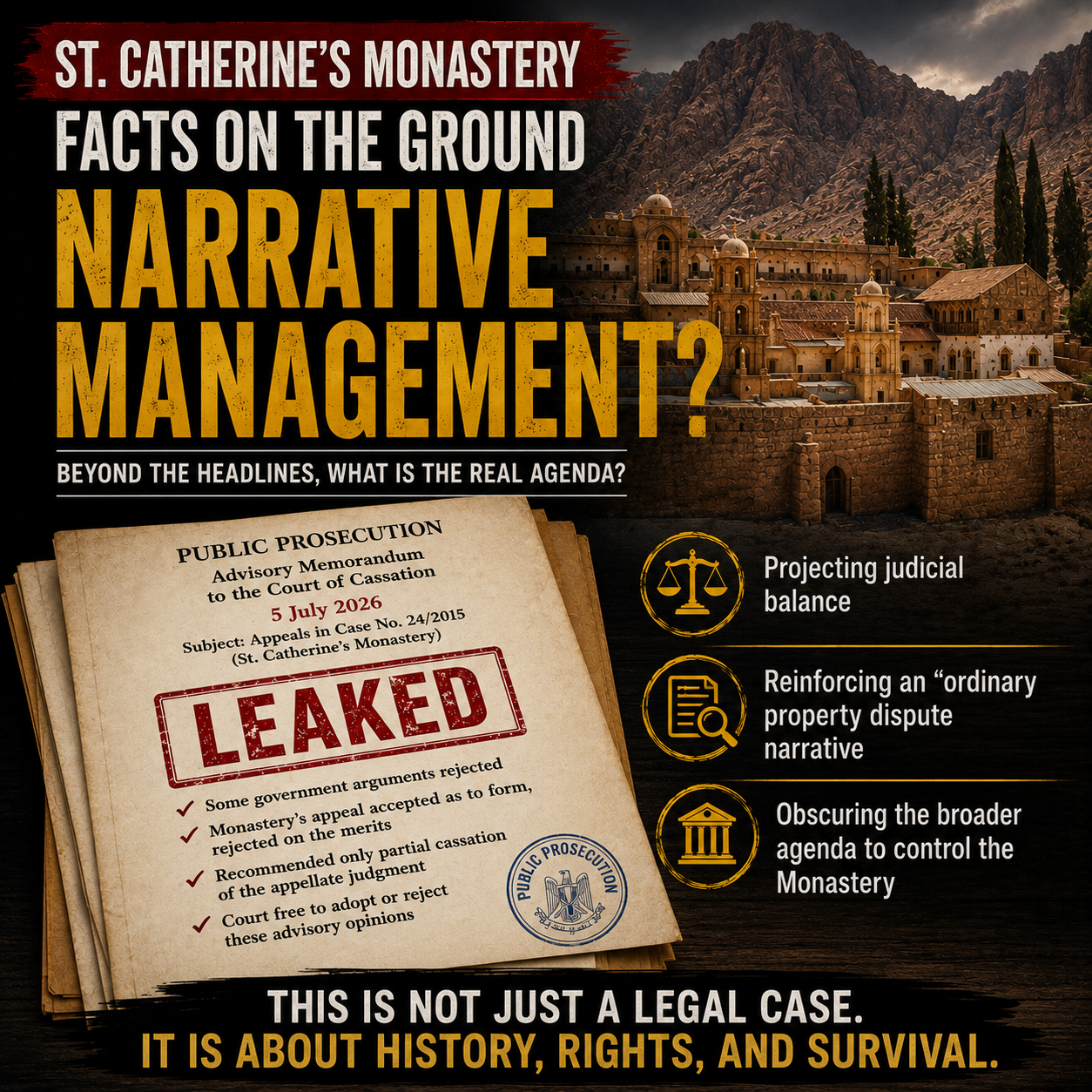
The memoranda, dated 5 July 2026, contain the advisory opinions submitted to the Court of Cassation concerning the appeals filed by both the Egyptian Government and St. Catherine’s Monastery against the May 2025 appellate judgment. The Court is expected to hear the appeals on 23 August 2026. As the article itself repeatedly emphasizes, these memoranda are not judicial rulings but advisory opinions that the Court is free either to adopt or reject.
The publication immediately raises an obvious question: why are confidential prosecutorial memoranda suddenly in the public domain?
An Unusual Publication
Matsada’sh is widely known in Egypt as a platform dedicated to verifying publicly circulating information. It does not ordinarily publish information—especially confidential judicial documents or investigative material obtained through undisclosed sources.
In this instance, however, the platform states that it obtained the two memoranda and proceeds to analyze them in considerable legal detail.
Whether the documents reached the platform through an authorized disclosure, an unofficial leak, or another channel is unknown. The article offers no explanation.
The timing, however, is difficult to ignore.
The publication comes amid intensified diplomatic activity surrounding the future of St. Catherine’s Monastery, including high-level U.S. engagement, continuing negotiations between the Monastery and the Egyptian authorities, and growing international scrutiny of Egypt’s handling of one of Christianity’s oldest continuously functioning monasteries.
Projecting the Image of Judicial Balance
Perhaps the most striking feature of the publication is not its legal conclusions, but the manner in which those conclusions are presented.
Rather than portraying the Government as having prevailed completely, the article repeatedly stresses that the Public Prosecution:
- rejected some of the Government’s arguments and declined to endorse some of its contentions;
- accepted the Monastery’s appeal—albeit only as to form—while rejecting it on the merits; and
- recommended only partial cassation of the appellate judgment and emphasized that some of the appellate court’s findings should remain undisturbed.
The repeated message is unmistakable: the legal process is presented as careful, balanced, and institutionally independent—not as a one-sided effort to secure a governmental victory.
Taken together, these elements project the image of an independent judiciary meticulously examining competing legal claims.
The Larger Question
Whether that image accurately reflects the broader reality is a different matter.
The central concern of those following the case of St. Catherine’s has never been that every individual judicial decision is legally indefensible. Rather, it has been that the litigation forms only one component of a much broader process involving judicial proceedings, administrative measures, executive decisions, and political pressure, all progressively reshaping the Monastery’s historic legal position.
From that perspective, the publication of prosecutorial memoranda emphasizing procedural balance does not, by itself, answer the more fundamental criticism.
The question is not whether the Public Prosecution accepted all of the Government’s legal arguments. Nor is it whether some claims advanced by the Monastery were rejected on legal grounds.
The question is whether the litigation itself can be viewed in isolation from the wider sequence of developments that has unfolded over the past decade.
The Narrative Being Advanced
The publication also reinforces a narrative that Egyptian officials have consistently promoted internationally: namely, that the dispute concerns an ordinary property case being resolved through normal judicial mechanisms.
That narrative is strengthened by repeated references to legal technicalities, procedural safeguards, expert reports, differing conclusions regarding individual parcels, and the prosecution’s refusal to endorse every Government argument.
Yet observers argue that this framing risks obscuring what is ultimately at stake.
The dispute is not merely about individual parcels of land. It concerns the survival of the Monastery’s historic legal status, institutional autonomy, and centuries-old rights—an issue that cannot be reduced to a technical disagreement over property boundaries.
Indeed, even if the Court of Cassation were ultimately to adopt the prosecution’s recommendations in full, the broader concerns would remain unresolved: the continuing uncertainty surrounding the Monastery’s legal position, the prolonged delay in recognizing its new Archbishop, and ongoing negotiations reportedly aimed at redefining the legal framework governing one of the world’s oldest Christian monasteries.
The publication of these memoranda comes at a moment of intense international scrutiny and presents the legal proceedings as measured, balanced, and institutionally independent.
That presentation may reassure some observers that the dispute is unfolding through the ordinary operation of the rule of law. Others, however, will ask a different question: who benefits from this narrative, and why has it emerged at this particular moment?
Until the circumstances surrounding the disclosure are better understood, the publication will inevitably be viewed by many not merely as an unusual legal disclosure, but as part of the broader campaign to shape international perceptions of the St. Catherine’s Monastery case.