
By Wagih Wahba –
There is no doubt that social media platforms have become indispensable for discovering news, facts, and events that were hidden—or deliberately concealed. These platforms also overflow with lies and “fabricated” incidents, especially following the astonishing, rapid advances in “artificial” intelligence. Separating fact from fiction and truth from falsehood has become no easy task. It requires acquiring a new kind of rapidly evolving “digital” literacy and keeping pace with its relentless development. And because the world we inhabit more closely resembles a “surreal” universe than the real world, we often disbelieve our own senses when we see and hear things. Our minds refuse to accept what is happening—to the point of outright denial, blaming poor, unfairly accused artificial intelligence (AI) for fabricating it all.
Here, dear reader, are some of the scenes shown to us that left us wondering what we were looking at, and suspecting that we were living in a “religious state dreamed up by AI”: a state of religious police enforcers (1), rather than one of citizens. A state that allows anyone so inclined to appoint themselves a religious enforcer, from the watchman to the minister.
- At a secondary school in Gharbia Governorate, the headmistress stands in the courtyard, microphone in hand, delivering a set of strict instructions to the girls: “The uniform is navy blue…the hijab is white.” She warns them against letting strands of hair show beneath their headscarves: “Either you wear the hijab or you don’t…no makeup…not in the first year, the second, or the third—not even at university.”
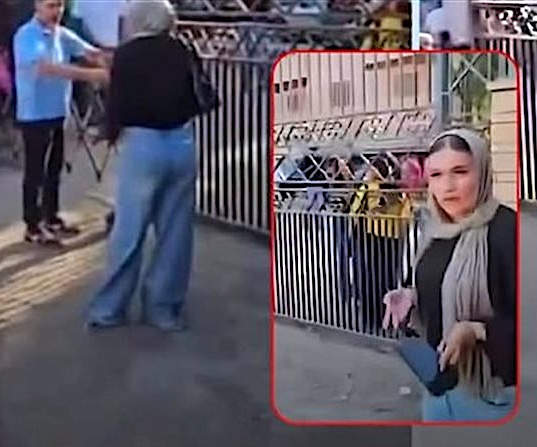
- A female student wearing loose jeans is stopped by a university security employee, who refuses to let her enter because her “trousers” are supposedly inappropriate. The jeans have a few small, barely noticeable rips, nothing glaring. Yet Mr Security Employee—or the university’s self-appointed religious enforcer, whose highest qualification may well be a literacy certificate—has appointed himself guardian of the morals of the university’s students, female and male alike.
- Another video shows another female student displaying what she is wearing: loose trousers and an open shirt over a top that is not see-through and reaches her neck. She complains that the “security guard” would not let her enter the university unless she “buttoned up her shirt.” But before she is a student, she is a free, respectable citizen with nothing to feel guilty about, and refuses the “security employee’s” moral guardianship. She returns home, and posts the video.
These examples are certainly no more than a drop in the ocean. It seems the issue has gone beyond what girls are “wearing” to a society that has “run headlong into a wall” (2)—the wall of backwardness and authoritarianism. A society of “religious enforcers everywhere,” moving towards forcing its members into a single mould, in the name of Islam and behind the “mask of morality.”
The obsession with the clothing, hijabs, and niqabs of “females”—and we deliberately do not say women—has intensified to the point of becoming pathological. Neither “males” nor even “females” have escaped it. Some women who, from childhood, have endured social oppression and male-imposed restrictions on their freedom in the name of religion, and who regard women as deficient beings without rights equal to men’s, have themselves begun to practise the same oppression and impose the same restrictions on younger generations.
Education—and Hitching a Free Ride on Religion and Identity
“Clinging on” and “riding on top” are expressions that have fallen out of use. In everyday speech, they mean secretly catching a free ride on a vehicle that takes you from one place to another, without a ticket: riding on the roof of a railway carriage or clinging to the back of a public bus. You reach your destination—your goal—without having earned the right to get there.
It seems that “Egyptian identity” has become everyone’s favourite punchbag—or a free pass and a ready-made excuse for anyone who dreams up some new imposition and wants to force it on people in the name of preserving “identity.” In reality, this identity is nothing more than their own notions—or delusions—about what “identity” means.
The decisions and pronouncements of the Minister of “Education and Edification” show that he has taken upon himself the task, and the burden, of bringing Egyptians up all over again and teaching them how to behave. He will raise them in virtue from their earliest years, so that they do not lie, falsify, flatter their superiors or pander to the public, or try to outdo others in displays of piety. This has become apparent in his attention-grabbing, revolutionary decisions, such as the decision to “make religious education a core subject in every grade and at every educational stage, with a minimum passing mark of 70 per cent.” This sends our children the message that “religion is the most important subject,” as he puts it.
“The minister also stressed that religion, values, and morals constitute the true foundation for building students’ character, pointing to the importance of embedding Egyptian identity and national belonging within schools,” according to media reports.
As for the instructions issued by the Minister of “Education and Edification” banning celebrations of holidays and occasions in schools that do not accord with Egyptian culture and values, with a particular focus on international schools and regulating their activities and events, the minister explained—again, according to media reports—that “the purpose of these instructions is to preserve Egyptian identity, strengthen social values, and instil a sense of national belonging in students.” End of quotation.
The minister’s decisions and pronouncements will not bring about the stronger national belonging or the social and religious values he hopes for. These things cannot be achieved through coercion and prohibition, imposed guardianship, and authoritarianism. Indeed, encroaching on the family’s role in bringing up children undermines social values. It is as though we were dealing with “orphanages,” rather than schools attended by children who have parents and families of their own.
How shabby—and how easy—it is to use religion to burnish one’s own image among the masses and the intellectually undiscerning, however high they may have climbed on the social or professional ladder, in order to attain a position or status without the necessary qualifications. And how shabby—and how easy—it is to brandish religion as a weapon: to create a din, intimidate, and divert attention from one’s own faults, failings, and deficiencies.
_________________________
https://www.almasryalyoum.com/news/details/4368781
- “Religious enforcers” ( مطوعين muawaa’in) are people policing Islamic observance and public morality, with an echo of Saudi religious policing.
- The expression ( لبس البنات / مجتمع لبس في الحيطة) is a linguistic pun.. English cannot reproduce it exactly, but the intended image of girls’ clothing and a society that has crashed into a wall is used instead.