
By Coptic Solidarity –
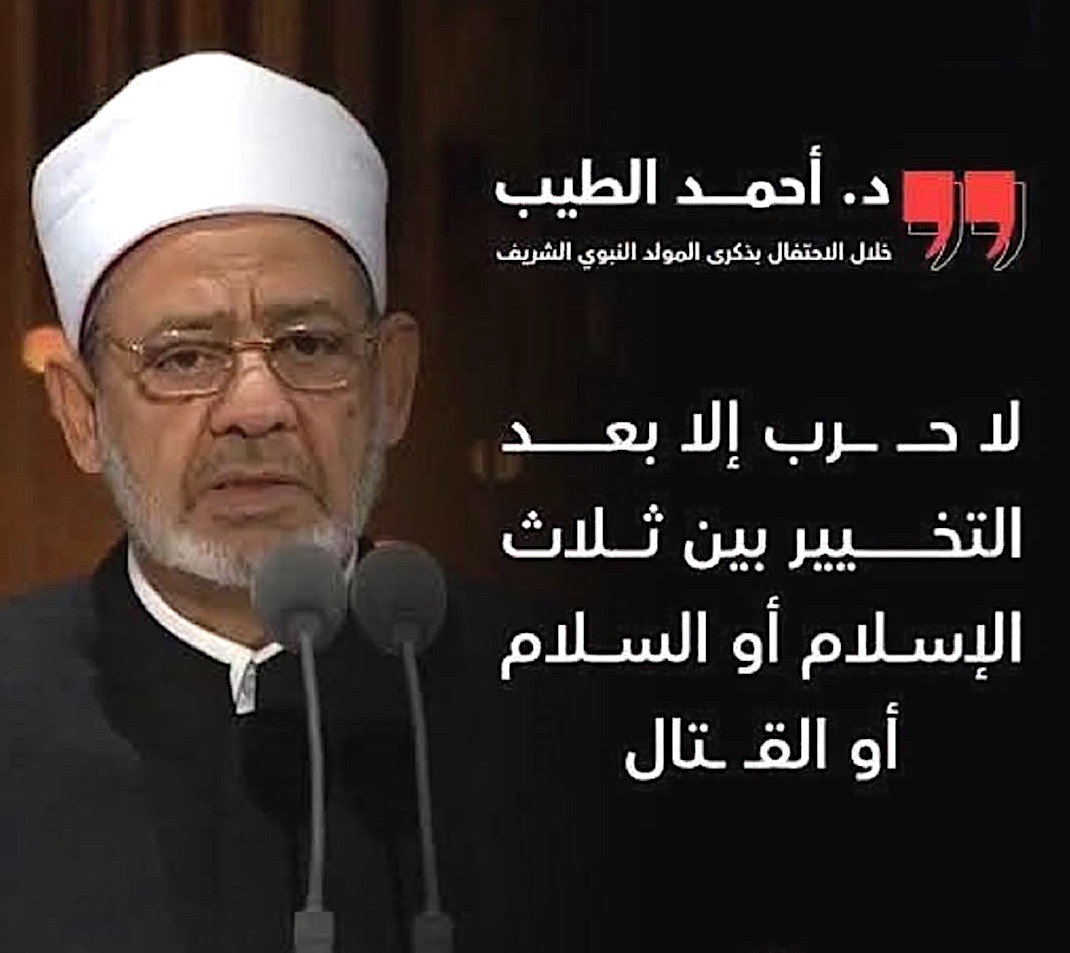
In remarks intended to emphasize Islam’s rejection of religious coercion and its supposedly strictly defensive conception of warfare, Al-Azhar Grand Imam Ahmed al-Tayeb declared that Muslims should not begin a war before offering the other side three choices: “Islam, peace, or fighting.” The formulation creates a striking tension with the very argument against religious compulsion that preceded it.
Speaking at an official celebration marking the Prophet Muhammad’s birthday, attended by President Abdel-Fattah el-Sisi, Sheikh al-Tayeb said that the Prophet’s moral teachings encompassed all peoples and God’s creatures. Muhammad, he said, was sent not only to the Arabs but to all nations.
Al-Tayeb contrasted what he described as the ethics governing warfare in the Prophet’s time with the wars of the twenty-first century. Humanity today, he said, is suffering from a continuing succession of wars and bloodshed, the destruction of homes and hospitals, the targeting of children, women and the sick, and the breaking of pledges and agreements. He maintained that there was no comparison between the brutality of contemporary wars and what he described as the justice governing warfare in the Prophet’s era.
Turning specifically to the ethics of war in Islam, the Grand Imam stressed that fighting in Islam is not intended to force people to embrace the religion or compel them to adopt a particular social or economic system. Its purpose, he said, is solely to repel aggression.
He cited Quranic verses including, “Fight in the cause of God those who fight you, but do not transgress; God does not love transgressors.” He also invoked the verse: “There is no compulsion in religion; truth has become distinct from error.”
Al-Tayeb further stated that the Prophet prohibited forcing anyone to embrace Islam, recalling the Quranic injunction that “there is no compulsion in religion.”
Three Choices
It was immediately after this extended rejection of religious coercion that the Grand Imam turned to the rules governing the commencement of war—and exposed the fundamental contradiction in his discourse.
Al-Tayeb said that if the purpose of fighting is confined to repelling aggression, war becomes a necessity to be avoided whenever possible. But once Muslims decide to go to war, he continued, they are religiously required not to begin fighting until the enemy has first been offered three alternatives:
“Islam, a peace treaty, or fighting.”
Fighting, he explained, thus becomes the last and unavoidable option.
But Al-Tayeb did not leave the formula there. He proceeded to explain in considerably greater detail what must happen before fighting begins.
Citing the Maliki and Hanafi schools of Islamic jurisprudence, he said that Muslims are required to wait three days after inviting the enemy to embrace Islam and not begin the confrontation before the fourth day, in the hope that the enemy will accept Islam or agree to a peace treaty or reconciliation. He based this on a tradition attributed to Ibn Abbas stating that the Prophet never fought a people without first inviting them to Islam.
Al-Tayeb went further still. He said Islamic jurisprudence prohibits fighting people who have not yet received the invitation (daawa) to Islam, which must be presented in a manner explaining the virtues of the religion. In his own summation, the enemy must not be taken by surprise: they must first be warned and adequately invited to Islam, or invited to conclude a peace treaty.
He also cited a tradition in which the Prophet reportedly instructed Muadh ibn Jabal not to fight the enemy before inviting them to Islam. Al-Tayeb presented these rules as an unparalleled example of justice, fairness and respect for the rights of the other—even an enemy engaged in fighting.
“No Compulsion”—But Islam Is Choice Number One
The contradiction could hardly be starker.
Only moments earlier, the audience had been assured that Islam does not seek to make others embrace the religion; that fighting is undertaken solely to repel aggression; that the Prophet prohibited religious coercion; and that the Quran itself declares, “There is no compulsion in religion.”
Yet when the Grand Imam arrives at the practical rules governing the commencement of war, Islam suddenly becomes the first of the three choices to be offered to the enemy. And this was no passing or unfortunate formulation. He elaborated upon it: the enemy is to be invited to Islam, allowed three days to consider that invitation, and fighting is not to begin before the fourth day in the hope that they will embrace Islam or agree to peace.
This raises a question that the discourse itself never resolves:
If war is undertaken solely to repel aggression, why should conversion to Islam enter the equation at all?
An aggressor can cease his aggression. He can withdraw. He can make peace or accept whatever legitimate conditions are required to end the conflict. His religion is logically irrelevant to the stated defensive purpose of the war.
The three-day rule makes the contradiction even harder to reconcile. If Muslims are confronting an aggressor whose attack makes defensive warfare an unavoidable necessity, why must that aggressor first be invited to change his religion—and then be given three days to consider doing so before the Muslims may fight him?
The audience is asked to accept two propositions operating according to fundamentally different logics: on the one hand, religion is entirely voluntary, warfare has nothing to do with conversion, and fighting is permitted solely to repel aggression; on the other, inviting the enemy to embrace Islam becomes a prescribed step preceding battle, with an actual waiting period intended, in part, to give the enemy time to accept Islam.
Repeating “there is no compulsion in religion” cannot make that contradiction disappear.
The result is an almost bifurcated discourse—modern and reassuring in one breath, while reproducing in the next a very different classical conception of the relationship between Islam, non-Muslims and warfare. Indeed, Al-Tayeb himself later referred to the wider body of rules governing “jihad in the path of God” before, during and after combat.
The setting makes this all the more consequential. This was not an obscure medieval text being examined in a theology seminar, nor the remarks of a fringe preacher. These were the words of the Grand Imam of Al-Azhar, one of the most prominent authorities in Sunni Islam, delivered in 2026 at a major official ceremony attended by President Abdel-Fattah el-Sisi.
And therein lies perhaps the greatest irony: a discourse offered as evidence of the humanity, restraint and non-coercive nature of Islamic warfare ends up revealing—through its own elaboration—the very contradiction it was apparently intended to dispel.
________________
Sources:
Masrawy; Al-Azhar official publication of the Grand Imam’s speech.
Al-Azhar — official text of Grand Imam Ahmed al-Tayeb’s speech