
By Coptic Solidarity –
The visit of U.S. Deputy Secretary of State Michael Rigas to St. Catherine’s Monastery, which began on August 27 and extended through August 30, offered an unusually revealing snapshot of the forces now surrounding the sixth-century monastery.
Publicly, the visit appeared reassuring. A senior American official had come to St. Catherine’s after months of growing international concern over Egypt’s attempts to alter the Monastery’s historic legal status. Earlier, Massad Boulos had conveyed President Donald Trump’s personal interest in preserving its “historic status quo.” Immediately before Rigas arrived, Greek press reports described his visit as an expression of American support for the Monastery.
What happened on the ground, however, appears considerably more troubling.
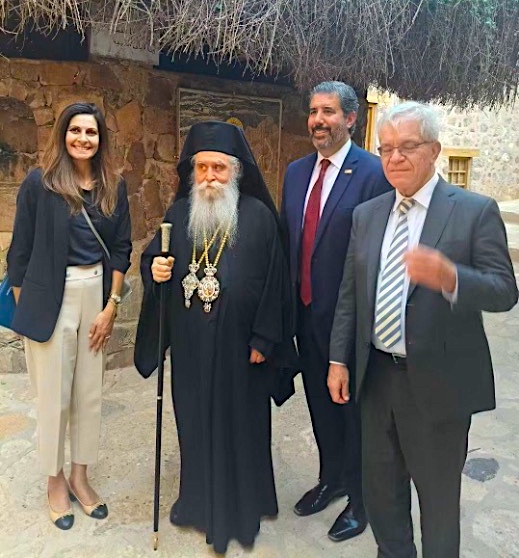
Rigas arrived during the celebration of the Dormition of the Virgin Mary according to the old calendar and attended the liturgy with Robert Silverman, Chargé d’Affaires of the U.S. Embassy in Cairo. But Egyptian officials were everywhere.
Among them was Dr Jasmine Moussa, Legal Adviser to the Egyptian Foreign Minister and an international lawyer who has represented Egypt before the International Court of Justice. Also present were Ahmed Adel, Director of the South Sinai Antiquities Area; Mohamed El-Nenny, Inspector of Antiquities for St. Catherine; and the head of the St. Catherine City Council. Published accounts place Moussa alongside Rigas and Silverman among the principal diplomatic attendees and separately identify the antiquities and municipal officials among those receiving the delegation with Archbishop Symeon and the Sinaitic Brotherhood.
The photographic record conveys the same impression: the Egyptian state was imposingly visible around the American visitors, the Archbishop and monks, and throughout the Monastery itself.
Even the public narration of the Monastery’s own history was largely assumed by an Egyptian archaeologist. Abdel-Rehim Rihan, Director of the Media Office of the Arab Archaeologists Council and head of the Campaign for the Defense of Egyptian Civilization, supplied lengthy explanations to the press concerning the Dormition, St. Catherine’s relics, Christian traditions, the monastery’s medieval history and its international religious importance.
The effect is difficult to miss. At a moment when the Egyptian state is seeking a new legal arrangement governing the Monastery, the state is imposingly visible around its diplomatic visitors, its archaeological heritage and even the public presentation of its Christian history.
Yet information from sources familiar with the circumstances of the visit paints an even bleaker picture.
According to these accounts, Rigas remained at St. Catherine’s through Sunday, but Archbishop Symeon and the monks were kept under virtually continuous Egyptian official presence. They even stayed during the Church’s vigil service in the evening sitting next to Rigas. Opportunities for substantive private discussion were severely restricted, and attempts at more confidential exchanges were reportedly obstructed. If these accounts are accurate, the extraordinary official presence was not merely ceremonial. It effectively limited the ability of the Brotherhood to speak freely with a senior American official who had come at a moment of existential importance for the Monastery.
That would make the visit revealing for a reason quite different from the one originally anticipated: the difficulty Rigas encountered in obtaining unrestricted access to the monks may itself have demonstrated the conditions under which they are now being asked to negotiate their future.
Jasmine Moussa: More Than an Official Presence
The role of Jasmine Moussa deserves particular attention.
Moussa is the Foreign Minister’s legal adviser, an exceptionally well-trained international lawyer, and has, according to sources close to the situation, been deeply involved in the discussions over St. Catherine’s legal and property status.
Representing Egypt’s interests as set by the country’s leadership, she is not at St. Catherine’s to arbitrate between two equal parties or independently safeguard the Monastery’s historical rights.
Her repeated presence around the Brotherhood therefore assumes particular significance when combined with reports that the monks had little opportunity for unrestricted conversation with Rigas.
One reported exchange following the visit is especially telling. According to a source familiar with the incident, Moussa subsequently went to the monks with other Egypt officials and demanded immediate signature without any guarantees.
If accurately reported, its significance is difficult to dismiss. The question was apparently not whether the Brotherhood accepted Egypt’s proposal, nor what objections remained, but when it intended to sign.

That formulation contrasts sharply with the language of an open negotiation between parties still seeking mutually acceptable terms.
And the imbalance between those parties is enormous. Egypt controls the administrative recognition of the Archbishop; the nationality and residency questions; the antiquities bureaucracy; the machinery through which any agreement would operate; and, as the litigating state, remains the opposing party in proceedings that have already produced an adverse judgment and are still pending before the Court of Cassation.
The monks negotiate under the weight of all of these instruments simultaneously.
The Story by Greek Media
Immediately before Rigas arrived, KontraNews reported that he was traveling to Sinai to express U.S. support for the Monastery after intensive diplomatic activity involving Cairo, Brussels and Washington.
Then, on August 30, Ta Nea reported that negotiations had reached their “critical final stage” and that the central architecture of the agreement was already “commonly accepted.” Egypt had reportedly transmitted its latest positions to the Sinaitic Brotherhood in early August and was awaiting the Brotherhood’s response.
Other Greek outlets, including Greek City Times and Vima Orthodoxias, presented a similarly advanced picture.
However, sources close to the situation describe a considerably less settled picture and caution that some of the optimistic Greek reporting may reflect the desire of certain governmental circles to bring the crisis rapidly to a conclusion rather than an objective assessment of what the Brotherhood itself is prepared to accept.
That possibility deserves particular attention because media language can itself become an instrument of pressure. Once an agreement is repeatedly described as “historic,” “locked,” in its “final stage,” and awaiting little more than signatures, the political presumption changes. The proposed settlement begins to acquire the status of an accomplished fact. A reluctant Brotherhood then risks being portrayed not as defending its historic rights but as obstructing a solution supposedly already accepted by everyone else.
In that environment, asking the monks when they will sign rather than whether they agree becomes significant.
The Proposed Agreement: A “New Legal Reality”
The substance of what has been reported gives even greater reason for caution.
Ta Nea says the proposed agreement will establish a “new legal reality” governing St. Catherine’s future. According to Ta Nea, Greek City Times and Vima Orthodoxias, the emerging formula involves an unusual form of “dual ownership.”
The Brotherhood would supposedly receive, in perpetuity, an “absolute” right of religious possession, use and operation over the Monastery’s movable and immovable property. At the same time, it apparently could not independently transfer, modify or exploit historic properties or archaeological and Byzantine treasures. Egypt’s Antiquities Authority would acquire an important role concerning historic property and the use, exhibition or movement of treasures.
Greek legal sources have described the structure more precisely as combining “bare ownership” with “conditional usufruct.”
Those terms deserve considerably more scrutiny.
- 1- “Dual ownership”
“Dual ownership” suggests that Egypt and the Brotherhood would somehow share ownership.
Bare ownership and usufruct, however, are not equivalent forms of ownership. The bare owner holds the underlying proprietary title. The usufructuary possesses and uses property whose title belongs to another.
If, as the reporting indicates, Egypt receives bare ownership while the Brotherhood receives conditional usufruct, the outcome is therefore much simpler than the terminology suggests: Egypt becomes the legal owner.
The Brotherhood receives a strong—and perhaps perpetual—right to remain, worship and operate the Monastery.
That may protect monastic life. It does not preserve ownership.
And it would mean that the litigation initiated by the Egyptian state ultimately achieved its fundamental objective through a negotiated settlement rather than a final judicial ruling.
- 2- “Religious possession”
The expression “religious possession” is equally problematic.
The Brotherhood would reportedly enjoy “absolute religious possession, use and operation” in perpetuity.
But possession is not ownership.
The addition of “religious” may provide important protection against expulsion or interference with liturgical and monastic activity. At the same time, however, it could narrow the Monastery’s rights to its religious function, separating the monks’ right to pray, live and operate there from the underlying proprietary rights historically exercised by the institution.
The central question is therefore not whether “religious possession” sounds protective.
It is why a Monastery that has exercised ownership for centuries should now require a newly formulated state guarantee permitting it to possess its own property for religious purposes.
- 3- “In perpetuity”
The promise of rights “in perpetuity” is repeatedly presented as another safeguard.
It may indeed provide substantial practical security. But perpetual use remains different from ownership.
Moreover, the durability of such a right depends upon the precise legal instrument establishing it, the law governing it, the mechanisms for enforcement, and the conditions under which those rights could subsequently be interpreted or regulated.
The word “perpetual” cannot compensate for surrendering title.
- 4- “Conditional usufruct”
The adjective “conditional” may ultimately prove more important than “perpetual.”
Usufruct already gives one party the right to use property legally owned by another. Conditional usufruct adds further restrictions.
The reported limitations are substantial: the Brotherhood apparently could not independently transfer, alter or exploit historic properties, while Egypt’s Antiquities Authority would gain an important role over the buildings and treasures.
What exactly does “important role” mean?
Consultation? Approval? Joint decision? Administrative supervision? Veto?
Those differences determine where effective control actually resides.
Egypt’s existing Antiquities Law already imposes substantial restrictions even upon privately owned antiquities. Article 6 recognizes exceptions for waqf and private property, while Article 8 restricts an owner or possessor from disposing of an antiquity without written approval of the Supreme Council of Antiquities.
That raises an obvious question: if Egyptian law already allows antiquities to remain privately owned (which is the case for numerous edifices belonging to the Coptic Church) while subjecting them to strong conservation controls, why is transfer of the underlying ownership to the state necessary?
The distinction between legitimate archaeological regulation and proprietary takeover must not be blurred.
- 5- The “Historic Status Quo”
The most consequential semantic struggle may concern the expression President Trump himself has invoked: the Monastery’s “historic status quo.”
Some Greek reporting appears to define that status quo primarily through the uninterrupted presence of a Greek Orthodox monastic community at Sinai.
That is far too narrow.
The historic status quo does not merely mean that monks remain inside St. Catherine’s and continue celebrating liturgies.
It encompasses the Monastery as an institution: its autonomy, legal continuity, Brotherhood, properties, ability to possess and administer those properties, and its historically distinct position within Egypt.
If the monks remain but Egypt acquires underlying ownership, one visible aspect of the status quo survives while a fundamental legal component disappears.
That would not simply preserve the historic status quo under modern terminology.
It would create precisely what Ta Nea has called a “new legal reality.”
- 6- The Properties Outside the Walls
The Monastery’s satellite properties may prove equally important.
The Brotherhood historically possesses cells, gardens, lands and other properties outside the main monastery complex. Some provide modest income necessary to sustain the community. Greek reporting indicates that these holdings are now being individually inventoried as the parties determine what will be covered by the prospective agreement.
This is not a secondary accounting matter.
A monastery permitted permanently to worship within its walls while losing the properties that support its independent existence could retain religious continuity while becoming increasingly dependent upon the state.
The annexes to any agreement may therefore prove as important as its headline ownership clause.
Recognition of Archbishop Symeon: Part of the Bargain?
The treatment of Archbishop Symeon illustrates the negotiating imbalance particularly starkly.
Greek reporting says his Egyptian nationality and formal recognition by presidential decree are expected in conjunction with the completion of the settlement. A special residency regime for the Brotherhood is also anticipated, while recognition of the Brotherhood’s statutes remains under consideration.
Ta Nea has gone so far as to describe recognition of Symeon as something resembling the “dowry” accompanying the final agreement.
But recognition of the duly elected Archbishop, his ability legally to represent the Monastery, and secure legal residence for the monks should logically precede negotiations in which they are expected to defend their rights.
Instead, these unresolved matters provide the Egyptian state with additional leverage while negotiations proceed. Indeed, their continued suspension means that Egypt is negotiating not only over property, but from a position in which it retains administrative control over the legal standing of the very people sitting across the table.
A party negotiating its property rights while simultaneously dependent upon the opposing state to recognize its leader, regularize its members’ presence and acknowledge its institutional status is plainly not negotiating from a position of equality.
What Did Rigas Take Away from Sinai?
Michael Rigas’s visit was supposed to represent an important manifestation of American concern. Yet if the accounts from inside the Monastery are correct, his ability to hear freely from the Brotherhood was severely constrained by the continuous Egyptian official presence surrounding his visit.
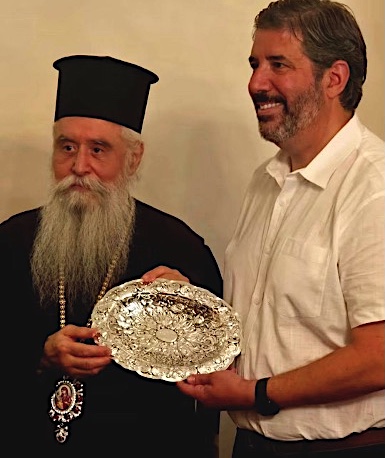
That does not necessarily mean the mission failed. Quite the opposite may still be possible.
Rigas is an experienced senior official. The apparent difficulty in meeting privately and freely with the ancient monastic community may itself communicate more about the pressures facing that community than any prepared briefing could have done.
The crucial question is therefore what happens after his return.
Does Rigas conclude that the Brotherhood is negotiating under extraordinary pressure and convey that assessment decisively in Washington?
Will the United States insist that preservation of the “historic status quo” means preservation of actual institutional autonomy and historic property rights—not merely perpetual permission to conduct religious life on property whose title has passed to Egypt?
Or does Washington accept assurances that the monks will remain, regard the immediate crisis as resolved, and allow the process to move toward the agreement now being promoted in parts of the Greek press?
No one yet knows.
A Settlement—or the Completion of the Takeover?
There is still no final agreement. That fact must not disappear beneath increasingly confident reports by some Greek media that an “historic agreement” is approaching signature.
The decisive questions remain unanswered: Who owns the Monastery after the agreement? Who owns its external properties? What legal content does “religious possession” actually carry? What conditions limit the usufruct? What authority does Egypt’s Antiquities establishment acquire? What happens to the Cassation proceedings? And can the Brotherhood meaningfully be said to consent while its Archbishop, legal status and monks’ residency remain dependent upon decisions of the state with which it is negotiating?
The danger is therefore no longer simply that an unfavorable judicial ruling could dispossess St. Catherine’s. The same result could now be accomplished through an agreement presented internationally as the solution that saved it.
Terms such as “dual ownership,” “religious possession,” “conditional usufruct” and “perpetuity” may create an appearance of protection while obscuring the transfer of the underlying proprietary position to the Egyptian state.
And the world may discover only afterward that the “historic agreement” celebrated as saving St. Catherine’s was the instrument through which its historic status quo was finally lost.