
By Coptic Solidarity –
The Egyptian government has taken another significant step toward integrating Al-Azhar into the country’s general education system, signing a broad cooperation protocol that grants the Islamic institution an unprecedented role in shaping religious instruction, teacher training, and educational policy. The agreement reflects a continuing trend under President Abdel Fattah el-Sisi toward expanding Al-Azhar’s authority beyond its own parallel education system into the national public-school sector.
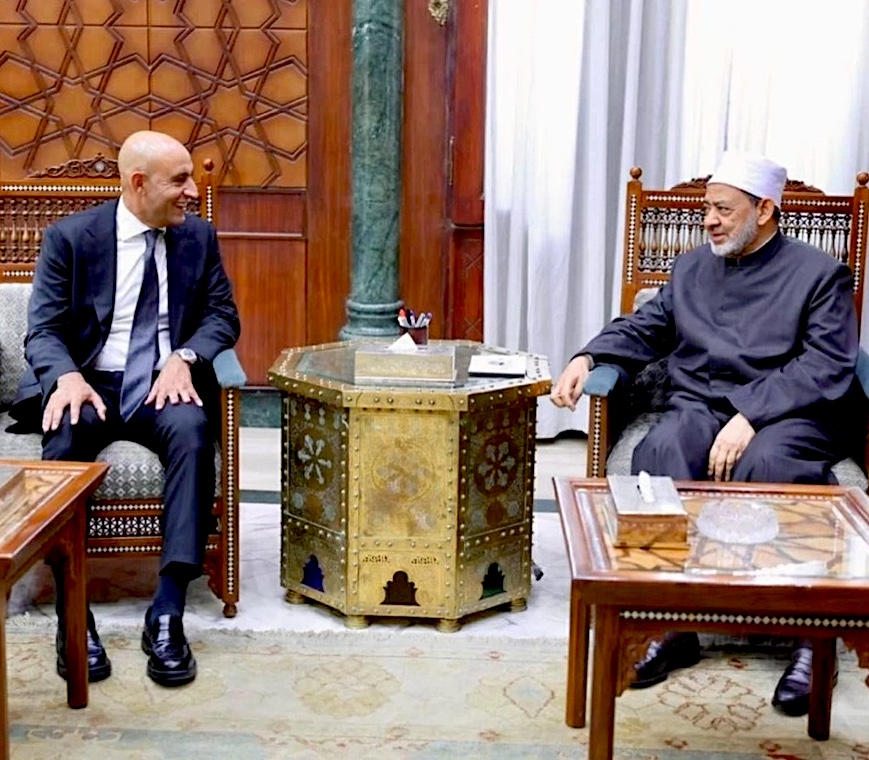
Signed by Minister of Education Mohamed Abdel Latif and Al-Azhar Undersecretary Sheikh Ayman Abdel Ghani in the presence of Grand Imam Ahmed al-Tayeb, the protocol goes well beyond technical cooperation. It provides for Al-Azhar’s direct involvement in developing Islamic religious education, training teachers of Islamic studies, organizing specialized workshops, exchanging pedagogical expertise, and introducing Qur’an instructors from Al-Azhar to train both teachers and students in the “correct recitation” (tajwid) of the Qur’an. The agreement also extends cooperation to educational assessment, teacher and leadership training, and reforms associated with the new Baccalaureate system.
The Language of Qur’an
The meeting also highlighted Al-Azhar’s growing influence over the broader philosophy of national education. Grand Imam Ahmed al-Tayeb argued that Arabic should occupy a central place in all educational systems because it is “the language of the Qur’an,” expressing concern that many families prioritize foreign languages over Qur’anic Arabic. He emphasized that Arabic should take precedence as a fundamental component of identity, culture, and belonging.
For his part, the Minister of Education praised Al-Azhar’s “leading role” in disseminating the “correct understanding of religion,” promoting “moderation,” and building societal awareness. He further stressed that the Ministry is working to strengthen religious and moral values through school curricula, underscoring the close institutional partnership between the Ministry and Al-Azhar.
The agreement represents the latest stage in a broader process that has progressively blurred the distinction between Egypt’s general education system and Al-Azhar’s traditionally separate religious education network. While Al-Azhar already administers more than 9,000 institutes serving approximately two million students, the new protocol extends its influence directly into public schools by giving it a formal role in curriculum development, teacher preparation, pedagogical standards, and Qur’anic instruction. Rather than remaining a parallel educational institution, Al-Azhar is increasingly becoming a central actor in defining the religious and cultural orientation of Egypt’s national education system.
This development further illustrates the institutional Islamization of public education documented in recent years. Successive policy measures have expanded the role of Islamic institutions not only in religious instruction but also in shaping educational content, teacher training, concepts of national identity, and the values promoted throughout the state school system. The latest protocol reinforces Al-Azhar’s position as the principal religious authority influencing public education, deepening the Islamic imprint on Egypt’s national educational framework.
_____________
Sources: