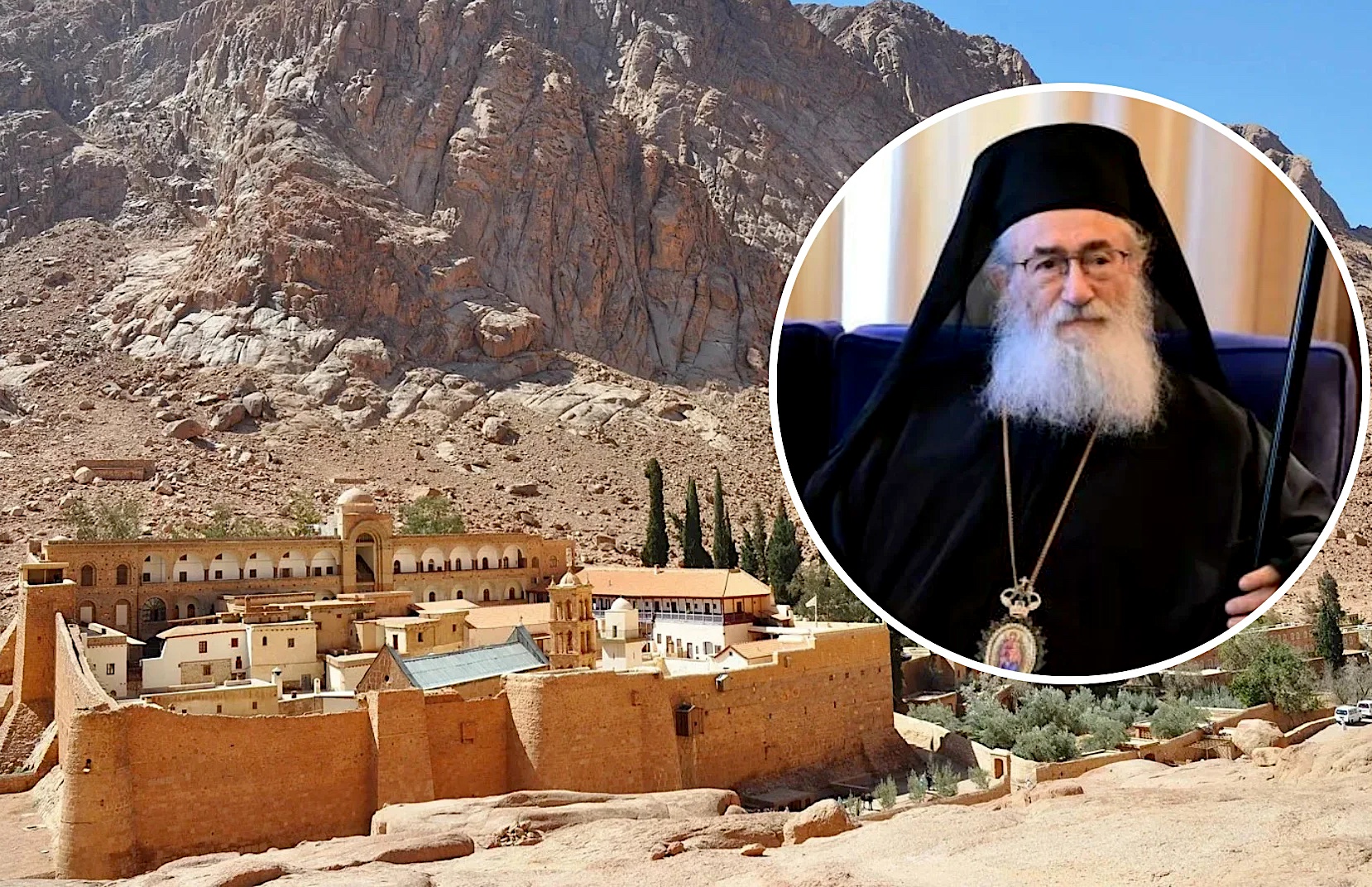

Former Archbishop Damianos has issued a public appeal warning that St. Catherine’s Monastery is facing one of the gravest crises in its fifteen-century history.
Archbishop Damianos adopted a tone of respect towards Egypt while emphasizing that genuine dialogue remains possible only if conducted openly and honestly. He notes that the Monastery has consistently supported Egypt’s development projects in the Sinai region, even when they disrupted the Monastery’s spiritual environment, and argues that there is no inherent conflict between Egypt’s development objectives and the preservation of the Monastery’s historic rights.
The Archbishop recalls that negotiations had previously reached a mutually acceptable basis before, in his words, this process was abruptly overturned by the court ruling issued in May 2025. According to him, the central issue has been deliberately obscured through repeated references to preserving the Monastery’s “religious status quo.” Religious life, he argues, cannot be separated from the legal foundations that make it possible.
According to Archbishop Damianos, the Monastery’s historic continuity ultimately rests on four indispensable legal guarantees:
- recognition of its historic ownership rights;
- recognition of its distinct legal personality under Egyptian and international law;
- Egyptian citizenship for the Archbishop;
- and secure long-term residence status for the monks. Without these guarantees, he argues, no agreement can provide lasting protection.
Archbishop Damianos recalls that Egypt initially accepted an out-of-court settlement recognizing the Monastery’s full ownership of all its historic properties before withdrawing from that agreement without explanation. He rejects accusations that he himself had accepted a disadvantageous compromise, insisting instead that he consistently defended the Monastery’s historic title deeds and sought a lasting settlement that would protect the legitimate interests of both sides.
He further expresses concern that responsibility for the proposed agreement is now being shifted onto the Brotherhood, even though, he states, the agreement itself was negotiated by the Greek and Egyptian Foreign Ministers. The Brotherhood, he argues, is being placed in the impossible position of approving or rejecting an arrangement whose essential terms were drafted without its participation.
The Archbishop reveals that he had proposed an alternative formula under which Egypt would be recognized as owner of the land while the Monastery would retain ownership of all buildings and structures, combined with reciprocal restrictions preventing either party from selling or changing the use of the property. Although he acknowledges that such a solution would not fully reflect historical reality, he argues that it would have protected both sides while preserving the Monastery’s essential legal rights.
He also insists that any lasting settlement should take the form of a formal interstate agreement between Greece and Egypt, rather than a bilateral arrangement between Egypt and the Monastery alone. Without such international guarantees, he warns, a future Egyptian government could simply revoke the agreement.
Archbishop Damianos expresses profound alarm over reports describing the proposed new agreement. If those reports are accurate, he argues, the Monastery would relinquish ownership of its historic properties while retaining only perpetual possession and use. Even more troubling, the Monastery’s vital agricultural lands would remain state property and merely be leased back to the monks.
From both a legal and practical standpoint, he argues, such an arrangement would fundamentally alter the Monastery’s status. In his view, ownership alone provides lasting legal protection, whereas possession and use ultimately remain dependent upon the will of the owner. Acceptance of such terms would therefore transform the Monastery from the owner of its historic patrimony into a tenant on its own land.
In his view, any agreement based on these principles would represent not a diplomatic success but a profound degradation of the Monastery’s historical, spiritual and institutional autonomy. It would undermine its religious freedom and accelerate its transformation from a living monastic community into a museum primarily serving tourism. He argues that such an outcome would fundamentally alter the very nature of one of Christianity’s oldest continuously functioning monasteries.
Archbishop Damianos also criticizes the handling of the issue by the Greek government. While welcoming efforts to place the Monastery on the diplomatic agenda, he argues that the protection of St. Catherine’s should be treated as a matter of the highest national and spiritual priority, comparable in significance to Hagia Sophia and the Monastery of Chora.
Internally, he also criticizes the manner in which the negotiations have been conducted within the Brotherhood. He argues that all monks, including those currently outside the Monastery, have a right under the Monastery’s regulations to be fully informed and to participate in decisions of such historic importance. He maintains that the moral and legal authority to decide the future of the Monastery rests with the General Assembly of the entire Brotherhood.
Finally, Archbishop Damianos warns that if the strategy pursued by the Greek and Egyptian governments amounts to gradually transforming the Monastery into a museum while reducing its monks to mere custodians or employees, then meaningful compromise is no longer possible. He calls instead for an international campaign mobilizing the entire Orthodox world in defense of St. Catherine’s. Despite his ninety-two years of age, he declares himself ready to participate “as a simple soldier” in that struggle.
He concludes by reminding the Brotherhood that St. Catherine’s is not merely a historic monument but a living spiritual community entrusted to them by history, the Orthodox faith, and God. Its future, he concludes, will depend upon the courage, unity and fidelity of the present generation.
Download the full text
https://www.romfea.gr/images/article-images/2026/07/Romfea2/epistoli-sinaiou.pdf