
By EIPR-
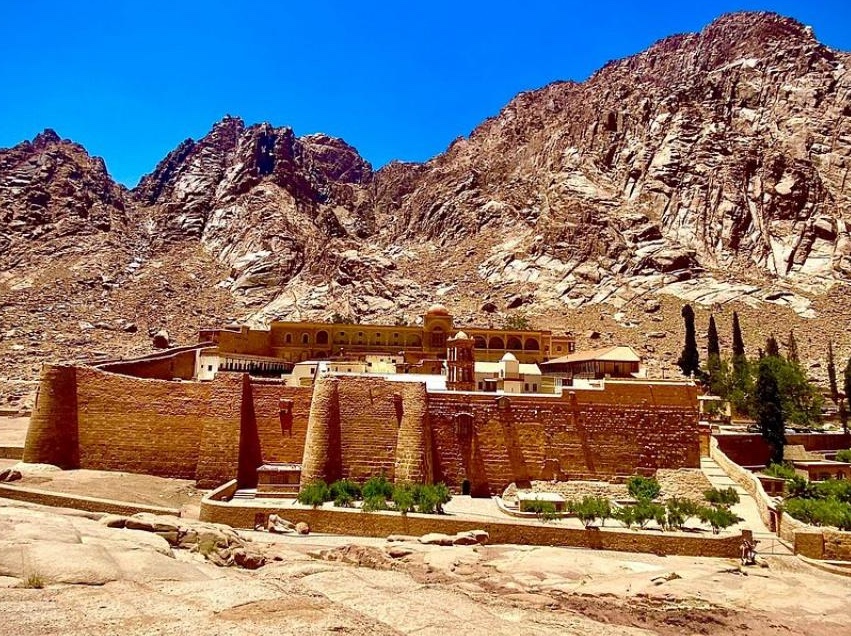
The Egyptian Initiative for Personal Rights (EIPR) has renewed its call on the Egyptian government to halt the measures and pressures aimed at changing the historic character and cultural distinctiveness of the St. Catherine’s Monastery site and its constituent elements in South Sinai, particularly in light of UNESCO’s renewed expression of concern over the impairment of the integrity and authenticity of the World Heritage property as a result of its development into a tourism investment project.
At its annual meeting held last July, the UNESCO World Heritage Committee—the intergovernmental body responsible for monitoring the implementation of the Convention Concerning the Protection of the World Cultural and Natural Heritage—unanimously adopted a decision calling upon the Egyptian government to suspend implementation of the “Great Transfiguration – Land of Peace” project until a technical assessment is carried out regarding its impact on the Outstanding Universal Value of the St. Catherine World Heritage property.
This decision was adopted for the third time, in light of the report prepared by the International Council on Monuments and Sites (ICOMOS), the body responsible for the protection and conservation of tangible cultural heritage. The report concluded that the construction works already carried out within the St. Catherine heritage area, in connection with the implementation of the Great Transfiguration project, may have serious and permanent adverse effects on the integrity and authenticity of the site.
The UNESCO Committee’s decision also recommended dispatching a mission to examine the possibility of adopting practical measures to mitigate the permanent adverse effects that have already occurred at the heritage site. It stressed that preserving the Outstanding Universal Value of the St. Catherine World Heritage property requires not only safeguarding St. Catherine’s Monastery and its architectural and archaeological components, but also preserving the entire landscape surrounding the Monastery.
Although, according to the Committee’s report, the Egyptian government assured UNESCO that the President had issued directives in September 2025 suspending work on the Great Transfiguration project until UNESCO’s requirements concerning an assessment of the project’s impact on the heritage area had been fulfilled, no public statement or official decision to that effect has been published in Egypt, nor was the autonomous Greek Orthodox Archbishopric of Sinai, to which the Monastery belongs, notified of any such decision.
Furthermore, statements made by the head of the Sinai Reconstruction Authority last June indicating that approximately 97.5% of the project had already been completed, together with the statement made by the Minister of Housing, Utilities and Urban Communities last May that the Great Transfiguration project was approaching its final stages, indicate that the impact of the project on the heritage area has in fact already occurred, even if those presidential directives were indeed issued.
The Egyptian Initiative also expresses concern in light of information it has received indicating that the Egyptian authorities continue to exert pressure on the Monastery’s leadership and monks to sign an agreement that would formalize a new status quo, legitimizing the confiscation of the Monastery and its affiliated lands from the monks while leaving them only rights of usufruct over sites of a religious nature. Such an arrangement threatens to introduce far-reaching changes affecting the Monastery’s environment and surroundings, which have been preserved by its monastic community and others for fourteen centuries.
According to several accounts from sources close to the Monastery, these pressures include the Egyptian government’s refusal to deal with the current Abbot in the same manner as it dealt with his predecessor. Specifically, the Presidency has not issued a Presidential Decree appointing the new Abbot, thereby formally recognizing his assumption of office following his election by the Holy Synod in October 2025.
According to these accounts, the Egyptian government has made the President’s ratification of the Abbot’s election conditional upon the Monastery signing the proposed agreement. Under this arrangement, the Abbot would retain only religious possession, enabling him merely to conduct religious services, while his legal status in Egypt would be reduced to that of a resident holding a renewable three-year residence permit, rather than being granted Egyptian nationality as had been the case with his predecessors.
EIPR fears that these efforts to impose the new arrangement constitute an attempt by the government to pre-empt the forthcoming final judgment of the Court of Cassation concerning the dispute over ownership of the lands surrounding the Monastery.
On 28 May 2025, the Ismailia Court of Appeal ruled that the Abbot enjoyed what it termed “religious possession” over 29 religious sites, without recognizing ownership. The Court rejected the government’s claim seeking the eviction of the monks from 17 plots of land covered by preliminary sale contracts concluded between the government and the Abbot in his official capacity.
At the same time, however, the Court ordered the eviction of the monks from lands not considered to have a religious character, directing that they be handed over, together with all buildings, plantations and crops thereon, to the South Sinai Governorate. Both parties subsequently appealed the judgment before the Court of Cassation, where the case is currently pending.
The government’s handling of the Monastery’s property dispute cannot be separated from the redevelopment of the St. Catherine heritage area, which has undergone extensive changes as part of the implementation of the Great Transfiguration – Land of Peace project, launched by the government in November 2021 with the objective of promoting St. Catherine internationally as a destination for spiritual tourism, on the basis that it represents a meeting point of the three Abrahamic religions.
The Egyptian Initiative for Personal Rights believes that the practical steps being taken by the government to alter the system of ownership and possession violate Egypt’s obligations under the International Covenant on Economic, Social and Cultural Rights, particularly the principle of non-retrogression, according to which deliberate governmental measures that reduce cultural rights already guaranteed constitute a violation of Article 2(1) of the Covenant, which Egypt ratified and incorporated into its domestic legal system in 1982.
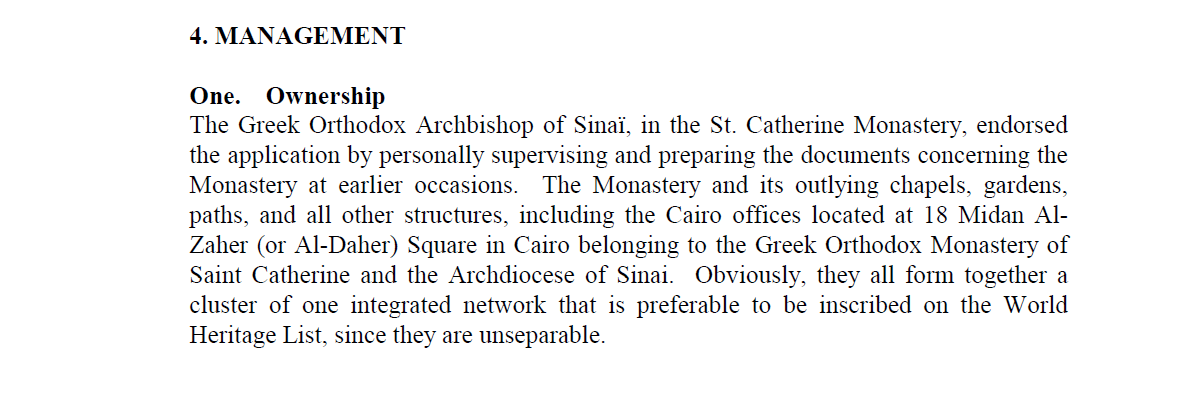
The government itself had previously acknowledged the ownership of the Monastery by the Metropolitan of Sinai, representing the Greek Orthodox Archbishopric of Sinai, in the nomination dossier submitted by Egypt for the inscription of the St. Catherine area on the UNESCO World Heritage List at the beginning of the millennium. The dossier explicitly referred to the Monastery, its chapels, gardens, pathways and all other associated structures as belonging to the Greek Orthodox Archbishopric of Sinai.
The Egyptian Initiative reiterates that it is the government’s responsibility to reach an agreement that preserves the character of the Monastery as a living religious heritage, while guaranteeing the rights of its monks within its surroundings, which constitute the essential space in which they carry out their daily activities within the heritage area, of which they form an integral part.
Monastic life at St. Catherine has contributed to the development of both the Monastery and its surroundings by establishing an infrastructure that enabled the Monastery to become self-sufficient. Monastic life was never confined to prayer and worship alone; it also included land reclamation, the digging of wells, and cooperation with the surrounding tribes in organizing life in the St. Catherine area on the basis of coexistence over many centuries.
This history has been a fundamental element in shaping the unique character of the St. Catherine heritage area, at the heart of which stand St. Catherine’s Monastery and the monastic life that continues within it. It is a heritage site inhabited by its own monastic community, unlike many archaeological monuments that are uninhabited and no longer used for their original purposes. This unique character requires legal arrangements governing ownership that take into account the special status of the monks of St. Catherine’s Monastery.
________
Source: