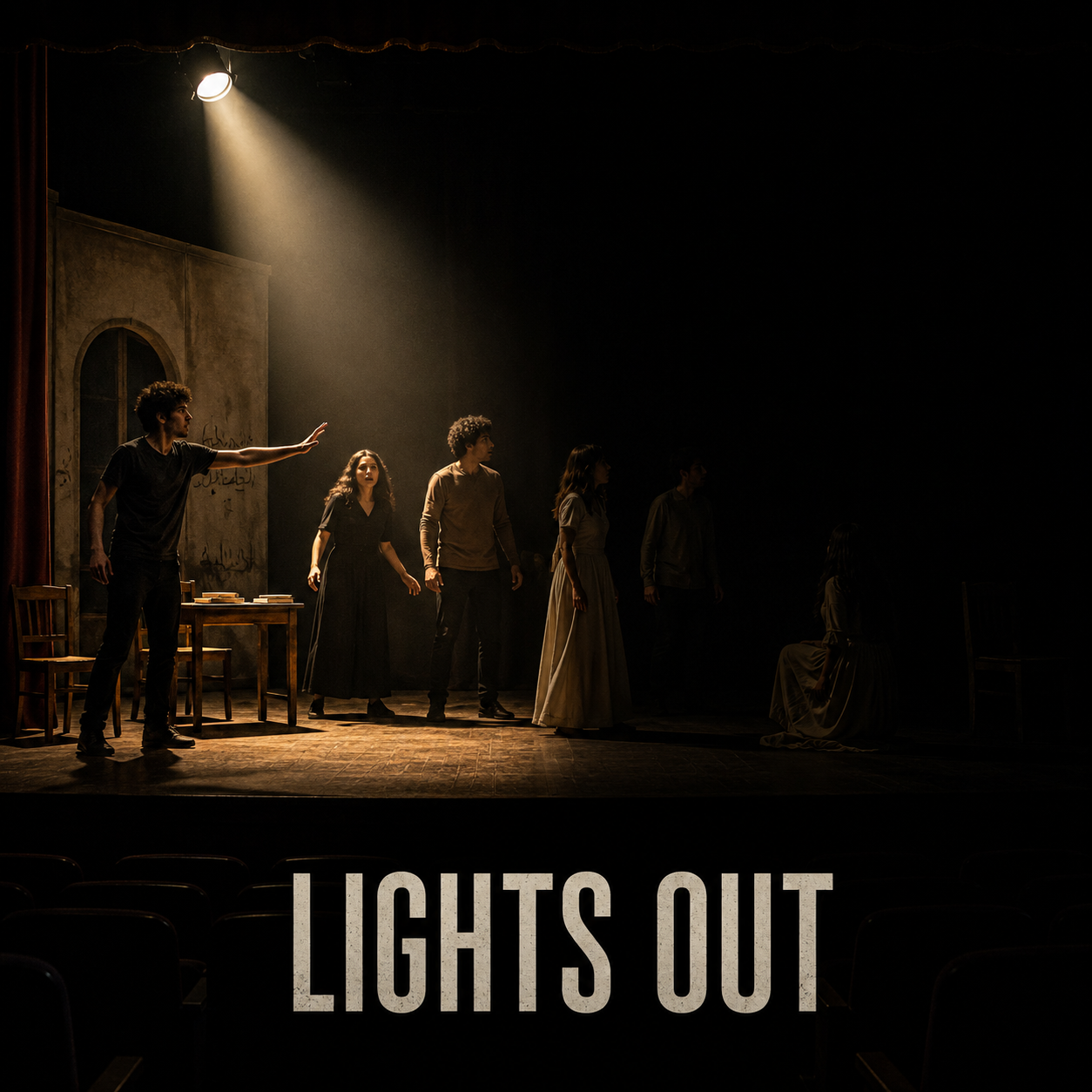

The stage of the Faculty of Law at Helwan University recently witnessed an incident that sparked widespread anger among students and parents after the theatrical production al-Duhdira (“The Downslide”) was forcibly halted while the actors were performing. According to reports, officials from the university’s Youth Activities Department abruptly ordered the electricity, lighting, and sound systems to be shut down, causing confusion and disorder inside the auditorium.
In a recorded testimony, student Mohamed Ashraf, the play’s director, revealed details of a months-long dispute, describing what he characterized as administrative obstruction and organizational chaos that allegedly resulted in ethical and practical problems. Ashraf recalled shouting inside the theater, “This is unfair—we worked hard for this,” before the power was forcibly cut, leading to confusion and crowding among audience members.
Ashraf explained that he was forced to stop the actors shortly after the performance began after receiving a firm order to cut the music and lighting completely and freeze all stage activity.
According to his account, a university Youth Activities official initially claimed that the decision had come directly from the university president. However, subsequent inquiries allegedly revealed that the university president had not intervened at all, and that the order had in fact originated from the vice dean, who instructed Youth Activities officials to terminate the event immediately.
“Theater Is Illicit”: Students Challenge the Dean’s Position
The play’s director expressed his shock, as well as that of the entire cast, at the dean’s position, claiming that she repeatedly refused to meet with them or listen to their concerns.
He added:
“We were told more than once that theater and acting are religiously illicit. But if they are truly forbidden, why does our university’s Faculty of Arts have a Department of Theater Studies and a separate department for Acting and Directing?”
The controversy marked a dramatic conclusion to more than four months of daily rehearsals and sustained effort by dozens of students.
The dispute reportedly began earlier when some students posted a video discussing problems they were facing. According to the report, the administration demanded that the video be deleted and that the students issue an apology. Although the students complied, they claim they continued to face obstruction and that two students were excluded from participation and evaluation.
In order to preserve their production, the team agreed to stage the play without the financial support originally allocated to it. They covered the expenses entirely from their own pockets and agreed to participate despite the exclusion of some of their colleagues from awards consideration. They say they ultimately faced expulsion from the venue, the withdrawal of the evaluation committee, and the destruction of months of work and personal financial investment.
A Debate Beyond a Student Performance
The controversy has attracted particular attention because, at the time of publication, no official statement had been issued by the university administration addressing the students’ allegations. Nor had the university publicly denied the claims or clarified who ordered the interruption of the performance.
Observers note that the incident appears to raise broader questions than a simple dispute over a student production. While Egyptian universities have long hosted theatrical activities, cultural competitions, and artistic initiatives, the space available for such activities has fluctuated over the years in response to changing political and ideological currents. During periods of heightened Islamist influence, artistic and cultural activities on university campuses have repeatedly come under pressure, faced restrictions, or been subjected to campaigns questioning their legitimacy on religious grounds.
Against this backdrop, allegations that theater and acting were described as religiously impermissible have attracted particular attention. For many observers, the controversy is significant not simply because a student performance was interrupted, but because it may reflect the re-emergence of attitudes that seek to subject artistic and cultural activities to religious scrutiny. The fact that such allegations have arisen within a university that includes academic programs dedicated to theater studies, acting, and directing has further intensified the debate.
Whether the dispute ultimately proves to be administrative, ideological, or a combination of both, it has revived concerns among students, academics, and cultural figures about the place of artistic expression within Egyptian universities and whether gains made in recent decades could be vulnerable to reversal. These concerns have been amplified by broader debates over the expanding role of religious institutions and religiously framed discourse in public life, including within educational and cultural spheres. For some observers, the incident raises questions about whether pressures once associated with periods of strong Islamist influence are re-emerging in new forms within state institutions.
The controversy has also drawn unusually sharp reactions from prominent Egyptian educators. Veteran educational expert Dr. Kamal Moughith published an open appeal to the Minister of Higher Education that amounted to a call for the dean’s dismissal. Expressing astonishment that a university dean could allegedly regard theater as religiously forbidden, Moughith argued that such views promote “ignorance and extremism” and are fundamentally incompatible with the educational mission of a university. To underscore the point, he reviewed the long history of theater—from ancient ritual performances and the dramatic traditions of Pharaonic Egypt to classical Greek theater and the modern Egyptian stage—arguing that the performing arts constitute an integral part of both human civilization and Egypt’s cultural heritage.
Appeal for Justice
The absence of an official clarification has further fueled calls for an independent investigation. Many students and commentators argue that a transparent review of the events is necessary not only to establish responsibility for the disruption of the performance, but also to determine whether the incident signals a broader shift in attitudes toward artistic activities and cultural expression within Egyptian public institutions.
Ashraf concluded by stressing that his statement was not intended as a personal defense but as a defense of the dignity of university theater and of an entire team whose efforts had been disregarded.
The students are calling for an immediate, transparent, and impartial investigation by both the university administration and the Ministry of Higher Education into all aspects of the incident. They are also demanding accountability for whoever was responsible for halting the performance and cutting the electricity and sound systems, as well as full compensation for the Faculty of Law theater team for the material and psychological damages suffered by them and their families, who witnessed what they described as a deeply distressing incident.
***
Since the controversy erupted, the university has indicated that it is “reviewing the circumstances of the incident,” while the Acting Professions Syndicate reportedly intervened in an effort to contain the dispute.. Nevertheless, the incident has continued to attract attention because of the broader questions it raises regarding artistic freedom, ideological pressures, and the place of cultural expression within Egyptian public institutions.
____________
This dispatch was edited by Coptic Solidarity from various public sources