
By Raymond Ibrahim – Coptic Solidarity –
For years, the Egyptian state has carefully tried to project an image of religious pluralism and national harmony, presenting itself as a protector of the country’s ancient Christian heritage while simultaneously integrating that same heritage into an expanding framework of tourism, development, and centralized administration.
But beneath the language of “coexistence” and “preservation,” a more historically rooted concern is increasingly voiced by Egypt’s Coptic community: not the disappearance of Christian holy sites, but the gradual transformation of their legal and spiritual status—specifically, who owns them, who governs them, and under what authority they are allowed to remain Christian in anything more than name.
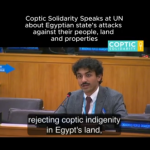
Last month, at the United Nations Permanent Forum on Indigenous Issues in New York, Coptic Solidarity issued a formal intervention warning of growing pressures on Egypt’s churches, monasteries, and historic Christian properties. The organization emphasized the Copts as the indigenous Christian population of Egypt and highlighted a series of legal and administrative developments that, taken together, appear to be reshaping the custodianship of their sacred institutions.
At the center of this concern stands the ancient Saint Catherine’s Monastery, a prominent World Heritage site of UNESCO and one of the oldest continuously functioning Christian monasteries in the world. For nearly fifteen centuries, it has endured successive waves of persecution and political transformation—the Islamic conquests of the seventh century, the rule of various caliphates, Mamluk sultans, and Ottoman administrations, followed by modern nation-state governance.
It is within that longer historical arc that many Christians now interpret present developments—not as isolated policy disputes, but as the latest expression of an older pattern.
Historically, under Islamic rule, Egypt’s Christian communities were incorporated into the dhimma system—a legal and civil framework that granted them protection (dhimma) only on the condition of political and religious subordination to Islamic authority. Christians were allowed to continue practicing their faith, but only as a marginally tolerated population—second class citizens. Their religious expression was circumscribed: church construction, repair, and the public display of Christian symbols were banned, and various social and legal regulations reinforced a clear hierarchy in which Islamic authority remained dominant. Even taxation—most notably the jizya—served as a visible marker of this unequal status, reminding the Copts of their subordinate position within the Islamic order.
It is precisely this historical memory that inflames contemporary anxieties—not because modern Egypt replicates medieval conditions in a literal sense, but because many of the structural questions appear familiar: who controls sacred property, and whether Christian institutions possess autonomy over their own religious heritage.
Recent legal disputes and administrative measures have raised fears that monastery lands and associated properties could come under expanding state oversight, justified through “sovereignty,” “state security” concerns as well as the language of “development,” “heritage protection,” and “tourism modernization.”
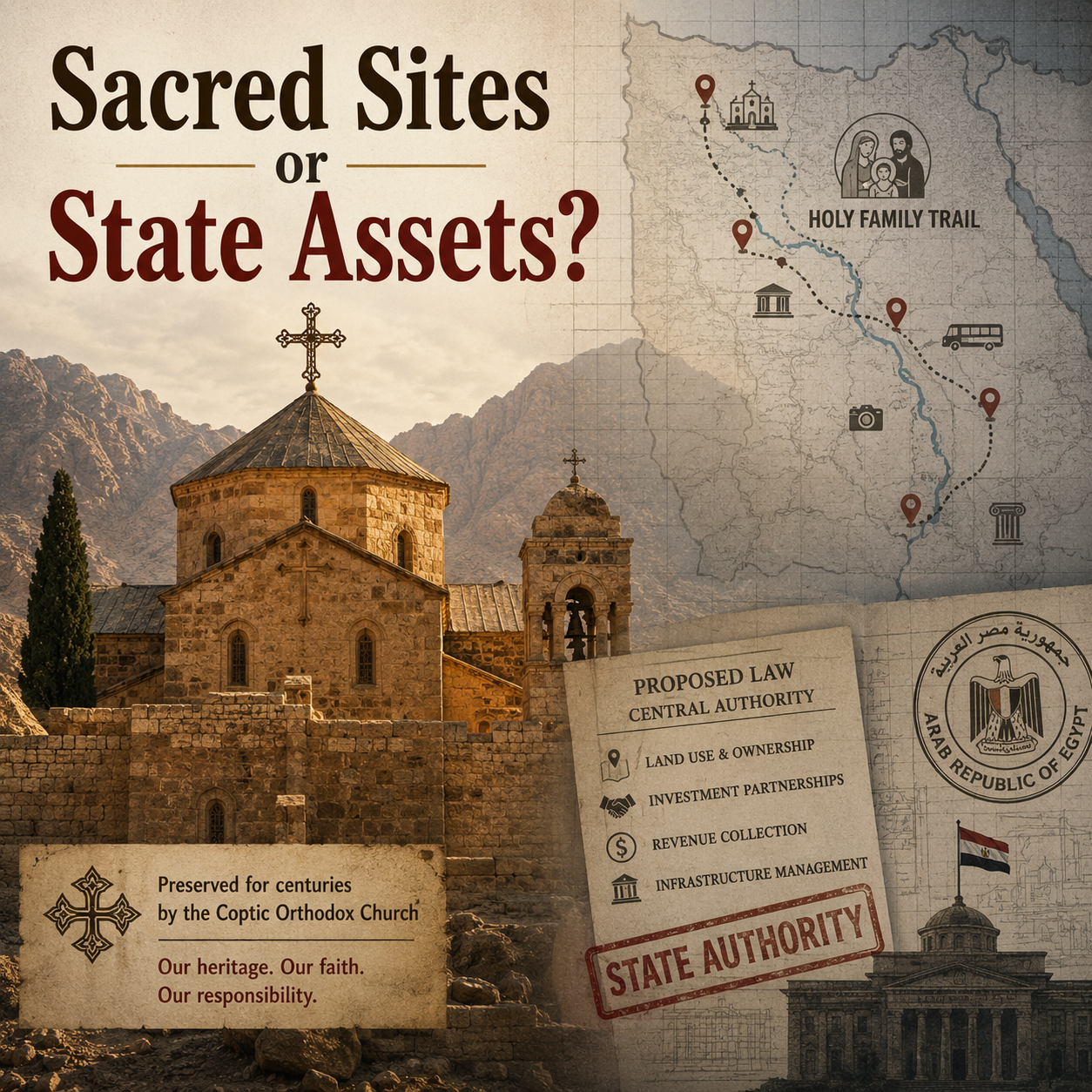
Similar concerns have emerged around Egypt’s proposed legislation governing the Holy Family Trail—the route associated with the flight of Joseph, Mary, and Jesus into Egypt.
The proposed framework would establish a centralized authority reporting to the Prime Minister, endowed with broad powers over land use, investment partnerships, revenue collection, and infrastructure connected to churches and monasteries along the route. The Coptic Orthodox Church—which has preserved and maintained these sites through centuries of persecution and upheaval—would, at best, be reduced to a consultative role in decisions affecting its own sacred inheritance.
Critics describe this not merely as administrative restructuring, but as a far-reaching shift in the relationship between religious presence and institutional control. As one formulation puts it, the process reflects “the separation of religious presence from ownership and control”—a distinction that permits continued worship while relocating authority elsewhere. Noteworthy, is that this same hegemonic logic has been used by the (Muslim) state and the judiciary to alter the historically preserved status of the Saint Catherine’s Monastery.
This distinction is central to understanding the emerging concern. Because the issue is not whether Christian worship will be permitted to continue, but under what conditions that worship will exist: as autonomous custodianship rooted in ecclesiastical authority, or as regulated access within a centralized state framework—dhimma 2.0.
In such a framework, Christian communities may retain ritual access to sacred sites, but lose meaningful authority over land, long-term stewardship, preservation, and development decisions.
The proposed Holy Family Trail legislation especially underscores these concerns. While presented as a cultural and economic initiative highlighting Egypt’s Christian heritage, it empowers state authority to manage investment, collect fees, and structure commercial partnerships across dozens of historic sites. In effect, sacred geography becomes integrated into a coordinated development portfolio—all under the state’s tight control.
The irony, from a historical perspective, is difficult to ignore. The Coptic Church preserved many of these sites through centuries of persecution and neglect. Long before they became assets within tourism economies or instruments of state branding, they functioned as living centers of worship maintained by ecclesiastical communities who bore the burden of their survival.
Now, however, their value has shifted—from sacred Christian sites preserved through centuries of endurance, to assets of economic and political interest for Egypt’s Muslim rulers—hence renewed concern among Copts that the logic of control they once lived under in earlier Islamic frameworks is re-emerging in modern administrative form.
The concern is not that Egypt today formally reinstates classical Islamic legal categories, but that certain underlying assumptions about religious hierarchy and custodianship persist in modernized administrative form—particularly regarding how non-Muslim sacred spaces are governed within a predominantly Islamic state tradition.
Seen from this perspective, the issue is not simply tourism policy or property administration. It is a question of sovereignty over sacred space, and whether the logic of historical dhimmi-like conditionality—Christian presence permitted, but under Islamic control and for Muslim economic gain (jizya)—has been fully displaced, or merely transformed into bureaucratic language.