
By Coptic Solidarity –
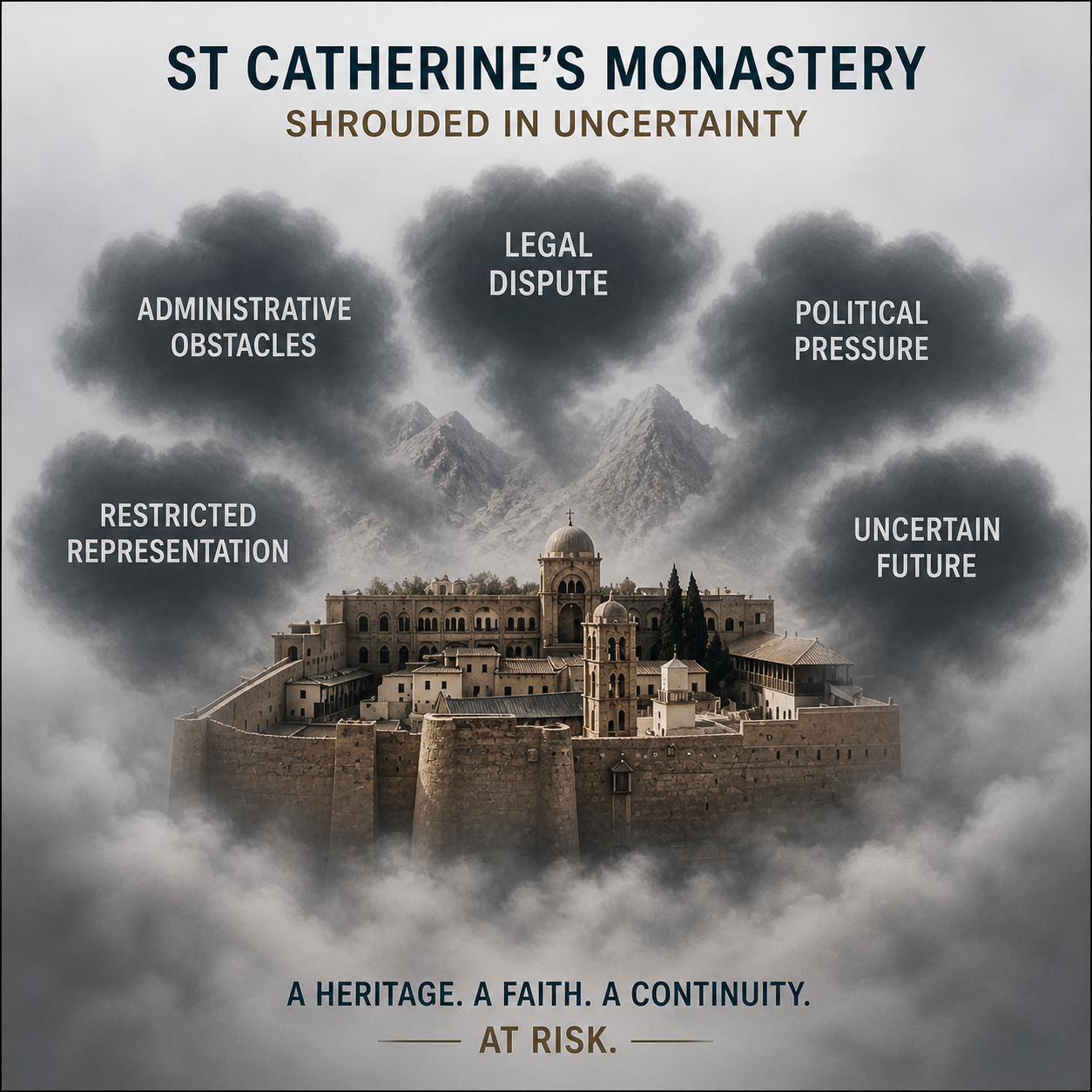
The situation surrounding Saint Catherine’s Monastery has never been a conventional legal dispute. It has evolved into a structured process in which judicial rulings, administrative control, and sustained pressure appear to operate in tandem, progressively redefining the monastery’s status while limiting its capacity to effectively respond.
The pivotal shift occurred with the appellate ruling of May 28, 2025. That decision did not challenge the monastery’s religious presence, and preserved the use of churches, chapels, and monastic facilities. What it did, however, was more fundamental and consequential: it rejected claims to ownership of the surrounding lands, including areas historically associated with the monastery. In doing so, it established a legal framework that separates religious function from property control. The monastery may continue to exist and operate, but without recognized ownership of the land on which its broader life depends. This “use without ownership” model has since become the backbone of the dispute.
Recent developments do not depart from that framework; they may even deepen it. The court session held on April 30, 2026 before the Ismailia Court of Appeal did not reopen the case on its merits. It examined two procedural motions directly tied to the 2025 ruling: a previously filed request for reconsideration submitted by the monastery’s Metropolitan, and a request for “omission” filed by the South Sinai Governorate, arguing that the court failed to rule on certain aspects of the case.
The significance of this step lies in what the “omission” request allows. It is not a neutral procedural correction. It enables the court to supplement its earlier judgment by addressing claims left unaddressed. In practical terms, this creates an avenue through which the logic of the 2025 ruling—already extremely unfavorable to the monastery’s ownership claims—can be extended further. The decision expected on June 30 will therefore not resolve the dispute, but it could consolidate or expand the legal structure already in place. It is a preparatory moment that shapes what, if anything, will later be subject to review before the Court of Cassation.
Constrained Representation
What makes this stage particularly troubling is the condition in which the monastery finds itself as this process unfolds. The newly elected abbot, who alone holds the authority to represent the monastery legally, has yet to receive Egyptian nationality more than seven months after his election. This is not a minor administrative delay. Without formal recognition, he cannot fully exercise legal authority, including the ability to assign powers of attorney. According to accounts from individuals familiar with the proceedings, this has led to a situation in which powers of attorney issued under the previous abbot are reportedly no longer accepted, while the current abbot cannot issue new ones.
The consequence is stark: the monastery’s legal personality is effectively suspended at a moment when its core rights are being adjudicated. Proceedings continue, yet the institution’s ability to direct its own defense is constrained.
Within this environment, representation itself becomes part of the problem. The same accounts indicate that legal representation has been restricted in practice to narrow channels, with resistance to independent legal engagement and reliance on intermediaries whose alignment with the monastery’s interests is questioned. Whether each detail can be independently substantiated, the overall configuration is clear enough: the legal process is advancing under conditions that limit the monastery’s autonomy in defending its position.
This dynamic is reinforced by sustained pressure toward a negotiated outcome that closely mirrors the court’s approach. Proposals reportedly advanced to the monastic community involve transferring ownership of the land to the state while allowing the monks to retain limited rights of use over religious buildings. Such an arrangement would not resolve the dispute so much as formalize the transformation already initiated by the 2025 ruling. Reports further indicate that this process is accompanied by warnings regarding the risks of continued litigation and by efforts to discourage the pursuit of independent legal strategies. The pressure is therefore not separate from the legal process; it operates alongside it, reinforcing the same outcome.
At the same time, official messaging projects reassurance. Statements linked to development plans in the area emphasize respect for religious life, preservation of heritage, and protection of the monastery’s spiritual character. Yet these assurances address only the visible dimension of the issue. They do not engage with the underlying legal transformation, in which control over land—and by extension, over the institutional future of the monastery—is being redefined.
International Dimension
The dispute also carries an international dimension, particularly through the involvement of Greek governmental and ecclesiastical actors. Accounts referenced in recent briefings point to efforts to manage the situation within a constrained diplomatic framework and to limit broader international engagement, given the monastery’s prominent status as a UNESCO World Heritage site. These elements, while not always fully visible in public reporting, underscore the sensitivity of the case and the broader stakes attached to its outcome.
The decision expected on June 30 should therefore be understood for what it is: not the culmination of the dispute, but a step that could further entrench the legal and practical conditions already shaping it. Whether the court maintains, supplements, or partially revisits its previous ruling, the direction remains consistent. The issue is no longer whether the monastery will continue to function—it almost certainly will—but under what terms, and with what degree of independence.
What emerges from the accumulation of these developments is not a series of isolated irregularities, but a coherent pattern. Judicial rulings redefine ownership while preserving outward religious continuity. Administrative delays affect the monastery’s legal capacity at decisive moments. Representation is narrowed in practice. Pressure is applied to align outcomes with a framework already articulated by the courts. These elements do not operate independently; they reinforce one another.
Conclusion
The result is a process in which the transformation of the monastery’s status is not imposed in a single act, but constructed incrementally. By the time a final judicial stage is reached, much of the outcome may already have been shaped—through legal interpretation, procedural conditions, and the constraints placed on the institution’s ability to respond.
The decision expected on June 30 will not settle the dispute, but it may further consolidate this trajectory. Whether the court maintains its previous ruling or extends it through the pending “omission” request, the underlying direction remains clear: the separation of religious presence from ownership and control, and the repositioning of the monastery within a state-defined framework.
These developments unfold as the UNESCO World Heritage Committee prepares to convene its upcoming session in Korea, where draft decisions relating to Saint Catherine’s Monastery are already under consideration. The timing underscores the growing intersection between domestic legal developments and international heritage oversight, raising the prospect that issues currently unfolding in national courts may soon be examined within a global institutional framework.
What is ultimately at stake is not simply land, nor even access to religious sites. It is whether a prominent, unique, and historic religious institution can function as a fully recognized legal subject when the mechanisms that define its status—recognition, representation, and adjudication—are themselves subject to control. The question is no longer only who owns the land surrounding Saint Catherine’s Monastery, but whether the institution itself retains the capacity to defend its rights on equal legal footing.