
By Dr. Craig Considine – MEF –
Pakistan was founded in 1947 partly on the promise of religious equality and pluralism. Muhammad Ali Jinnah envisioned a state in which religion would remain separate from governance and all citizens would enjoy equal status regardless of faith. In his famous August 11, 1947 speech to the Constituent Assembly, he declared that citizens were free to go to their temples, mosques, or any other places of worship, and that religion had “nothing to do with the business of the State.” Early appointments of minority figures to government positions appeared to reflect this vision.
Over the decades, however, Pakistan steadily moved away from this pluralistic ideal and evolved into an increasingly Islamized state. Influenced by Islamist thinkers such as Maulana Abul A’la Maududi, who argued that Muslims required protection from the cultural influence of Christians and other minorities and who rejected Christianity as a valid divine religion, the state gradually institutionalized Islamic supremacy. The 1949 Objectives Resolution declared that Muslims should organize their lives according to the Qur’an and Sunnah, and by 1956 Pakistan officially became the “Islamic Republic of Pakistan.” These developments laid the foundation for a system in which Christians and other minorities became protected in theory but subordinate in practice.
This process intensified under General Zia-ul-Haq’s regime between 1977 and 1988. Zia embedded Islamist ideology into education, law, finance, and public life, ending what some historians described as the state’s neutrality toward minorities. Educational policies became increasingly discriminatory, including curricula hostile to minorities and measures such as compulsory Qur’anic studies without meaningful alternatives for non-Muslims. Despite constitutional guarantees of religious freedom, Pakistan’s Christians experienced growing marginalization within state institutions and society.
The Betrayal of Jinnah’s Vision
Christians today represent roughly 1.5–2 percent of Pakistan’s population, although some church sources claim higher figures. Most are concentrated in Punjab and are descendants of Dalits—formerly “untouchable” communities—who converted to Christianity during the late nineteenth and early twentieth centuries. Unlike many Hindus and Sikhs who left during the Partition of India, most Christians remained in the territories that became Pakistan. At Partition, non-Muslims represented a far larger proportion of the population than they do today, reflecting a dramatic erosion of Pakistan’s pluralistic character.
The condition of Christians is described as a modern form of “neo-dhimmitude,” a contemporary adaptation of the historical Islamic concept of dhimmitude. Under classical Islamic rule, Christians and Jews could remain under Muslim authority as protected but subordinate communities in exchange for paying the jizya tax and accepting numerous legal and social restrictions. In Pakistan, the system no longer functions through a formal jizya tax but through a combination of legal discrimination, ideological suspicion, economic exclusion, and societal pressure. Christians live in a condition of conditional tolerance, where protection depends upon accepting a subordinate status within an Islamic-dominated social and political order.
This neo-dhimmitude is reinforced by the interaction between Islamization and South Asia’s caste system. Although Islam formally preaches equality, caste hierarchies remained deeply embedded in Pakistani society and evolved into what scholars describe as “Islamic castes.” In Punjab especially, social identity continues to be shaped by concepts such as zaat, qoum, and biraderi, which function as markers of caste, clan, or kinship. Questions about caste background remain socially important and often determine access to jobs, marriage opportunities, political representation, and social acceptance.
Most Pakistani Christians occupy the lowest social strata because of their Dalit origins. They are heavily concentrated in sanitation work, manual scavenging, street cleaning, and other degrading occupations. The Urdu term Isai (“Christian”) has become socially associated with sweepers and laborers, reinforcing the stigma attached to Christianity. Christians are thus trapped in a system where religious minority status overlaps with inherited caste-based exclusion. This creates what amounts to an “invisible jizya,” paid not through taxation but through economic exploitation, poverty, and social degradation.
The biraderi system further entrenches exclusion by favoring dominant Muslim kinship networks in employment, politics, and community support. Christians often fall outside these structures and remain marginalized socially and economically. Incidents of coercive conversion to Islam also reinforce their vulnerability. In one case, a prosecutor reportedly offered acquittal to Christian prisoners facing murder charges if they converted to Islam, illustrating how religious and social subordination intersect.
Blasphemy Laws as Instruments of Subordination
Pakistan’s blasphemy laws represent one of the most severe mechanisms through which this system operates. Originally introduced under British rule to preserve communal harmony in a multi-religious society, these laws were later transformed into tools primarily protecting Islam. Under Zia-ul-Haq, new provisions were added to the Penal Code criminalizing desecration of the Qur’an, insults against the Prophet Muhammad, and other acts considered offensive to Islam. The Federal Shariat Court, established in 1980, strengthened the Islamic legal character of the state and helped make the death penalty mandatory in some blasphemy cases.
These laws are widely perceived by Christians as a “hanging sword” constantly threatening their existence. Mere accusations—often arising from personal disputes or rumors—can lead to arrests, prolonged detention, mob violence, or extrajudicial killings. In many cases, the accused spend years in prison before trial. The burden of accusation itself often functions as punishment, regardless of eventual acquittal. Christians therefore live under constant fear of unintentionally provoking allegations that can destroy their lives.
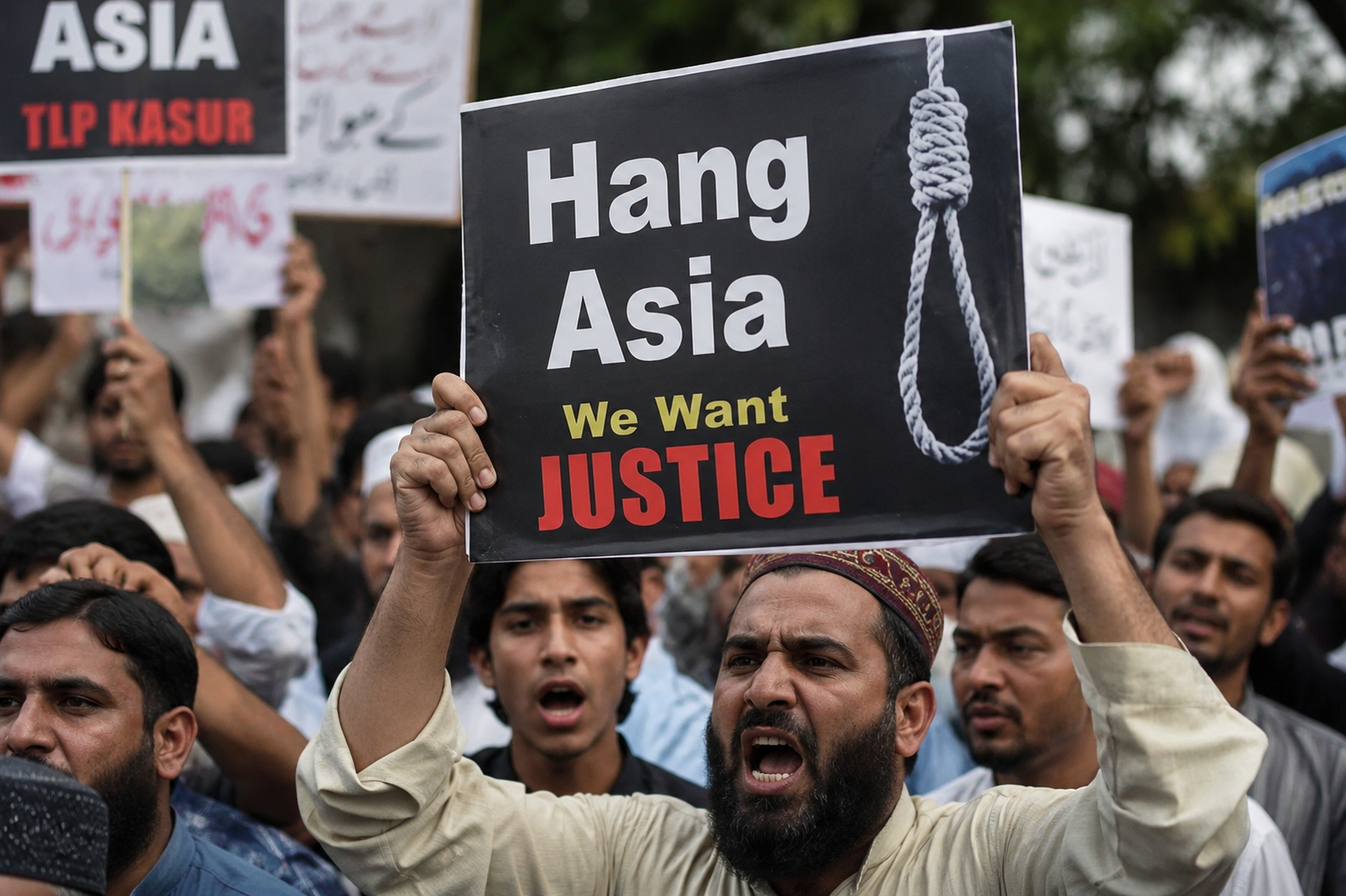
The case of Asia Bibi became one of the most internationally known examples. A Christian farmworker accused of blasphemy after an altercation with Muslim coworkers, she spent years on death row before the Supreme Court overturned her conviction in 2018. Despite her acquittal, massive protests erupted demanding her execution, and she eventually fled the country. Her case demonstrated how blasphemy accusations can expose Christians to both judicial persecution and violent public mobilization.
The dangers extend even to Muslims who defend Christians or call for reform. Salman Taseer, the Governor of Punjab, publicly criticized the blasphemy laws and supported Asia Bibi. In 2011 he was assassinated by his own bodyguard, Mumtaz Qadri. The climate of intimidation became so severe that lawyers and judges feared involvement in blasphemy-related cases. Even the judge who later sentenced Qadri reportedly had to flee Pakistan because of death threats. This atmosphere discourages public criticism of the laws and isolates Christians further.
Blasphemy accusations frequently lead to mob violence against Christian communities. Churches, homes, and neighborhoods have repeatedly been attacked after allegations of Qur’an desecration or insults to Islam. In Jaranwala in 2023, mobs attacked multiple churches and Christian homes after accusations against a Christian resident. Similar incidents occurred in previous years, including church bombings and attacks on Christian localities. Such violence often unfolds with limited protection for the victims and reinforces the perception that Christians remain vulnerable to collective punishment.
Native Yet Alienated: Pakistan’s Christians Today
Beyond legal discrimination and mob violence, Christians are also framed ideologically as representatives of hostile Western powers. Islamist organizations portray Pakistan as a nation whose Islamic identity is threatened by the United States, Israel, India, and Western cultural influence. Because Christians are associated with the West, they are frequently viewed as internal agents of foreign interests. Anti-Western sentiment, especially after events such as the U.S.-led invasion of Afghanistan in 2001, intensified suspicion toward Christian communities. Extremist groups used this narrative to justify attacks against Christians as part of a broader civilizational struggle.
Violence against Christians is therefore presented not only as religious enforcement but also as defense of Pakistan’s Islamic purity and sovereignty. The very name “Pakistan,” often interpreted as “land of the pure,” contributes symbolically to the notion that non-Muslims represent alien or impure elements within society. This framing reinforces the exclusion of Christians from the national identity and casts them as perpetual outsiders despite their deep historical roots in the region.
Addressing these conditions would require dismantling the legal, social, and ideological structures that sustain discrimination against Christians and other minorities. Reforming or repealing the blasphemy laws is presented as especially urgent, although political leaders have generally defended them. Even leaders portrayed internationally as moderate or Westernized publicly embraced the laws domestically. International organizations continue to designate Pakistan as a country of particular concern regarding religious freedom because of systematic violations against minorities.
The persistence of these conditions demonstrates the gap between Pakistan’s founding ideals and contemporary realities. Christians remain indigenous to the land yet marginalized socially, economically, and politically. They are constitutionally protected in theory but vulnerable in everyday life to discrimination, violence, and accusations that can destroy entire communities. The restoration of equal citizenship would require reviving the pluralistic principles articulated at independence and confronting the intertwined systems of Islamization, caste hierarchy, and ideological hostility that have transformed Pakistan’s Christian minority into a permanently subordinated community.
__________________________
Summarized from:
Photo: Protesters gathered outside Pakistan’s Supreme Court in 2018 to demand the execution of Asia Bibi, a Christian farmworker accused of insulting Islam.