
New archaeological findings in northern Sudan have revealed further details of one of medieval Africa’s largest churches, providing striking evidence of the scale and sophistication of the Christian civilization that flourished for centuries along the Nile, across territories now divided between Sudan and southern Egypt.
Although the precise construction date of the Great Church of Jesus has yet to be established, the building belongs to the long Christian era of Makuria, whose origins date to the sixth century. A church added to the complex in the thirteenth century confirms that the principal structure was already standing by that time. The discovery thus illuminates a Christian civilization that flourished in the Nile Valley for some eight centuries, from the sixth to the fourteenth century, before the gradual decline of Christian political authority and the region’s subsequent Islamization.
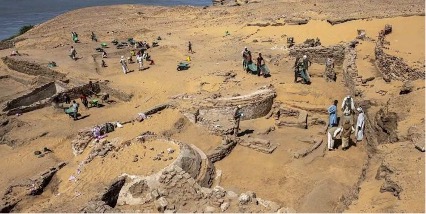
Announced in early November 2026, the findings come from Old Dongola, the former capital of the Christian Kingdom of Makuria. A joint Sudanese-Polish archaeological expedition has uncovered substantial new sections of the Great Church of Jesus, a monumental structure believed to have occupied a central position in the religious life of medieval Nubia.
The discoveries add to the growing archaeological record of a region where Christianity was once the dominant religion, supported by powerful kingdoms, elaborate churches, monasteries, and a rich artistic and literary tradition.
A Monumental Church at the Heart of Christian Nubia
The excavations, conducted by the Polish Centre of Mediterranean Archaeology at the University of Warsaw in cooperation with Sudan’s National Corporation for Antiquities and Museums, are directed by Professor Artur Obłuski.
The Great Church of Jesus was first identified in 2021. Recent excavations have exposed a monumental staircase leading to its entrance, structural supports around the apse, and sections of its original floor, reached for the first time.
According to the researchers, the church measured approximately 57 meters long and 47 meters wide, with an estimated original height of 21 meters—dimensions that place it among the most imposing Christian religious buildings of medieval Africa. Some surviving walls reach 11 meters in height.
Professor Obłuski has suggested that the church may have influenced religious architecture throughout Nubia, comparing its potential architectural importance to that of Hagia Sophia in Constantinople.
The findings may also require historians to reconsider the location of Old Dongola’s principal cathedral. A church outside the city walls had previously been assigned that role, but the scale and central location of the Great Church of Jesus raise the possibility that it occupied a more important position in the ecclesiastical hierarchy.
Only a small portion of the structure has been excavated, and its precise historical function remains under investigation.
The team also uncovered the remains of another church on the upper floor of an adjoining building. Hundreds of fragments of painted plaster, including religious inscriptions in Greek, provide further evidence of the artistic and liturgical sophistication of Nubian Christianity.
Among the inscriptions are fragments of biblical hymns, including the Prayer of Hannah, mother of the prophet Samuel, from the Old Testament. These discoveries illuminate the use of biblical texts in Nubian worship and the region’s connections with the wider Christian world.
Nubia: A Major Center of African Christianity
The significance of the discoveries extends far beyond the dimensions of a single church.
Christianity became established in Nubia during the sixth century, giving rise to three major Christian kingdoms: Nobadia in the north, Makuria in the center, and Alodia farther south. Makuria subsequently incorporated Nobadia, creating a powerful Christian state extending across much of the Nile Valley in what is now northern Sudan and southern Egypt.
Old Dongola became Makuria’s political and religious capital, a center of royal authority, ecclesiastical organization, scholarship, and artistic production.
Nubian Christianity maintained close historical ties with the Church of Alexandria, while developing its own distinctive religious and cultural traditions. Greek, Coptic, and Old Nubian were used in religious and literary contexts, reflecting a sophisticated multilingual civilization.
The Christian kingdoms also demonstrated considerable political and military resilience. During the seventh century, Nubian forces resisted Arab-Muslim expansion southward from Egypt. The resulting Baqt agreement, traditionally dated to 652, helped establish a framework for relations between Muslim Egypt and Christian Makuria that endured, in changing forms, for centuries.
Christian political authority and religious institutions survived in parts of Nubia long after the Islamic conquest of Egypt. Makuria remained an important Christian kingdom until its gradual weakening and political transformation during the later medieval period, particularly in the thirteenth and fourteenth centuries. The decline of Christian political power was followed by a prolonged and uneven process of Islamization.
The churches, monasteries, paintings, inscriptions, and other archaeological remains of Nubia are therefore witnesses to a Christian civilization that shaped the region’s history for many centuries.
Rediscovering a Neglected Chapter of African History
The discoveries at Old Dongola challenge simplified historical narratives that overlook the depth and duration of Christianity’s presence in the Nile Valley south of Egypt.
They reveal not an isolated Christian outpost but a civilization capable of constructing monumental religious buildings, sustaining complex ecclesiastical institutions, producing sophisticated religious art, and maintaining political independence over extended periods.
The newly uncovered Greek inscriptions are particularly valuable because they illuminate the intellectual and liturgical life behind the monumental architecture. Together with discoveries elsewhere in Nubia, they demonstrate that Christianity was deeply rooted in the region’s cultural and political identity.
The excavations also underscore the importance of protecting Sudan’s archaeological heritage, particularly amid the country’s continuing conflict and environmental threats. The Old Dongola team has undertaken conservation work following severe flooding in 2024 and supported nearby communities through solar-powered water infrastructure serving approximately 10,000 residents.
The broader significance of the Great Church of Jesus lies in what it reveals about the historical identity of the Nile Valley. Long before the region acquired its predominantly Islamic character, Christian kingdoms flourished there for centuries, leaving an extensive architectural, artistic, and literary legacy.
The ongoing excavations are gradually bringing that legacy back into view—not as a marginal episode in African history, but as an integral part of the continent’s religious and civilizational heritage.
__________________
Sources: