
By Raymond Ibrahim – Coptic Solidarity –
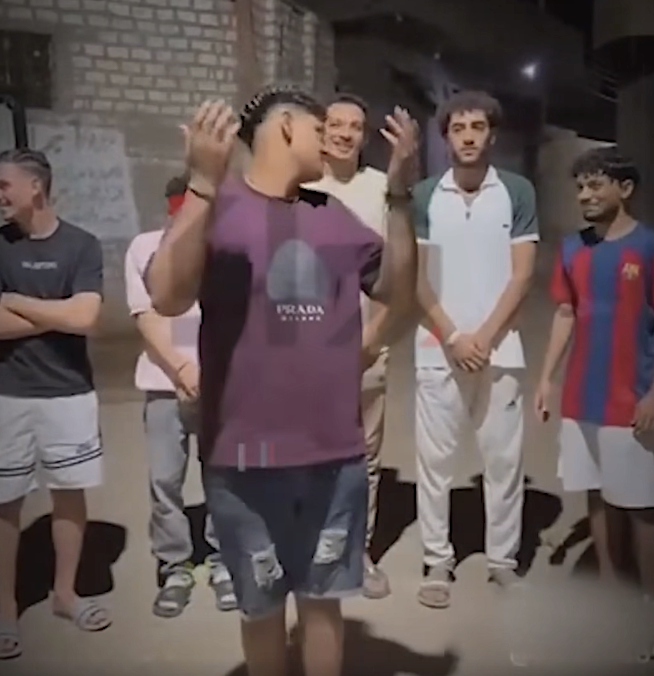
Six young Coptic Christians—aged 17 to 23—have now spent more than two weeks behind bars in Egypt for reenacting a scene from a comedy film. Their alleged offense: insulting Islam.
The young men used audio from a popular Egyptian comedy, approved by the nation’s own authorities, to act out a scene involving prisoners unfamiliar with Islamic prayers. What Muslim viewers can enjoy as entertainment became, when performed by these Christians, grounds for arrest.
The six live in Ezbet Tanious, in Minya’s Samalout district. The film, Khalawis, appeared in Egyptian cinemas in 2018 and continues to be broadcast on satellite television. Its production received censorship approval before filming. Moreover, hundreds of TikTok videos recreate the same scene using the same soundtrack.
Yet these six young men found themselves before the Supreme State Security Prosecution.
Consider how a spontaneous joke became a security case.
On October 4, they uploaded their video to TikTok. Within hours, after friends warned them, they removed it. But a village resident had reposted it with denunciatory comments. Hostile Muslim responses followed, targeting the young men, their relatives, and the village’s Christians generally. Some demanded arrests; others called for violence against the men and their families.
Deleting the clip could not undo its circulation. The families were left trying to protect their sons while fearing what might happen to the wider community.
To diffuse the situation—which, based on precedent, could have gotten murderous—on October 6, relatives and church representatives delivered five of the young men to Samalout Police Station, including for protection. Police promised to release them when tensions subsided.
The account of one detainee is particularly disturbing: he told prosecutors that he surrendered after police arrested his mother in his place.
On October 9, village elders, government-affiliated Muslim clerics, and Coptic priests attended a customary reconciliation meeting. The Diocese of Samalout formally apologized to the village’s Muslim residents.
That was not enough to release the young men back home.
On October 10, state security prosecutors questioned them and ordered four days’ detention. The following morning, a judge extended detention by fifteen days. Accusations included contempt of religion, blasphemy, and exploiting religion to promote extremist ideas.
Thus a comedy reenactment becomes blasphemy and extremism.
Nor is this the first time young Copts have discovered that laughter can cost them their liberty.
In April 2015, I reported on Christian students and their teacher, Gad Yunan, arrested over a brief video mocking ISIS. The boys imitated jihadists praying and pretending to slit a victim’s throat.
Local Muslim demonstrators responded by attacking Christian homes and businesses. Yunan was driven from his village in an effort to appease the anger. One Christian shopkeeper described families remaining indoors for days, afraid to send their children to school or attend church—even for Easter.
The Christians had mocked a terrorist organization. Their neighbors treated that mockery as an attack on Islam.
In an April 2016 follow-up, I described the consequences: three teenagers received five-year prison sentences; a fourth was ordered into juvenile detention. Their teacher received three years. The Muslim judge had imposed the maximum punishment.
More than a decade later, the resemblance is unmistakable: a short video, accusations of religious insult, threats against Christians, efforts at appeasement, and prosecution of the people whose speech provoked the threats.
The latest arrests also belong to a continuing crackdown on Christian expression online.
On October 5—between the TikTok upload and the young men’s surrender—Egyptian National Security forces arrested Sherif Wagih Fahmi, a forty-one-year-old Coptic engineer, at his Alexandria home.
Officers arrived at about 1 p.m. with two military-grade vehicles. Fahmi faces an accusation of contempt of Islam. The organization attributed the arrest, citing informed sources, to Facebook posts he had shared in preceding weeks.
The precise posts underlying the accusation were not established in that report. But an anonymous Christian clergyman quoted by the organization said Fahmi had criticized the Islamization of education and interpreted his arrest as intimidation. He invoked an Egyptian proverb: “Beat the one who is tied up to frighten the one who is free.”
That is the wider injury inflicted by these prosecutions. Every arrest reaches beyond the individual detained. Others learn to refrain from speaking their mind and remain silent.
Then there is Dr. Augustinos Samaan, the Coptic researcher and Christian apologist sentenced to five years’ imprisonment with hard labor.
Samaan’s YouTube channel had more than 100,000 subscribers. His videos answered questions about Christianity, compared Christianity and Islam, and included theological and philosophical criticism of Islam.
Those activities brought charges of contempt of religion and misuse of social media.
Coptic Solidarity’s case brief describes masked officers arresting him in the early hours of October 1, 2025, and confiscating his laptop, telephone, books, and personal papers. It also notes reports of torture, mistreatment, and abuse in detention—all of which warrant but have not received independent investigation.
The account of his prosecution is scarcely less disturbing. His family and lawyers arrived at court on January 6 expecting a detention-renewal hearing, only to discover that he had already been tried and sentenced. They had received no notification of the proceedings.
According to an August update, the sentence was imposed on January 3, upheld on February 23, and is now subject to a cassation challenge scheduled for November 15. His defense did not obtain access to the case file until February 11—after conviction.
These cases involve different kinds of expression: a comic performance, shared Facebook posts, and sustained religious argument. Their differences make the common problem clearer. Christians in Egypt cannot know whether a joke, a criticism, or a defense of their own beliefs will be recast as a criminal insult.
Egypt’s authorities have a straightforward choice. They can protect citizens threatened over peaceful expression, or teach those making the threats that intimidation works.
For the six young men still awaiting freedom, that choice has already acquired a painfully concrete meaning: a comedy scene available on Egyptian television has become a reason to keep them in a cell.