
By EIPR-
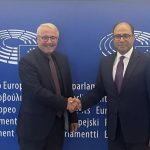
At the invitation of the European Parliament, Hossam Bahgat, Executive Director of the Egyptian Initiative for Personal Rights (EIPR), addressed the Subcommittee on Human Rights (DROI) on September 2. The session was dedicated to presenting the findings and report of the Subcommittee’s official delegation visit to Egypt, led by chair Mounir Satouri, in July.
The session also featured contributions from Amnesty International, representatives from the European Commission’s Middle East division, the European External Action Service, as well as members of the delegation and representatives from the European Parliament’s political groups.
In his address, Bahgat emphasized that recent external economic and financial support, alongside diplomatic initiatives, has not yielded positive improvements in Egypt’s human rights landscape. On the contrary, the country has witnessed a sustained and deepening human rights crisis marked by systemic abuses.
EIPR highlighted seven key areas reflecting the deterioration of human rights over the past year:
- Political Arrests and Expanded Indefinite Pretrial Detention: Thousands remain detained, with new arrests on political charges. Pretrial detention continues to be used as a punitive measure against critical and dissenting voices, with zero presidential pardons for political prisoners issued in the last year.
- Arbitrary Measures Against Human Rights Defenders: The ongoing use of travel bans, asset freezes—including three EIPR directors for nearly six years—designations on “terrorist lists,” and funding restrictions aimed at stifling independent civil society.
- Continued Censorship of Independent Media: Persistent website blocking and security harassment that have pushed Egypt to the lowest international rankings for press freedom.
- Prosecution Based on “Morality,” Religious Beliefs, and Targeting of the LGBTQ+ Community: Escalating campaigns of arrest under the pretext of protecting “family values” or “contempt of religion,” alongside a rise in the targeting of LGBTQ+ individuals.
- Decline in International Rankings: Over the past year, Reporters Without Borders ranked Egypt 169th out of 180 countries, while the Committee to Protect Journalists consistently lists Egypt among the world’s top six jailers of journalists. Egypt ranks 135th out of 142 in the Rule of Law Index, 130th in Transparency International’s Corruption Perceptions Index, and is among the 10 worst countries in the World Economic Forum’s gender gap index.
- Deterioration of Economic Rights: The severe burden of high inflation, the removal of subsidies on fuel and essential goods, and a national budget that prioritizes debt repayment over health, education, and wages—all of which have fueled labor protests.
Bahgat criticized the recent report from the European Commission, which—despite these objective international indicators—concluded that Egypt had made “concrete and credible” steps in the human rights domain, satisfying the precondition for the release of a €1.5 billion tranche of a €5 billion loan in July.
Bahgat concluded his remarks by stating:
“Egypt is on a dangerous path. The systemic closure of legal and peaceful channels for dissent, organizing, expression, or political participation—compounded by acute poverty and stark inequality—is turning the country into a ticking time bomb. This risk is particularly acute given that 60% of Egyptians are under the age of 30. This demographic majority has grown up under a ‘republic of fear,’ where life is defined by a constant struggle for survival and a total lack of future prospects. History teaches us that such conditions are the primary recipe for instability.”
____________________