
By Coptic Solidarity
Effective advocacy for persecuted communities is rarely dramatic. It is slow, often unglamorous, and built on credibility accumulated over time rather than moments of visibility. Yet in Washington and other policy centers, advocacy is too often reduced to access, public statements, or high-profile meetings that generate attention but produce little lasting change.
For communities like the Copts of Egypt—who face systemic discrimination, periodic violence, and structural barriers to equal citizenship—this distinction between meaningful long-term advocacy and advocacy theater is consequential.
The importance of serious, sustained work was underscored again on January 28, 2026, when the U.S. Commission on International Religious Freedom (USCIRF) reiterated its recommendation that the U.S. State Department place Egypt on the Special Watch List due to ongoing and systematic violations of freedom of religion or belief. Determinations of this kind reflect years of research, corroboration, and trusted institutional relationships—not isolated meetings or short-term campaigns.
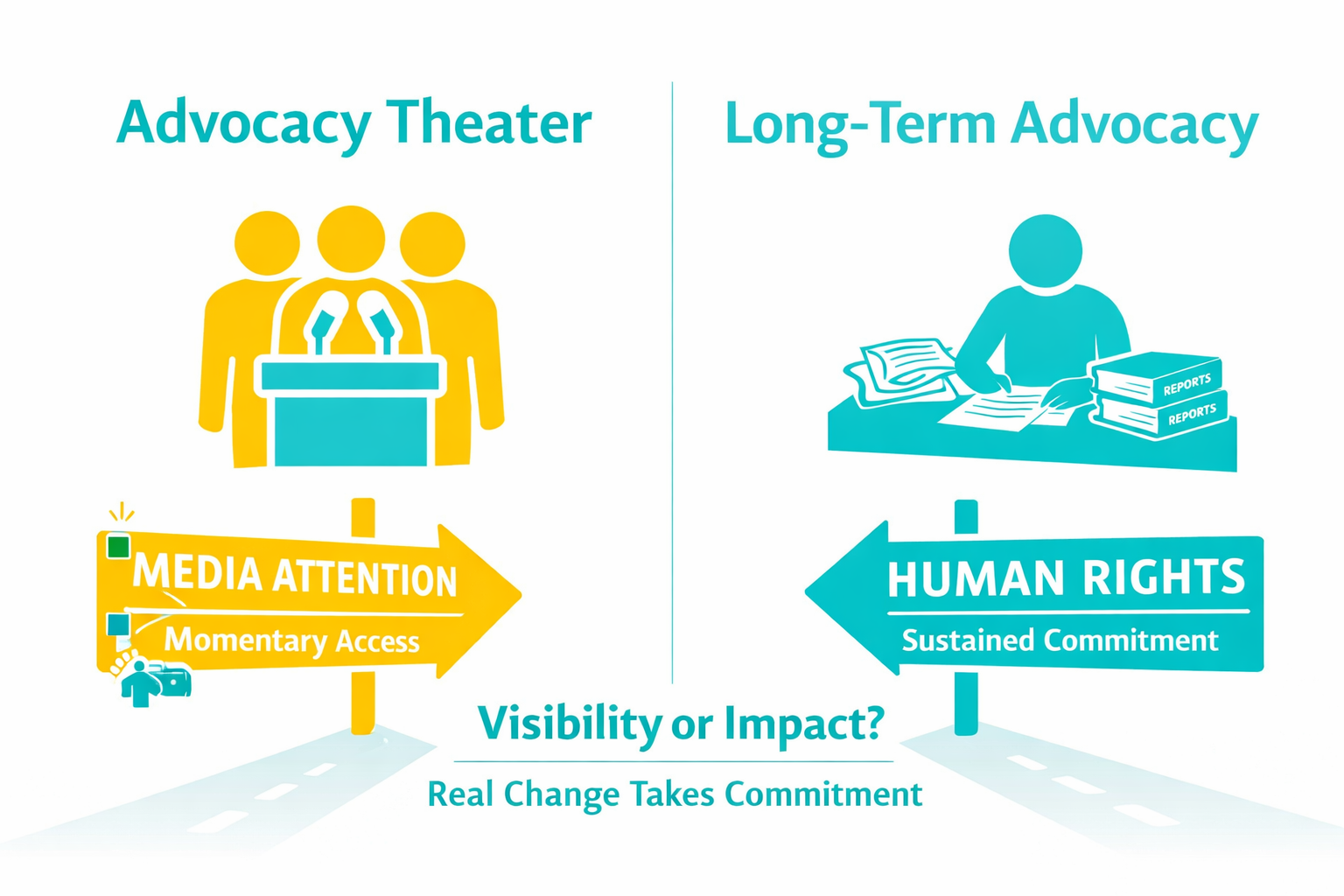
Visibility vs. effectiveness
Advocacy theater often emphasizes optics: meetings with senior officials, publicized visits, media appearances, and symbolic gestures that demonstrate access. However, without follow-through and reliable information, these activities rarely shape policy.
Effective advocacy requires long-term relationships with professional staff, credible case documentation, clear policy recommendations, and a willingness to challenge inaccurate narratives. It is cumulative work that gradually shapes how institutions understand an issue and ensures decisions are grounded in reality.
Why access alone does not produce change
Access to powerful officials is often mistaken for influence. In reality, access is transient. Administrations change, political priorities shift, and commissioners and staff rotate. Relationships built solely on proximity to power rarely endure long enough to produce structural change.
Lasting influence comes from being recognized across administrations as a reliable source of information and analysis. For vulnerable communities, whose needs do not disappear when attention fades, advocacy must be structured to outlast political cycles.
How long-term engagement improves official reporting
This kind of credibility produces measurable results. Over time, sustained research and engagement have helped improve how conditions facing Copts are reflected in official U.S. reporting.
As far back as 2014, Coptic Solidarity started publishing annual analyses of the USCIRF and U.S. State Department’s religious freedom reports on Egypt, providing ongoing accountability and evidence-based critique that contributed to improvements in accuracy and scope.
One of the most serious omissions in U.S. reporting for years was the systematic luring, abduction, forced conversion, and forced marriage of Coptic women and minor girls. Coptic Solidarity documented this crisis for over a decade, including providing Congressional testimony as early as 2011 and the landmark publication in 2020 of thereport Jihad of the Womb. Only in 2021 did USCIRF begin explicitly acknowledging the phenomenon.
The U.S. State Department first explicitly acknowledged the targeting and disappearance of Coptic women and girls in its annual International Religious Freedom Report in 2023, after years of documentation and advocacy that made omission increasingly untenable.
Similarly, discrimination against Copts in sports—long evident in exclusion from national teams and elite clubs—was incorporated into both USCIRF (2021) and State Department (2022) reporting following extensive research and engagement with institutions including FIFA and the IOC.
These changes did not result from isolated campaigns or brief access to officials. They emerged from years of credible information, detailed casework, and sustained institutional engagement.
Reputation laundering and episodic advocacy
The limits of superficial advocacy become particularly clear when authoritarian governments invest heavily in shaping international perception. Egypt offers a notable example.
Over the past decade, several prominent Evangelical leaders and public figures visited Egypt, met with President Abdel Fattah el-Sisi, and returned to the United States speaking enthusiastically about supposed improvements in religious freedom. Their remarks were widely publicized and reinforced a narrative of progress.
One of the most visible moments occurred at the 2019 Ministerial to Advance Religious Freedom in Washington, D.C., when an Evangelical leader was given a prominent platform and portrayed Egypt as a regional leader in religious freedom—claims that aligned closely with official Egyptian messaging. The results were naturally minimal.
Many of the same figures who spoke positively on Egypt paid little attention to the disappearance of Coptic women and girls, discriminatory church construction policies, blasphemy prosecutions, or imprisonment of converts and other prisoners of conscience.
If their engagement had reflected a long-term sincere commitment to religious freedom and human rights, it would not have ended when media attention faded.
Misrepresentation through access
A related concern persists in Washington.
Rev. Andreas Zaki, head of the Protestant Churches of Egypt, continues to receive access to U.S. legislators and officials , where he presents himself as an independent representative of Egypt’s Christian community. At the same time, he is registered under the U.S. Foreign Agents Registration Act as a foreign agent for Egypt.
These realities cannot be reconciled. A registered foreign agent for an authoritarian government cannot credibly represent a persecuted minority within that same system. Allowing such representation to stand unchallenged risks distorting policymaker understanding and sidelining independent civil society voices.
Building capacity for lasting impact
Long-term effectiveness depends on institutional capacity: the ability to document cases, analyze patterns, engage policymakers consistently, and maintain credibility across political cycles. This capacity allows advocacy across interconnected issues—from legal discrimination and violence to trafficking, and foreign influence operations.
Over time, sustained research has also shaped broader understanding. Increasingly, policymakers and scholars refer to Copts as Egypt’s indigenous Christians and recognize their situation within a wider framework of equal citizenship and minority rights. Such shifts rarely result from episodic attention; they emerge from years of credible engagement.
Refocusing on what works
If advocacy is to produce meaningful change, it must prioritize impact over visibility. Short-term access may create the appearance of influence, but without continued engagement it rarely produces lasting results.
Advocates must ask:
- Does this engagement produce lasting change or only attention?
- Does it reinforce accurate information or convenient narratives?
- Does it continue when media interest fades?
Communities facing systemic discrimination need advocates who remain engaged regardless of visibility or political cycles.
Conclusion
The most effective advocacy is rarely the most visible. It is built through careful documentation, institutional credibility, and persistence. It continues when attention shifts elsewhere and measures success by tangible improvements in people’s lives.
For communities like the Copts—whose challenges are structural and ongoing—the recent USCIRF recommendation that Egypt be placed on the Special Watch List reflects years of sustained work by credible actors. Such developments are the product of long-term engagement, not short-term visibility.
Only that kind of principled advocacy produces meaningful, lasting change.