
By Coptic Solidarity
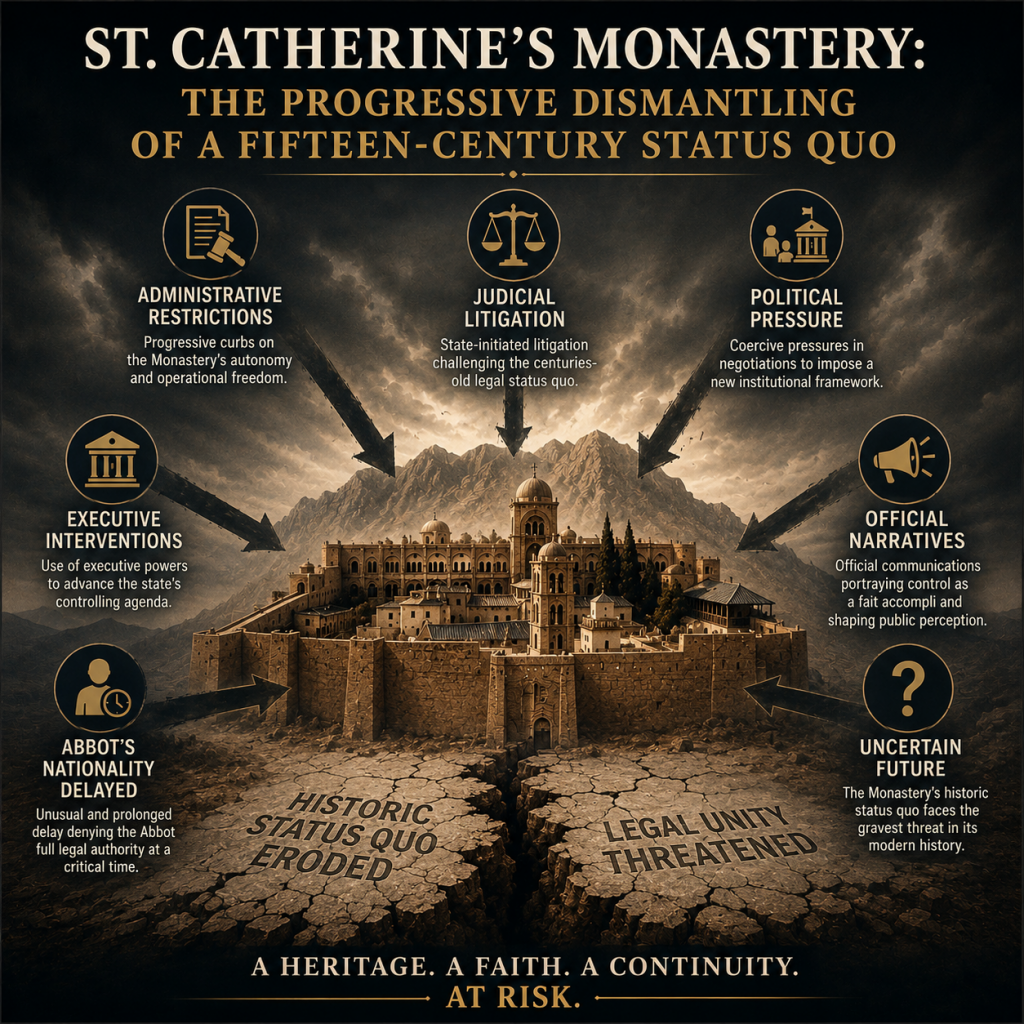
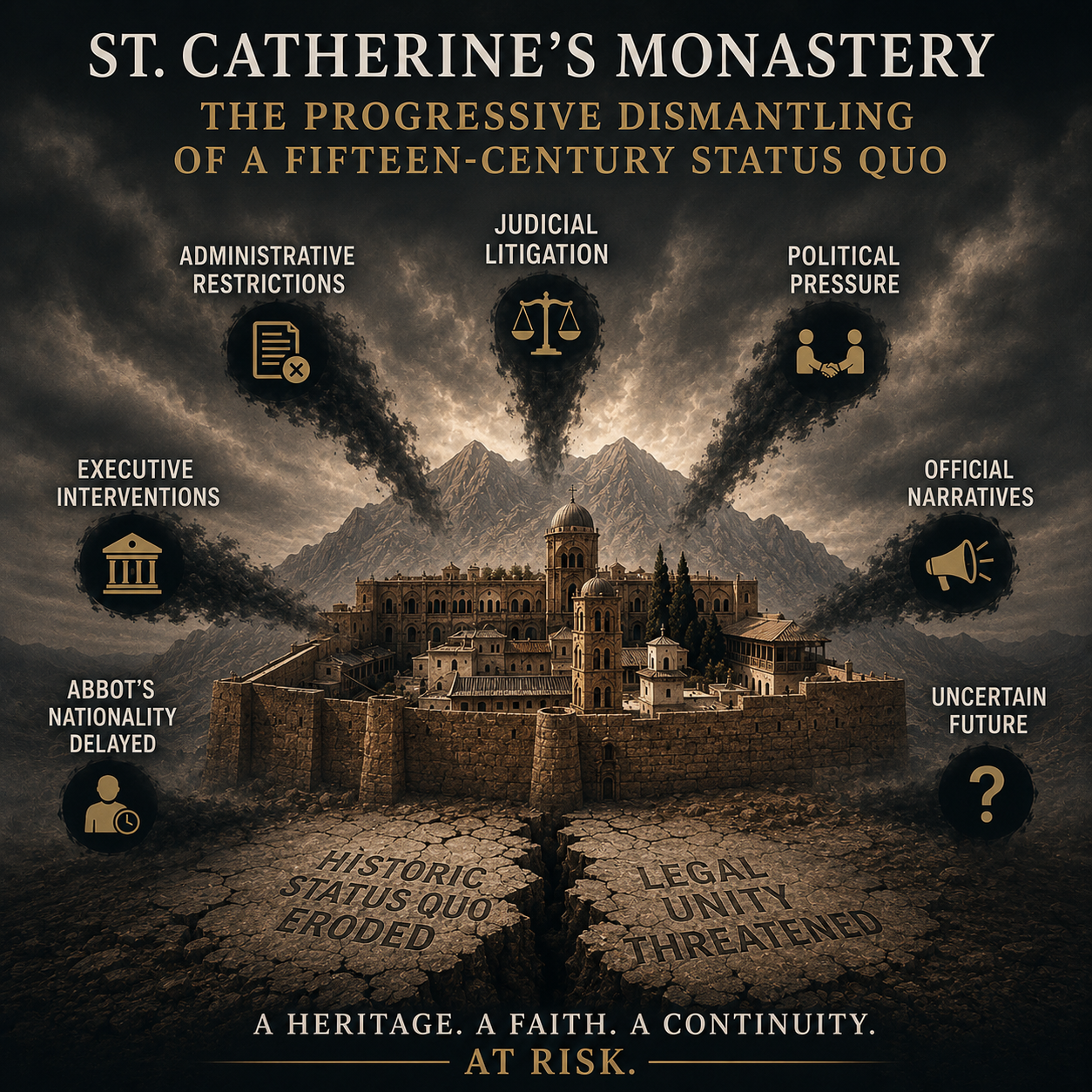
This report argues that the current crisis surrounding St. Catherine’s Monastery is not an isolated property dispute but the culmination of a decade-long process through which successive instruments of state authority have progressively challenged the centuries-old legal and institutional order governing one of the world’s oldest continuously functioning Christian monasteries.
***

St. Catherine’s Monastery in Sinai is confronting the gravest challenge to the status quo under which it has existed for more than fifteen centuries. Nearly a year after the election of Archbishop Symeon as Archbishop of Sinai, Pharan and Raithu and Abbot of the Monastery, the presidential decree conferring Egyptian nationality and full legal authority upon him has still not been issued. Such prolonged delays are highly unusual and have left the Monastery without the full legal capacity of its leader at the very moment it faces the most serious challenge to its historic legal status in modern times.
This delay should not be viewed as an isolated administrative matter. It is the latest manifestation of a much broader process that continued over the past decade through successive judicial, executive, administrative and political measures which have progressively challenged the centuries-old legal and institutional order under which the Monastery has existed for more than fifteen centuries.
Throughout its long history, St. Catherine’s Monastery survived empires, dynasties, invasions, wars, and successive political regimes. The irony is that one of the gravest threats to its legal and institutional continuity has emerged not during those turbulent centuries, but in the twenty-first century, under a government that promotes itself internationally as a protector of religious coexistence and cultural heritage.
St. Catherine’s is one of UNESCO’s most emblematic World Heritage Sites and one of humanity’s most remarkable historical, cultural and religious institutions. Changes affecting its centuries-old legal status therefore cannot be regarded as an exclusively domestic matter.

How the Crisis Was Engineered
The present crisis did not arise from a dispute over land or property. On the contrary, it originated with litigation initiated by the Egyptian state itself against a centuries-old status quo that had governed the legal and institutional position of St. Catherine’s Monastery for generations.
The litigation marked the beginning of a gradual process through which different instruments of state authority came to reinforce one another. Judicial proceedings, administrative decisions, executive action and political negotiations did not evolve independently. Over time, they formed a cumulative sequence in which each new development progressively weakened the Monastery’s position while increasing the Egyptian state’s leverage.
The negotiations between the Monastery, the Egyptian authorities and the Greek government provide the clearest illustration of this pattern.
According to the detailed chronology recently published in Greece—largely based on the testimony of former Archbishop Damianos—Egyptian officials repeatedly informed him in advance of forthcoming postponements of court hearings and of developments in the judicial process. Whether these communications were intended as reassurances or as part of the negotiation process, they created the unmistakable impression that the pace of the litigation and the political discussions were closely interconnected.
After years of negotiations, the parties reportedly reached agreement in principle early in 2025, offering what appeared to be a mutually acceptable resolution of the dispute. Former Archbishop Damianos has stated that he was expecting the agreement to be finalized during President Abdel Fattah el-Sisi’s official visit to Athens, where a meeting had been anticipated to mark the conclusion of the process. That meeting never took place.
Instead, according to the same account, the Egyptian authorities unexpectedly introduced new conditions affecting the Monastery’s institutional position and declined to proceed with the agreement that had previously been accepted in principle. The anticipated settlement never materialized. Shortly thereafter, the judicial proceedings resumed and culminated in the Court of Appeal’s ruling, fundamentally altering the Monastery’s legal position and bringing negotiations to an abrupt end.
This sequence of events is central to understanding the present crisis. Viewed as a whole, the chronology reveals a consistent progression in which each successive development reinforced the practical effect of the previous one, progressively challenging rather than preserving the centuries-old status quo.
The same pattern appears to be reflected in the Egyptian government’s public presentation of the Monastery. During a recent official visit, the Minister of Culture received a detailed briefing on restoration works being carried out at the Monastery before directing that the works be completed according to the established timetable in order to preserve the site’s historical, religious and human value. While such language may appear routine, it also conveys the image of a state authority exercising direction over a site whose centuries-old status quo has historically recognized the Monastery itself as the sole authority responsible for its own buildings, treasures and internal affairs.
Because the Monastery continues to reject arrangements that would fundamentally alter its historic legal status, such official messaging risks conveying the impression that the legal and institutional order long sought by the authorities is gradually being treated as an established administrative reality.
The situation of the Monastery’s leadership fits within the same chronology. Nearly a year after the election of Archbishop Symeon, the presidential decree conferring full legal authority upon him remains outstanding. The delay is exceptional and cannot reasonably be viewed in isolation from the broader sequence of events that preceded it.
Egyptian officials have recently continued to reassure foreign interlocutors that negotiations remain active. If that was the case, it is to be noted that no meaningful negotiations can realistically be regarded as free of coercion while, at least, the new Archbishop has not received the presidential decree conferring Egyptian nationality and the legal authority required to represent the Monastery.
Recent reports from Greece further indicate that the Monastery’s Brotherhood itself continues to resist any settlement that would require relinquishing the Monastery’s historic legal rights in exchange for mere rights of possession or use. This continuing resistance underscores that the central issue remains the preservation of the centuries-old legal status rather than the conclusion of an agreement at any cost.
The Crisis Reaches A Decisive Stage
Recent developments indicate that the crisis has now reached a decisive stage. Following months during which Archbishop Symeon has remained without the presidential decree traditionally issued shortly after the election of each new Archbishop—and required to confer the legal authority necessary to represent the Monastery before Egyptian authorities— he has remained unable to exercise the legal functions indispensable to the defense and administration of the Monastery, including appointing legal counsel, granting powers of attorney to represent the Monastery before the courts and public authorities, or even accessing the Monastery’s bank accounts. It was under these circumstances that the Egyptian government reportedly presented him last week with a draft agreement that would fundamentally redefine the Monastery’s historic legal status.
Under the reported terms, the Monastery would relinquish its historic ownership rights and instead be recognized merely as an Egyptian religious legal entity enjoying rights of possession and religious use. Its surrounding gardens and agricultural lands would remain under state ownership and be leased back to the monks under long-term symbolic rental agreements. At the same time, neither the Archbishop nor the monks would be granted Egyptian nationality, but only renewable residence permits.
Archbishop Symeon reportedly declined to sign the proposal and instead referred it to the Brotherhood for consideration. The Brotherhood has so far resisted any arrangement requiring the surrender of the Monastery’s historic legal rights in exchange for mere possession or use.
These new demands mark not a resolution of the crisis, but the culmination of a decade-long process through which successive judicial, administrative and political measures progressively weakened the Monastery’s legal position before seeking its acceptance of a fundamentally altered legal order. Rather than preserving the centuries-old status quo, the proposed agreement would formalize its eradication.
An Overwhelming Structural Imbalance
The chronology demonstrates that what may appear to be isolated judicial, administrative and political developments in fact form part of a cumulative process challenging the centuries-old status quo.
The resilience of that centuries-old legal order is illustrated by the conduct of successive governments across radically different political eras. For example, following flood damage in 1798, General Kléber of the French Expedition ordered the restoration of the Monastery’s northeastern tower, commemorated by a marble inscription that remains in situ. The Monastery also preserves Napoleon Bonaparte’s 1799 proclamation to its monks, expressly reaffirming all privileges previously granted to the Monastery and exempting it from customs duties on goods imported and exported for its use. In doing so, Napoleon explicitly recognized the Monastery’s pre-existing legal and economic status, adding yet another historical example of rulers acknowledging the Monastery as an existing rights-holder rather than merely permitting its occupation or exploitation.
This distinction is critical. The fundamental question is whether the historic legal status and institutional order will survive in the form in which it has long existed, or whether it will be replaced by a new order in which the Monastery’s legal authority, governance and future become increasingly subject to the authority and discretion of the Egyptian state.
The chronology described above points to a consistent pattern. State-initiated litigation challenged the centuries-old status quo. Lengthy negotiations created the expectation that the Monastery’s historic legal status would ultimately be preserved. Those expectations were then overtaken by new conditions, the collapse of the anticipated agreement and judicial rulings that fundamentally altered the Monastery’s legal position. Most recently, the prolonged withholding of the presidential decree conferring Egyptian nationality and full legal authority upon the newly elected Archbishop has further restricted the Monastery’s ability to defend its interests during one of the most critical periods in its history.
The continued delay in issuing the presidential decree should be understood in precisely that context. The decree is not, in itself, the objective. Even if it were issued tomorrow, the fundamental imbalance would remain. The litigation would continue. The Court of Appeal’s ruling would remain in force. The uncertainty surrounding the Monastery’s future legal status would persist. The underlying question would therefore remain unchanged: whether the centuries-old status quo will continue to govern the Monastery’s existence, or whether it will gradually be replaced by a fundamentally different legal and institutional order.
The imbalance is no longer confined to the courtroom. It is increasingly reflected in the Egyptian state’s public administration of matters relating to the Monastery, reinforcing the impression that the relationship long sought by the authorities is already being presented administratively as though it were an accomplished fact.
Recent Greek press reports indicate that the negotiations may now be moving toward an arrangement that would formalize precisely the transformation at the heart of the present crisis. According to these reports, the proposed agreement would recognize ownership of the Monastery’s buildings, installations and related sacred sites as belonging to the Egyptian state, while granting the Monastery possession and use in perpetuity. If accurately reported, such a formula would not preserve the centuries-old status quo. It would replace historic ownership and institutional autonomy with a state-recognized right of use, leaving the Monastery dependent upon a fundamentally different legal order created under the pressure of litigation initiated by the Egyptian state.
This development should not obscure the source of the crisis. Greece is not reported to be a contracting party to the agreement, and its role appears to have been that of a state seeking to avert further damage after Egypt’s judicial and administrative actions had already placed the Monastery under extraordinary pressure. Responsibility for the present situation therefore remains squarely with the Egyptian state, whose litigation, judicial victories, administrative measures, delayed approvals and resulting negotiating leverage have progressively shifted the balance against the Monastery.
No private institution—however ancient, respected or internationally recognized—can reasonably be expected to negotiate on equal terms with the full judicial, executive and administrative machinery of a state. The disparity of institutional power is simply too great. The Monastery may defend its position with determination, but it cannot, acting alone, restore a balance that has progressively shifted over many years through successive actions of different state institutions.
The imbalance between a monastic community and the power of a state is overwhelming. For that reason, the present crisis can no longer be regarded as one the Monastery can realistically resolve through negotiations conducted in isolation.
The implications extend beyond the fate of a single religious institution. If the centuries-old status quo governing St. Catherine’s Monastery can be progressively replaced through the cumulative use of litigation, executive authority, administrative measures and political leverage, the precedent established will resonate far beyond Sinai. It will raise fundamental questions about the security of historic legal arrangements protecting religious and cultural institutions throughout the region and about the practical effectiveness of international mechanisms established to safeguard sites recognized as possessing Outstanding Universal Value.
For these reasons, the preservation of the Monastery’s centuries-old status quo is not solely the concern of its monastic community or of the Greek Orthodox Church. It has become a matter of legitimate international concern, engaging the responsibilities of governments and institutions committed to protecting religious freedom, cultural heritage and the rule of law.
The latest reported developments illustrate this structural imbalance with particular clarity. According to multiple sources close to the Monastery, the Egyptian government presented its new, even more radical, proposal shortly before the Court of Appeal is expected to rule on the Monastery’s challenge to the earlier judgment. The result is a situation in which judicial proceedings, executive decisions and political pressure no longer appear as separate processes but as mutually reinforcing components of a single strategy, leaving the Monastery with little meaningful room to negotiate on an equal footing.
No meaningful parity can exist where one party retains the power to determine the legal capacity of the other while simultaneously negotiating the future of its legal rights.
Religious Autonomy and International Human Rights
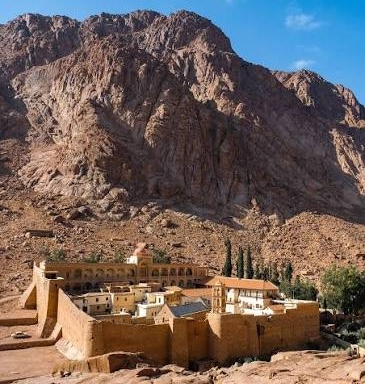
The Monastery of Saint Catherine cannot be reduced to a collection of antiquities. It is a living monastic institution whose churches, manuscripts, icons, relics, and liturgical treasures have remained in uninterrupted religious use for more than fifteen centuries. While every State has a legitimate interest in protecting cultural heritage, international law does not permit heritage protection to become a pretext for assuming control over the internal life, governance, or sacred patrimony of a religious community.
Article 18 of the United Nations International Covenant on Civil and Political Rights protects not only individual belief but also the collective freedom of religious communities to manifest their religion through worship, observance, practice, and the preservation of their institutions. Article 27 further guarantees that members of religious minorities shall not be denied the right to profess and practice their own religion in community with others.
These guarantees necessarily encompass the institutional autonomy and legal personality required for religious communities to govern their internal affairs, safeguard their sacred property, appoint their own leadership, and conduct their religious life free from state interference.
Heritage protection cannot lawfully be invoked as a justification for state interference in the internal governance of a historic religious community or in its stewardship of its churches, sacred objects, manuscripts, relics and religious patrimony.
Recognition as a UNESCO World Heritage Site neither diminishes nor supersedes the Brotherhood’s religious autonomy. On the contrary, the Outstanding Universal Value of Saint Catherine’s derives precisely from the uninterrupted continuity of the monastic community that has preserved, inhabited and administered the site for more than fifteen centuries.
To preserve the monuments while fundamentally altering the legal position of the community that has sustained them for more than fifteen centuries would not preserve the status quo; it would replace the very legal and institutional order that gave those monuments their living character and universal significance.
International protection of cultural heritage and international protection of freedom of religion are complementary, not competing, obligations. A State cannot fulfil one by undermining the other.
UNESCO: Conspicuous Silence
Recent developments further underscore the urgency of UNESCO’s engagement. According to multiple reports, the Monastery is now under increasing pressure to accept proposals that would fundamentally redefine its historic legal status. If implemented, such changes would affect not merely the management of a World Heritage property, but the legal and institutional continuity of the monastic community whose uninterrupted presence for nearly fifteen centuries constitutes an integral part of the site’s Outstanding Universal Value.
Continued public silence in the face of developments of this magnitude risks being interpreted not as neutrality, but as acquiescence. Continued public silence in the face of developments of this magnitude risks being interpreted not as neutrality, but as a failure to discharge UNESCO’s responsibility to safeguard one of the world’s most significant living World Heritage Sites.
The Organization bears a unique responsibility for safeguarding sites recognized as possessing Outstanding Universal Value. Yet during the most critical phase of the present crisis, it has remained publicly silent despite developments affecting one of its oldest and most emblematic World Heritage Sites.
That silence inevitably attracts particular attention because UNESCO is now headed by Khaled El-Enany, Egypt’s former Minister of Antiquities, whose ministry became directly involved in the legal proceedings concerning the Monastery. UNESCO’s credibility now depends upon demonstrating that its commitment to protecting World Heritage is guided exclusively by its constitutional mandate and not influenced by the previous governmental responsibilities of its leadership.
The present silence risks creating the perception that UNESCO is prepared to remain passive while one of its own World Heritage Sites undergoes a fundamental transformation of the centuries-old legal and institutional order that has preserved it for more than fifteen centuries. Such a perception would be profoundly damaging—not only to St. Catherine’s Monastery, but also to UNESCO’s own standing as the guardian of humanity’s shared cultural heritage.
UNESCO exists not merely to record irreversible losses after they occur, but to help prevent them. Its responsibility extends beyond safeguarding the physical fabric of World Heritage Sites to preserving the living institutional continuity that gives them their Outstanding Universal Value. No World Heritage Site should be left to defend its historic legal status alone against the state within whose territory it is located. Recent developments indicate that the Monastery is now under increasing pressure to accept a fundamentally different legal order. If UNESCO does not speak out in circumstances such as those confronting St. Catherine’s, when the historic legal status of one of the world’s oldest continuously functioning monastic communities is reportedly at risk of being fundamentally altered, it is difficult to imagine when that responsibility would ever be exercised.
Who Can Stop Egypt’s Scheming: A Responsibility Before History
The situation outlined above points in one direction. State-initiated litigation challenged a settled legal order that had endured for centuries. Time therefore no longer favours the preservation of the centuries-old status quo. On the contrary, every additional delay increases the practical advantage of the stronger party and narrows the range of options available for restoring the historic legal status that has long governed the Monastery’s existence.
The responsibility now extends well beyond the Monastery itself.
Above all, the United States possesses a unique capacity to encourage a solution that fully preserves the centuries-old status quo. Its strategic relationship with Egypt provides a degree of influence that few other governments can exercise. That influence should now be employed constructively, consistently and at the highest political levels. Other governments maintaining close relations with Egypt likewise have both the opportunity and the responsibility to make clear that the preservation of St. Catherine’s Monastery is a matter of legitimate international concern, not merely a domestic administrative issue.
Timely international engagement in this case should not be confused with interference in Egypt’s internal affairs. The preservation of St. Catherine’s Monastery concerns a World Heritage Site whose protection has long been recognized as a matter of legitimate international interest and responsibility.
UNESCO‘s response will likewise be judged by whether it fulfilled the responsibilities entrusted to it under the World Heritage Convention.
The stakes therefore reach far beyond a single monastery. If the centuries-old status quo governing St. Catherine’s can be progressively replaced through the cumulative use of successive instruments of state authority while the international community remains largely passive, the implications will resonate wherever historic religious and cultural institutions depend upon longstanding legal arrangements for their continued existence.
For more than fifteen centuries, St. Catherine’s Monastery survived because successive rulers—despite profound political, dynastic and religious differences—ultimately respected the centuries-old status quo under which it existed. Today, that status quo faces one of the gravest challenges in the Monastery’s long history.
The latest reported developments suggest that the process documented throughout this report has now entered a decisive phase. What began as a succession of judicial proceedings, administrative restrictions and executive delays has reportedly culminated in a proposal requiring the Monastery to relinquish the historic legal order under which it has existed for fifteen centuries in exchange for a fundamentally different legal status defined by the Egyptian state. The issue is therefore no longer whether pressure is being exerted on the Monastery, but whether the international community will act before that historic legal order is irreversibly extinguished.
Whether it survives the current crisis may now depend less upon the Monastery itself than upon whether those governments and international institutions possessing the influence to make a difference choose to exercise that influence before the opportunity is lost.
Egypt’s leadership should also consider the far-reaching ramifications of the precedent it is creating. If the centuries-old legal order governing one of the world’s oldest continuously functioning Christian institutions can be dismantled and ultimately eradicated by the state within whose territory it is located, the implications will inevitably extend far beyond St. Catherine’s. Such a precedent could one day be invoked—by other governments and under different political circumstances—to justify comparable interference with the historic legal status of other ancient religious institutions, including Islamic holy sites. That is a precedent from which no religious community would ultimately benefit.
The protection of historic religious institutions cannot be defended selectively. A principle weakened in one place inevitably weakens it everywhere. States rarely foresee that the legal precedents they establish today may tomorrow be invoked by others against institutions they themselves regard as inviolable.
History will judge this moment not only by the actions of those who sought to replace a legal and institutional order that endured for more than fifteen centuries, but also by the response of those who possessed the influence to help preserve it.
Recent developments suggest that eradication the historic status quo is now being actively pursued through a proposed new legal order. The question is whether those with the influence to preserve that fifteen-century legal heritage will choose to act before its dismantling becomes irreversible.
In a Nutshell