
By Coptic Solidarity/EHP –
Contextualizing The Record As He Assumes Leadership of UNESCO
Mr. Khaled El-Anany has just assumed his position as Director-General of UNESCO. Few people outside Egypt are aware of the extensive damage inflicted upon the country’s heritage during his tenure as Minister of Antiquities (2016-2022.) While recent debates surrounding St Catherine’s Monastery have drawn attention internationally to Egypt’s total disregard to such a unique World Heritage, the cases analyzed and presented in this report focus instead on other sites across Egypt where irreversible heritage loss occurred under his authority.
The cases were originally compiled by EHP (Egypt Heritage Professionals, a group whose members wish to remain anonymous.) These are based on reports published in Egyptian and other media.
These cases illustrate a broader pattern: neglect followed by deregistration, demolition, or redevelopment, often justified under procedural or “public interest” reasoning. Each case retains its own documentation and media sources. The purpose of this report is to record and contextualize what occurred because heritage, once lost, cannot be restored.
*****
1 — The Destruction of Mikhael Luka Palace (Assiut)
The palace known as Qasr Mikhael Luka al-Zaq (built 1914 in Baroque Revival style) was officially registered as a protected monument in 1998. Over subsequent decades the building deteriorated, with cracked walls, collapsing ceilings, and apparent signs of intentional neglect. Inspection committees of the Ministry of Antiquities recommended urgent restoration. Despite that, in November 2021, the Permanent Committee for Islamic & Coptic Antiquities approved its deregistration, effectively clearing the way for demolition and redevelopment.
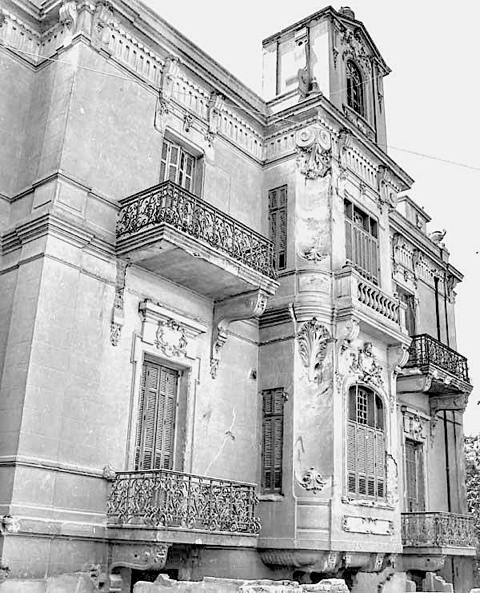
The decision relied heavily on a report from a university engineering office rather than the ministry’s own conservation experts. Legal advisers had previously flagged conflicts, including a pre-existing demolition ruling dating to before the building’s registration. Critics argue that neglect was used strategically to justify removing the palace from protection — a pattern increasingly common across Egypt.
This case illustrates how bureaucratic process can be used not to preserve heritage, but to neutralize it.
(Source: Akhbar El-Yom)
2 — Removal of the Ottoman Baths in Qena from the Heritage List
The Ottoman public bath in the Qaysariyya district of Qena, registered as an antiquity in 2002, was one of the last surviving bathhouse complexes of its type in Upper Egypt. Years of neglect, structural cracks, damage from traffic vibrations, and continued residential occupation were cited as reasons for declaring that the structure had “lost its archaeological characteristics.”
Despite objections from heritage specialists — who argued the bath could and should have been restored — the ministry formally removed it from the protected register, clearing the way for demolition or redevelopment.
This case exemplifies a recurring pattern:
Neglect → deterioration → declaration of “loss of value” → deregistration → removal.
The heritage value disappears not naturally, but through administrative abandonment.
(Source: Al-Masry-Al-Youm)
3 — Parliamentary Debate on Heritage Registration Criteria
In remarks to Parliament (4 February 2021), Khaled El-Anany stated that Egypt cannot register every building older than 100 years as a monument, arguing that this would mean “registering half the houses in the country.” He emphasized prioritization and limited capacity. While technically correct that age alone should not determine heritage status, critics point out that this logic provides broad discretionary cover for shrinking the legally protected heritage zone, especially in historic urban areas vulnerable to speculative redevelopment.
This policy framing has been repeatedly invoked to justify demolition or deregistration across Cairo’s historic quarters.
(Source: Al‑Masry Al‑Youm)
4. The Destruction of the Mameluke Cemetery
A significant case of heritage loss concerns the demolition of tomb structures in the historic Mamluk Cemetery (Jubbānat al-Mamālīk) along the route of the newly constructed Firdous Axis road. In mid-2020, images and video circulated showing bulldozers leveling tombs and funerary structures in an area long recognized as a key component of Cairo’s medieval architectural and cultural memory. The removal triggered strong public reaction: heritage advocates, architects, historians, and civil society groups emphasized that the cemetery contains important burial sites, including those of prominent Egyptian cultural and political figures, and represents an irreplaceable layer of urban history.
Authorities, including the Ministry of Tourism and Antiquities and the Cairo Governorate, denied that any registered Islamic monuments had been destroyed. They described the demolished structures as “private graves” or “modern tombs” outside the legally protected boundary. Critics argued that this classification was misleading, given that the heritage value of the cemetery extends beyond the subset of sites formally listed as antiquities. Parliamentary inquiries, petitions, and public appeals followed, highlighting a structural issue: legal ambiguity around what constitutes “registered” heritage allows state agencies to remove historically meaningful sites under the justification of development or “public benefit.”
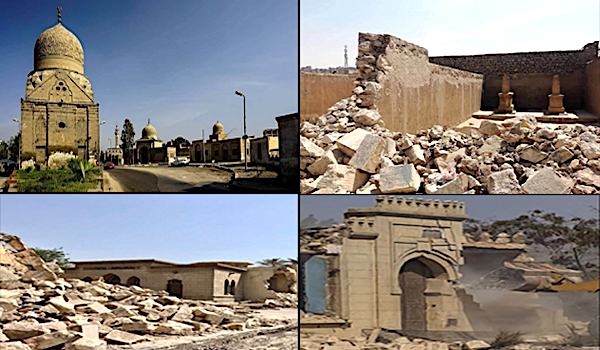
This case underscores how heritage protection based solely on registration status can be inadequate. When deterioration, administrative delay, and infrastructural priorities converge, even historically rich areas can be recast as expendable. It also demonstrates how state narratives of modernization and traffic improvement are used to justify irreversible transformation of cultural landscapes. The Mamluk Cemetery has therefore become a symbol of how heritage, memory, and public space are vulnerable when legal frameworks, preservation policy, and civic oversight fail to align.
(Sources: articles by Daarb and Al-Masry Al-Youm)
5. Historic Cairo as a UNESCO World Heritage Site
The UNESCO World Heritage designation for “Historic Cairo” establishes the city’s medieval core as having Outstanding Universal Value for its urban fabric, mosques, madrasas, hammams, and civic monuments dating back to the Fatimid and Mamluk eras. The official UNESCO boundary maps define precisely which districts fall under the protective regime and which areas lie outside it or in buffer zones. This delineation is not merely technical: it directly influences which heritage environments benefit from international conservation oversight and which remain exposed to policy changes, commercial development, or infrastructure expansion.
In practical terms, sites just outside the mapped boundary are significantly more vulnerable. The Mamluk Cemetery, the Sayyida Nafisa–Imam al-Shafi‘i funerary belt, and many contested redevelopment zones lie in or near the perimeter of Historical Cairo’s formally inscribed zones. Their position makes them particularly susceptible to administrative reclassification or selective preservation. The UNESCO map therefore serves not only as a reference document but as a reminder of the widening gap between recognized heritage and the historic environments that remain unprotected due to jurisdictional or bureaucratic definitions.
(Source: WHC-UNESCO)
6. The Destruction of the Shafi‘i and Sayyida Nafisa Cemeteries
Multiple reports document widespread clearance and restructuring across the interconnected historic cemetery districts surrounding Sayyida Nafisa, Imam al-Shafi‘i, and Sayyida ‘Aisha. These burial grounds hold deep cultural resonance, containing graves of major literary, religious, political, and social figures. Infrastructure and “urban renewal” projects, however, have led to displacement of tombs, forced relocation of human remains, and fragmentation of the historic cemeteries into discontinuous plots. Citizens frequently report being required to move remains at their own expense.
Parliamentary interventions sought to halt demolition and reassess the cultural impact of the works. Heritage specialists argue that even when individual mausoleums are not formally registered as antiquities, the landscape as a whole remains a coherent repository of collective memory and religious identity. Official statements often repeat the phrase “not registered,” which has become a policy tool that permits demolition while avoiding the legal ramifications associated with altering listed monuments. Independent reporting highlights that the failure to register such heritage may itself be intentional, as registration would legally require maintenance budgets, conservation planning, and public oversight.
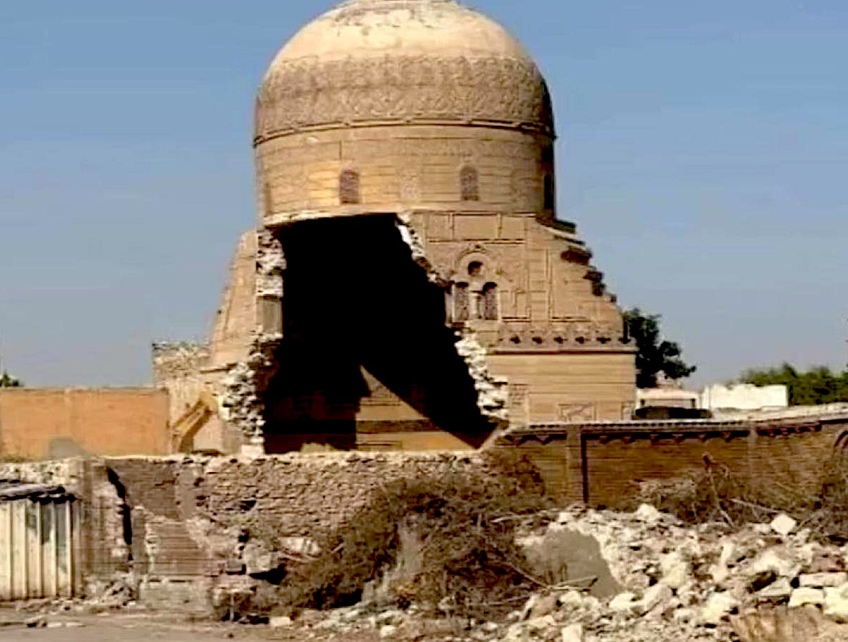
Across these cases, a consistent pattern emerges: urban development framed as modernization proceeds by eroding unregistered heritage; the state’s classification criteria determine whether structures are preserved or cleared; and public protest, while growing, remains structurally limited. The result is the gradual loss of historic funerary landscapes that once formed an integral component of Cairo’s cultural continuity.
(Sources: several reports BBC-Ar. Al-Masry Al-Youm, Daarb, Mada, FB Reel, CNN-Ar, Independent-Ar. , and Al-Masry Al-Youm).
7 — The Destruction of the Ibn Ṭūlūn Aqueducts
The surviving structures of the Qanātir Ibn Ṭūlūn aqueduct system, dating back to the 9th century, are among the few remaining elements of the Ṭūlūnid period in Cairo. Reports and images circulated through media and social platforms show structural collapse, partial demolition, and advanced neglect in the site and the surrounding funerary areas. Officials have claimed that the damaged parts are either privately owned or unregistered, and therefore fall outside the protection of heritage law.
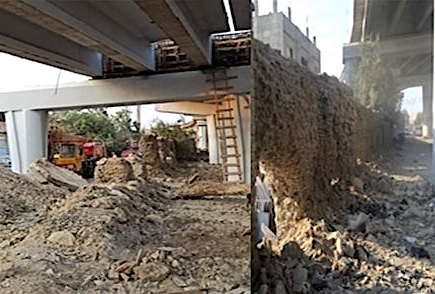
Critics counter that this reflects a familiar pattern: once heritage sites deteriorate due to lack of maintenance, the state then argues that they no longer qualify for preservation, clearing the way for urban redevelopment. The aqueduct site lies along the route of major infrastructure projects, and the tension between heritage protection and urban expansion is central to the dispute. This case again shows that legal registration alone does not secure protection when administrative neglect enables the reclassification of irreplaceable heritage as expendable.
(Sources: reports by El-Fagr, Cairo24 and Bab-Masr)
8 — The Demolition of the Palace of Tawfik Pasha Andraos (Luxor)
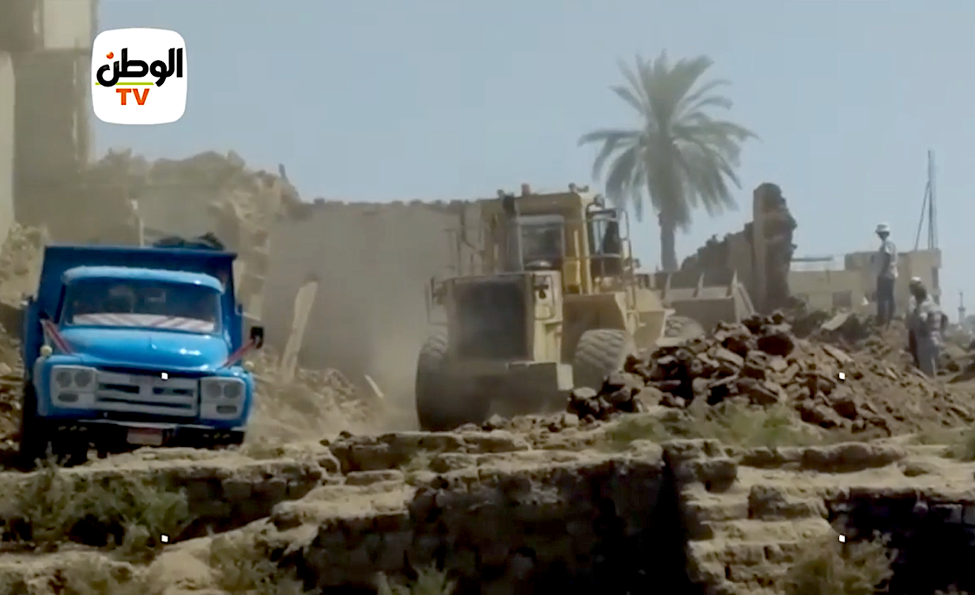
Video documentation shows the systematic demolition of the Andraos Palace in Luxor, an important architectural and historical landmark. The demolition proceeded despite professional objections and public criticism. Its destruction forms part of a broader trend in which significant historic buildings are deemed “non-essential,” “structurally unstable,” or “regrettably beyond restoration,” clearing the way for redevelopment in regions prioritized for tourism or urban redesign. The loss is both architectural and historical, representing another case in which heritage was not defended despite its recognized cultural value.
(Sources: videos here and here)
9 — The Dismantling and Relocation of the Tomb of Toto (Sohag)
The Ministry of Antiquities dismantled the decorated walls of the Ptolemaic-era tomb of “Toto” and his wife near Akhmim, in Sohag, in preparation for its relocation to the New Administrative Capital Museum. The tomb contains sarcophagi, mummies, and vivid painted reliefs. Heritage experts objected to the removal, emphasizing that dismantling the tomb strips it of archaeological context, risks damage during transportation, and places tourism display above scientific preservation. The ministry justified the relocation as enhancing display and protection. However, specialists argue that the speed of dismantling, limited transparency, and relocation logic reflect a growing trend in which heritage is physically displaced from its original landscape to serve symbolic, narrative, or political priorities. The case raises direct concerns about the principle of preserving monuments in situ — a foundational pillar of global heritage conservation standards.
(Sources: Masrawy, El-Watan and Al-Jazeera)
10 — The Displacement of the Luxor Sphinxes to Tahrir Square
In late 2019 and early 2020, the Egyptian Ministry of Antiquities dismantled and transported four ram-headed sphinx statues from the Avenue of the Sphinxes in Luxor to Cairo’s Tahrir Square, presenting the move as part of a project to revitalize the capital’s most symbolic urban space. Officials emphasized that the relocated sculptures were from a secondary section of the avenue and that they underwent professional restoration before transport. The state described the initiative as reinforcing Egypt’s cultural identity and enhancing tourism visibility in the capital.
The decision, however, provoked widespread criticism among archaeologists, heritage scholars, and members of the public. They objected that removing the rams from their original ritual and historical context in Luxor disrupts the continuity of one of Egypt’s most important sacred landscapes. Concerns were also raised about Cairo’s air pollution, humidity fluctuations, and traffic vibrations, which could accelerate deterioration of the sandstone surfaces. The debate became emblematic of a broader trend: major heritage decisions undertaken with limited public consultation, where cultural objects are repurposed to serve national image, ceremony, and spectacle rather than scientific conservation principles.
(Sources: reports by Al-Yom7, SkyNews Arabia, and DW-ar)
11 — Criticism of the Restoration of Baron Empain Palace
A report by Independent Arabia documents mounting criticism of recent restoration practices in Egypt, citing the Baron Empain Palace as a prominent example. Specialists argue that restoration has often involved excessive or inappropriate materials and techniques, including repainting, synthetic coatings, and structural alterations that mask or distort original features. The case of the Baron Palace illustrates a broader systemic issue in which heritage sites undergo renovation that emphasizes visual novelty or aesthetic “renewal” over the preservation of historical and architectural authenticity.

Experts highlight that many heritage structures remain unregistered or ambiguously classified, meaning they do not benefit from the stricter conservation protocols required for recognized antiquities. This ambiguity allows restoration to proceed without adequate oversight, scientific documentation, or conservation planning. The resulting transformations often leave monuments physically intact but historically compromised. The case demonstrates that heritage can be lost not only through demolition, but also through restoration that erases material history, contextual meaning, and architectural integrity.
(Source: Independent Arabia)
12 — Reconstruction and Redesign of the Sayyida Nafisa Shrine
Beginning in 2022, the Sayyida Nafisa Shrine and surrounding historic district underwent large-scale redesign led by the Engineering Authority of the Armed Forces with Arab Contractors executing the works. The stated goals were to enhance visitor access, unify the aesthetic continuum of the shrines of the Prophet’s family, and promote religious and cultural tourism. Official statements described the project as restoring “spiritual identity” and improving urban space.
However, archaeologists and heritage scholars reported the removal or covering of Ottoman, Mamluk, and Khedival architectural layers, replacing them with new marble, lighting schemes, and expanded ceremonial space disconnected from the shrine’s historical setting. The project is widely viewed as an example of urban and architectural homogenization, transforming a layered living heritage site into a stylized monument. Moreover, evidence indicates that decisions were made outside the Ministry of Antiquities’ regulatory authority, reinforcing a pattern in which military-led development proceeds independently of conservation standards.
The surrounding neighborhood — one of Cairo’s oldest continuous religious and residential zones — has also been subject to demolition and reconfiguration. This risks severing the shrine from its socio-historical context and transforms a living pilgrimage environment into a curated display space. The case highlights the growing tension between political-aesthetic redevelopment and heritage preservation grounded in authenticity and lived continuity.
(Sources: Arab Contractors site, Mada Masr)
13 — UNESCO Concerns and the Transformation of Historic Cairo
In 2019, a joint UNESCO–ICOMOS mission to Historic Cairo reported critical degradation in the city’s historic urban fabric, citing structural decay, informal expansion, infrastructure intrusion, and repeated demolitions of historic buildings. The mission recommended halting demolitions, revising legal frameworks that permit the removal of structures deemed “unsafe,” and activating joint governance mechanisms intended to coordinate heritage protection among state institutions.
The Egyptian government responded by referencing regulatory measures and ongoing urban regeneration projects. However, the UNESCO report noted that despite official assurances, demolition permits continued, large-scale infrastructure projects advanced, and the cumulative erosion of historical context persisted. The case underscores that even sites recognized for their Outstanding Universal Value remain vulnerable when legal protections are weakly enforced or overridden by development priorities. The stakes extend beyond individual monuments to the continuity of an urban cultural landscape central to Egypt’s historical identity.
(Source: Bab MISR)
*****
OVERALL CONCLUSIONS
The cases documented in this report reveal a systemic pattern in the management of Egypt’s heritage during Khaled El-Anany’s tenure as Minister of Antiquities and later Minister of Tourism & Antiquities. While each case involves different sites and circumstances, the underlying administrative approach is remarkably consistent.
Across palaces, shrines, cemeteries, aqueducts, and archaeological landscapes, sites were left to deteriorate, subsequently reclassified as structurally or historically compromised, and then removed, relocated, redeveloped, or “restored” in ways that altered their authenticity. Neglect, followed by deregistration or aesthetic reconfiguration, became a recurring policy sequence.
This pattern reflects structural governance weaknesses rather than isolated technical errors. The legal distinction between registered and unregistered heritage was frequently used as a loophole, permitting demolition or transformation of historically significant urban fabric under the rationale of modernization or public utility. Meanwhile, the increasing marginalization of professional conservation bodies and academic specialists, often in favor of ad-hoc executive implementation or non-specialist contractors, resulted in interventions that damaged historical integrity and erased accumulated cultural layers.
Such outcomes are not merely material losses. They contribute to a progressive erosion of historical memory and urban identity, in which monuments are retained as objects but deprived of context, continuity, and meaning. A tomb removed from its funerary landscape, a palace reconstructed in a contemporary luxury aesthetic, or a cemetery fragmented by road axes may remain physically present but culturally de-rooted.
These recurring patterns are particularly significant in light of Mr. El-Anany’s forthcoming role as Director-General of UNESCO, the institution internationally responsible for safeguarding cultural heritage. It is noteworthy, and to many observers surprising, that an individual associated with the deregistration, displacement, or irreversible transformation of heritage sites now assumes leadership of the very organization tasked with ensuring the protection of heritage against such risks.
This does not pre-judge intentions. Leadership positions can allow individuals to learn from past controversies and adopt more rigorous, consultative, and preservation-centered approaches. However, it does underscore the importance of:
- Close monitoring by UNESCO’s Member States, advisory bodies, and partners to ensure that global heritage protection standards are upheld without exception.
- Transparency in decision-making, particularly in cases involving contested restorations, site relocations, or large-scale urban redevelopment affecting historic fabric.
- Reaffirmation of conservation principles rooted in authenticity, context, and continuity, rather than in museum display, tourism-driven spectacle, or aesthetic modernization alone.
The responsibility now extends beyond Egypt. As Director-General, Mr. El-Anany will be accountable to the international community, to expert conservation bodies such as ICOMOS and ICCROM, and to the global public for whom heritage is a shared human legacy.
The hope—expressed here with clarity and good faith—is that this leadership role becomes an opportunity for corrective course, guided by lessons drawn from past experience, strengthened oversight, and a renewed commitment to safeguarding—not merely showcasing—the cultural heritage of all peoples.
The stakes are high. Heritage once lost cannot be recovered. The world will be watching.