
By Raymond Ibrahim – Coptic Solidarity –
Just days ago, a Muslim mob attacked a Coptic church in the Upper Egyptian village of Tal al-Quiblya, in Minya Governorate. Shouting sectarian slogans, the assailants pelted the church with stones, injured several Christians, and damaged both the building and the priest’s car. When police finally arrived, they proceeded to arrest four of the Christian victims.
Two days later, those Christians regained their freedom only after agreeing to withdraw their criminal complaint against the Muslims who had assaulted them.
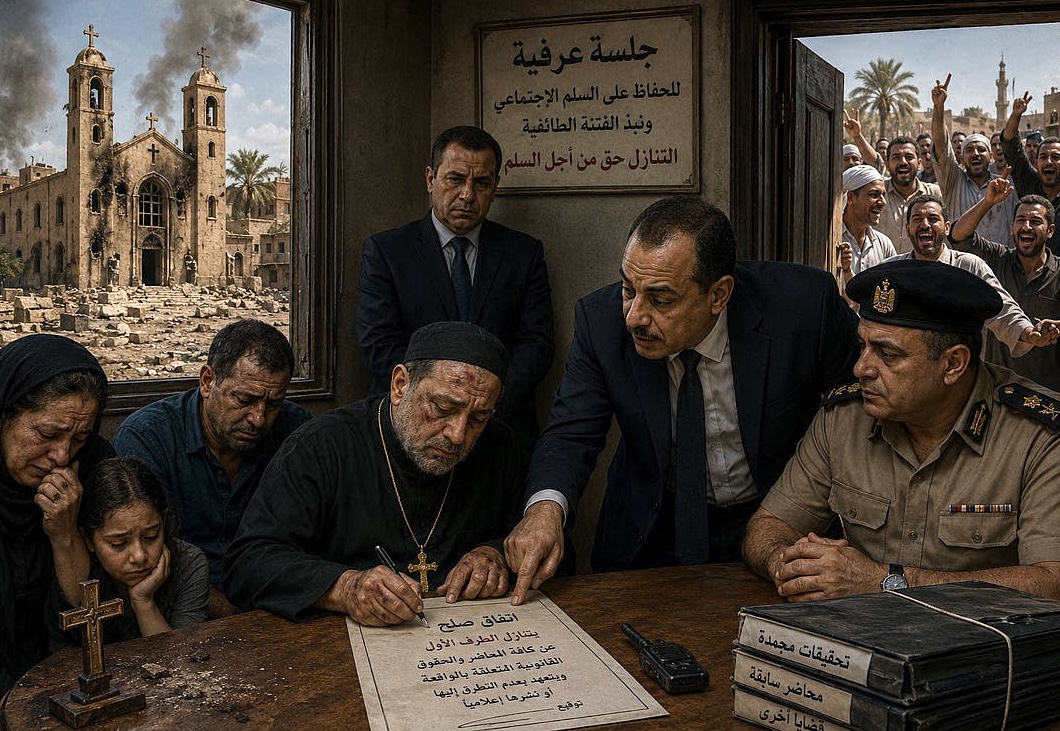
At first glance, this appears to be another example of Egypt’s chronic failure to protect its Christian minority. It is that—but it is also something more. The incident exposes the inner workings of one of the Egyptian state’s most effective mechanisms for shielding anti-Christian violence from legal consequences: the so-called “reconciliation session” (جلسة عرفية).
These sessions are routinely portrayed by officials as noble efforts to preserve “social harmony” and prevent sectarian tensions from escalating. In reality, they achieve the opposite. They do not reconcile aggressor and victim so much as compel the latter to surrender to the former.
By now, the formula is familiar. A Muslim mob attacks Christians. Police intervene—not primarily to enforce the law, but to calm down the violence and avoid being accused of doing nothing. Christian men who defended their homes or churches are detained, threatened with prosecution, or otherwise pressured. Once sufficient leverage has been applied, local officials convene a “reconciliation session,” where the victims are expected to forgive, forget, and return home empty-handed.
The arrests in Tal al-Quiblya were therefore no inexplicable bureaucratic blunder. They were leverage. By depriving the Christian victims of their liberty until they withdrew their complaint, authorities ensured that the matter would be resolved outside the courts—where Muslim assailants so often escape meaningful punishment anyway.
Nor is this an isolated incident.
Last October, following Friday prayers, a large Muslim mob descended on the Coptic community of Nazlet Gelf in the same Minya Governorate after rumors spread that an 18-year-old Christian man had been involved with a Muslim girl. Under Islamic law, while Muslim men may marry Christian women, the reverse is forbidden; the mere allegation was enough to ignite collective punishment.
Muslims shattered windows, battered doors, burned Christian homes and businesses, and threatened to torch churches while expelling the village’s Christians. Viral footage captured terrified Coptic families—including a young girl desperately begging her mother for protection. As usual, security forces restored order only after the mob had exhausted itself.
Then came the predictable sequel.
Rather than prosecute the attackers, local authorities convened another “reconciliation session.” The resulting agreement had little to do with reconciliation or elementary justice and everything to do with rewarding the mob’s demands. The Christian family was effectively exiled from the village, fined heavily, prohibited from discussing the incident publicly, and threatened with even greater penalties should it violate the agreement. The announcement was met with applause, ululations, and cries of “Allahu Akbar” from the assembled Muslim crowd.
Meanwhile, the young Christian whose alleged “offense” had triggered the violence remained in police custody.
The silence of Egypt’s political leadership was equally revealing. President Abdel Fattah el-Sisi said nothing, even though Egypt’s own Constitution explicitly forbids arbitrary forced displacement of citizens. Such constitutional guarantees apparently evaporate whenever Christians become the targets.
Nazlet Gelf or Tal al-Quiblya are hardly unique.
In April 2024, in al-Kom al-Ahmar, a Muslim mob attacked Christian homes after Copts received permission to build a church. Once again, instead of pursuing criminal charges, authorities organized a reconciliation session during which Christians were pressured to drop legal action in exchange for vague promises that their church permit would remain intact.
The same pattern unfolded five years earlier in the village of Nagib, where reconciliation sessions effectively nullified the protections supposedly guaranteed under Egypt’s Church Construction Law, allowing attackers to escape accountability while Christians were compelled to yield.
The structure of these sessions resembles a classic “good cop, bad cop” routine.
The Muslim mob plays the “bad cop,” unleashing violence and threatening even greater destruction. State officials assume the role of the “good cop,” urging Christian leaders to accept concessions “for the sake of peace,” warning that refusing to cooperate could provoke further bloodshed—something the authorities supposedly cannot prevent.
Christians are instructed to close churches, worship elsewhere, leave their homes, abandon lawsuits, or even depart their villages altogether. Those who insist on pursuing justice are reminded that doing so may bring additional retaliation.
Even more revealing, Christian youths who defend their homes or churches are, as seen, frequently arrested themselves. They may spend days in detention, face criminal charges, or endure relentless intimidation—until Christian leaders finally agree to the humiliating terms dictated during the reconciliation session.
The message is unmistakable: seeking justice carries greater risks than submitting.
These sessions therefore institutionalize the punishment of victims and the impunity of perpetrators while masquerading as instruments of communal harmony.
Tellingly, the Egyptian Ministry of Interior’s response to the Nazlet Gelf attack perfectly illustrated this inversion. It dismissed the violence as merely “a dispute between two families” arising from a personal relationship, while accusing unnamed parties of attempting to give the incident a “sectarian dimension.” The Ministry then proudly noted that the matter had been resolved through a customary reconciliation session.
In other words, the government erased the religious motive entirely, transformed an organized anti-Christian riot into an ordinary family disagreement, and celebrated an extralegal proceeding that rewarded those responsible for the violence. Its accompanying warnings against anyone seeking to “undermine national unity” merely reinforced the state’s true priorities: suppress discussion, preserve appearances, and deny that Christians were targeted because of their faith.
The consequences are entirely predictable.
The attackers emerge emboldened, knowing that little—if anything—will happen to them. Christian victims lose their homes, livelihoods, legal rights, and often their communities. The state maintains a convenient veneer of stability while quietly reinforcing a hierarchy in which Copts remain subordinate and perpetually vulnerable—true dhimmis.
As Bishop Makarious of Minya observed in 2024, “As long as the attackers are never punished… this will just encourage others to continue the attacks.“
That observation remains as true today as ever.
The events in Tal al-Quiblya, Nazlet Gelf, al-Kom al-Ahmar, Nagib, and countless other villages demonstrate that these are not isolated failures of law enforcement. They are manifestations of a system. What Egyptian media routinely describes as “sectarian violence” has become a predictable ritual: Muslims attack; authorities pressure Christians to relinquish their legal rights; reconciliation sessions ratify the mob’s demands; and the perpetrators walk away vindicated and emboldened.
In short, reconciliation sessions are anything but conciliatory. They are instruments of state-sanctioned coercion. They transform acts of anti-Christian violence into carefully choreographed displays of communal “peace,” while ensuring that only one side benefits. The aggressors are rewarded, the victims are punished, and the cycle begins anew—with the quiet blessing of the state.