
By Manos Chatzigiannis – Newsbomb –
The project threatens the autonomy of the Greek monastery and the Bedouins’ way of life, against a backdrop of geostrategic considerations
The pharaonic tourism project planned for the Sinai region—including Saint Catherine’s Monastery—has once again come to public attention following a report by the French newspaper Libération, confirming what Newsbomb revealed last May.
According to the French daily, the Egyptian government is on the verge of completing an ambitious project to transform the remote area where Saint Catherine’s Monastery is located into a massive tourist hub—the third largest in the country. Libération reports that this project threatens the way of life of the Bedouins and the autonomy of the Greek monastery, against a backdrop of geostrategic calculations.
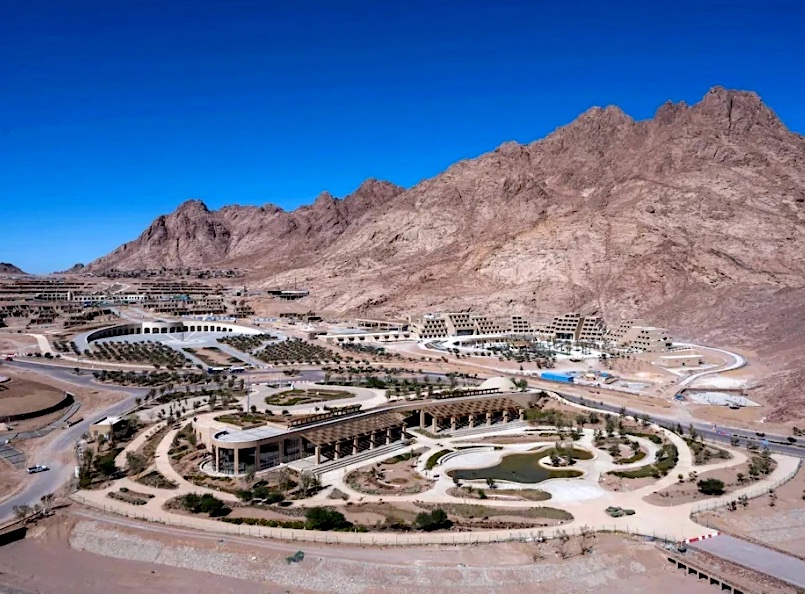
Following the New Administrative Capital (NAC) and the Grand Egyptian Museum, which were finally inaugurated with much fanfare in early November, comes the so-called “Great Transfiguration Project.” According to Libération, this project includes—among dozens of buildings—a cable car to the summit of the sacred mountain.
However, over the past three years, since construction began—without the consent of the Bedouins—the Jabaleya tribe fears for its livelihood.
“If they actually install a cable car to the summit of Mount Sinai, as they announced, then we’re finished,” laments a Bedouin man who prefers to remain anonymous for fear of reprisals by the authorities.
The rest of the construction is reportedly 90% complete: on the plain where major Bedouin celebrations traditionally took place, there now stand a five-star hotel, a complex of private chalets, and a large visitor center. Nearby, the airport has been expanded—far removed from the once-remote settlement that attracted hikers seeking spirituality.
What the Bedouins Are Denouncing
A Bedouin guide told Libération:
“This project is destroying Saint Catherine. It is completely contrary to the spirit of the place and to what people come here to find: peace, the divine, and a connection with nature.”
Another Bedouin recounts:
“One day, the police came to my house and demanded that we register it, even though it had always been informal. To do so, they asked for our family identity documents going back five generations. But we can only find documents for three generations, because before that Sinai was under Israeli occupation. So the army placed a sign on our front door stating that they could reclaim our house at any time. Once the project is completed, we don’t know what will happen to us…”
Other residents confide that their homes were partially demolished for the project and that the village cemetery was razed to make space for a parking area.
The Monastery’s Governance and Authority
Another collateral victim of the Great Transfiguration Project is the Greek monastery. Built by Emperor Justinian in the 6th century, it is the oldest continuously inhabited monastery in the world. It is also the site where the Codex Sinaiticus, the oldest surviving manuscript of the Bible, was discovered—most of which is now housed at the British Museum in London.
Months ago, amid significant tension, Archbishop Damianos was replaced by Archbishop Symeon. The 62-year-old cleric waves aside concerns about land nationalization.
“I don’t like the word ‘land,’” he says. “Can we call ‘land’ a piece of desert where a sacred mountain, ancient churches, or a historic monastery stand? I don’t think so.”
The new Archbishop assures that discussions with the Egyptian authorities are “still open,” that they have “never exerted any pressure to reach an agreement,” and that the tourism project is a “good thing” because it allows the area to “remain alive,” according to Libération.
What an American Organization Says
How can this 180-degree turn be explained? According to the American organization Coptic Solidarity, at the time of the new Archbishop’s election, “certain candidates were sidelined under pressure,” which the organization characterizes as “political interference.”
According to the Coptic advocacy group, this pressure comes both from Athens and Cairo, as the two countries are in talks to finalize a major energy agreement. This agreement includes the construction of a subsea pipeline between Egypt and Greece to transport Egyptian natural gas to Europe—against the backdrop of the war in Ukraine, which has jeopardized Europe’s energy supply, and an economic crisis that has increased Cairo’s need for foreign currency.
Speaking by phone to Libération, Greek MP Markos Bolaris criticized this “secret diplomacy” and expressed concern about the future:
“If the Egyptian state takes possession of these lands now, in a few months or years it will be able to claim them as its own and do whatever it wants there in terms of tourism development—even if that means demolishing churches or expelling Greek monks.”
He recalled that all rulers of Sinai—from the Crusaders to the Mamluks, including Napoleon, Israel, and even the Prophet Muhammad—always respected this sacred place and its inhabitants, which moreover constitute a UNESCO World Heritage Site.
_______________