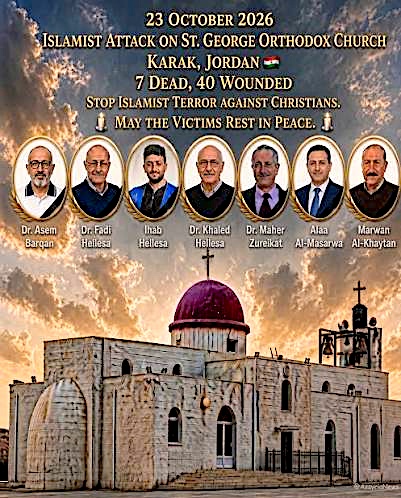

By Magdi Khalil – IDI Center –
On Friday, October 23, 2026, three Islamic terrorists attacked St. George Greek Orthodox Church in the village of Hamoud, which belongs to Karak Governorate in Jordan. Members of the church were holding prayers for a deceased Christian woman. The terrorists killed nine people and wounded more than 30 people who are currently being treated in hospitals.
Anyone who follows Islamic terrorism against Christians around the world, especially in the Middle East, observes that they prefer to attack during Christian occasions, Christian gatherings, and churches. They also carry out many terrorist acts on Fridays, when Muslims are charged with hatred toward Jews and Christians during prayers and then go out afterward like beasts, killing, destroying, and looting. Hundreds of terrorist incidents have been documented over the past five decades that occurred during Christmas, New Year’s, Easter, and Palm Sunday, and many of them also occurred on Fridays. A very large number of them were attacks on churches, as well as attacks on weddings or funeral prayers in churches, and also on Christian schools and institutions.
The Islamic terrorization of Christians continues and is expanding, from Egypt to Jordan, from Iraq to Syria, from Nigeria to Mali, from Sudan to Burkina Faso, from Africa to Europe, and from the Middle East to Pakistan and Afghanistan….
The Religion of Peace website documented 50,100 terrorist attacks carried out by Muslim terrorists around the world from September 2001 to October 2026, resulting in the deaths of 321,139 people and the wounding of another 383,684.
Killing, bombing, vehicle ramming, knife attacks, kidnapping, rape of women, looting and robbery… and every kind of barbaric attack, until they turned Christian holidays for Christian minorities in Islamic countries into hell.
In 2019, an attack took place on a mosque in New Zealand, carried out by a person who classified himself as an atheist. Members of the United Nations gathered and designated that day as an international day to combat Islamophobia. Yet, despite all this widespread Islamic terrorism around the world, which has claimed hundreds of thousands of innocent victims in just the past two decades, the members of the United Nations have not gathered to designate a day to confront this Islamic terrorism, or to confront Christianophobia, even though Christianity is currently the most persecuted religion around the world.
Is there Islamic extremism in Jordan?
Although the monarchy in Jordan is relatively moderate compared with other regimes in Islamic countries, Jordan as a country has a very large number of extremists from all trends, especially since Jordan shares a border with Israel and more than half of its population is of Palestinian origin.
- In Jordan, there is one of the most extremist Islamic groups, Hizb ut-Tahrir al-Islami, which was founded in 1953 by Taqi al-Din al-Nabhani for the purpose of overthrowing the existing political regimes and restoring the Islamic Caliphate once again. The party still exists to this day.
- In Jordan, there is a strong Muslim Brotherhood current. Although the Muslim Brotherhood itself was banned in Jordan in 2025, its political arm, the Islamic Action Front, continues to have members serving in parliament. In the 2024 parliamentary elections, the Islamic Action Front won roughly one-fifth of the seats and became the largest single political bloc in parliament.
- In Jordan, there is a strong Salafi-jihadist current, among whose most prominent leaders are Abu Musab al-Zarqawi, Abu Qatada, Abu Muhammad al-Maqdisi, Abu Anas al-Shami, Abu Sayyaf al-Urduni (Muhammad al-Shalabi), and others.
- Jordan also has a current that takes pride in its loyalty to ISIS, including names such as Abu Muhammad al-Tahawi, Saad al-Hunaiti, Omar Mahdi Zaidan, Ahmad Atta Allah Majali, and others.
And we should not forget that in Jordan, mourning ceremonies were held after the killing of bin Laden and also after the killing of Abu Musab al-Zarqawi.
Muslim Reactions to Terrorist Incidents
What concerns me most after terrorist attacks carried out by Muslims is not only the violence itself, but the pattern of reactions that follows. In many cases, the same ecosystem appears again and again: clerics and media figures who spend years describing Jews and Christians as infidels, agents of the West, or threats to Islam; apologists who explain terrorism as a reaction to Iraq, Afghanistan, the Crusades, or Western imperialism; and a broad chorus that immediately insists Islam bears no responsibility at all, repeating that “terrorism has no religion” and that Islam is a religion of peace. Alongside them are those who openly celebrate the victims’ deaths, those who spread conspiracy theories blaming Israel or America, and a much larger group that simply remains silent.
The smallest group is made up of Muslims willing to condemn the attack without excuses and confront the incitement that created the environment in which it became possible. Their position is deeply unpopular, and they are often attacked by the broader Muslim population.
The Jordan massacre is not the first against Christians in the region, and will not be the last. Christianity is experiencing one of the most dangerous periods of persecution, attacks, and targeting it has faced in centuries. This is happening in both East and West through Islamic terror, anarchic leftist sabotage, and an alliance of evil against it.
The fundamental objective of what happened in Jordan, what happened before it, and what will happen after it is to empty the Middle East of Christians through intimidation, terror, and forced displacement. The number of Christians in the Middle East has already declined in a single century from around 20% of the population to around 4% today.
Christians in the Middle East need special attention and special care from the international community and from Western countries so that Christianity can continue in the region where it originated and where the oldest churches in the world were established.
_______________
https://idicenter.org/article/the-terrorization-of-middle-eastern-christians?
Magdi Khalil is Senior Fellow – Policy, Middle East Affairs, IDI Center