

By Markos Bolaris, Member of the European Parliament –
International law is being violated. Specifically:
a) the Universal Declaration of Human Rights, and
b) the international conventions for the protection of the cultural heritage of humanity.
The perpetrators are acting today — and they have accomplices in Athens.
What is unfolding in Sinai remains ongoing.
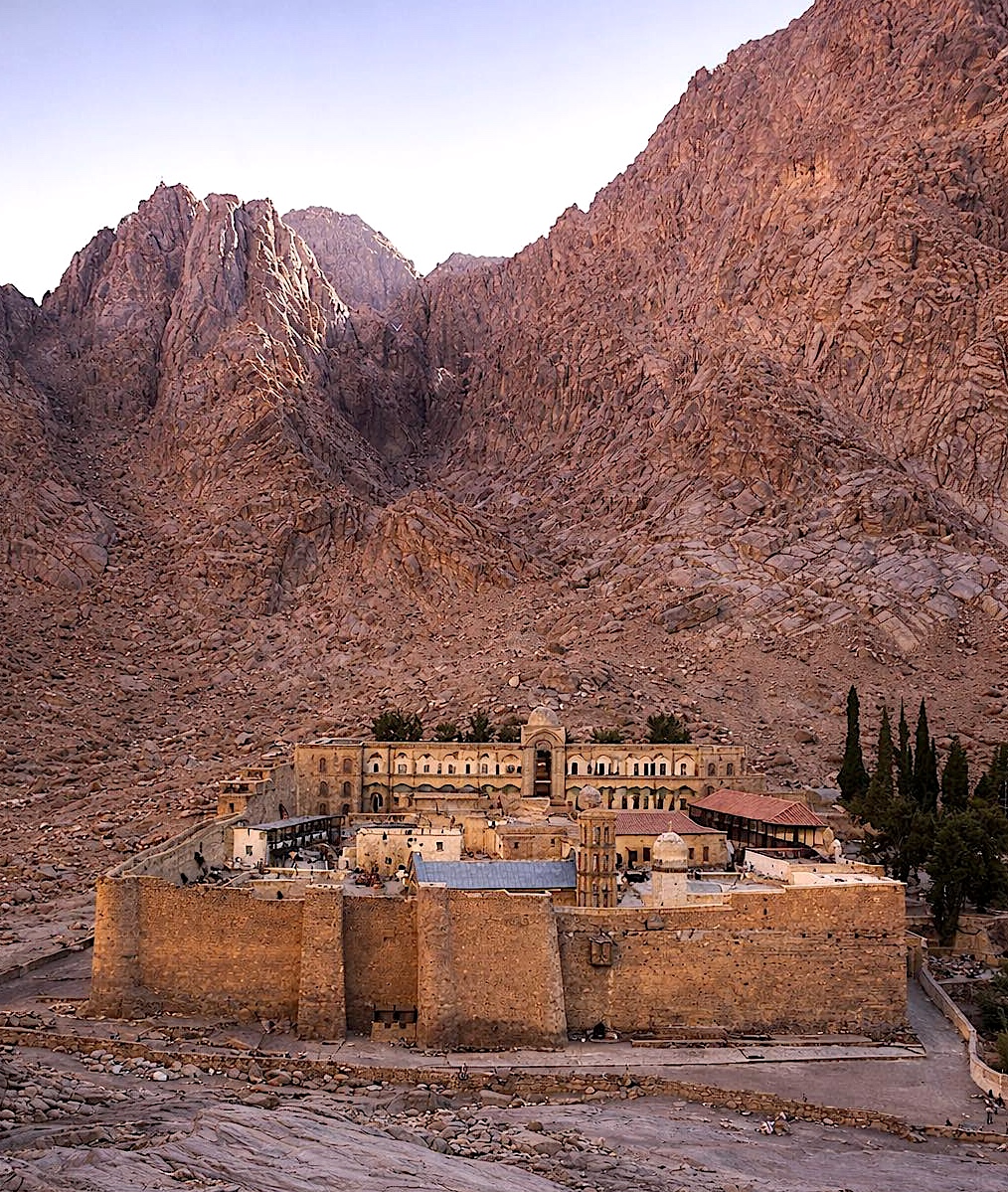
You, the concerned and vigilant reader — and I, who was initially taken by surprise and am now examining the depths of the case of the Sinai Monastery — naïvely believed that the crisis surrounding the ancient monastery, built in the heart of the desert by the renowned Emperor Justinian I fifteen centuries ago, was moving toward resolution.
Yet this crisis was never merely one of administration or spiritual leadership. It was, and remains, multifaceted.
Consequently, the collateral effects — or rather, the consequences of a strategic attack against the Sinai Monastery — continue and are intensifying.
For this reason, public opinion in Greece, in the Orthodox world, in Europe, in the Americas, in Australia, and worldwide must be fully informed of the unlawful schemes being pursued by the Egyptian government — actions that trample upon the commitments Egypt has undertaken under international conventions concluded under the auspices of UNESCO, which form an integral part of international law.
To understand what follows, two fundamental truths must be kept in mind.
First truth: Historical continuity and inviolable rights
The ancient Royal Monastery of Sinai, dedicated to Saint Catherine, has an unbroken historical continuity of fifteen centuries. During this time, it has existed successively under the Roman (Byzantine) Empire, the Umayyad Caliphate, the Mamluk Sultanate, the Crusader Kingdom, the Ottoman Empire, the British Mandate, the modern Egyptian state, and — for roughly a decade following the Six-Day War — Israeli administration.
Moreover, the ascetic Christian presence in the area is even older: hermits, ascetics, and monks are attested in the region from the third and fourth centuries AD, around the Holy Bush beneath the Sacred Mount.
Throughout all these centuries, no sovereign authority — Christian or Muslim — ever questioned the Monastery’s property rights: neither over its built complex nor its chapels, hermitages, desert cells, gardens and orchards, olive groves and fields, dependencies and estates in Faran, Raitho, and Cairo, nor over its movable treasures, including manuscripts and parchments of inestimable value, early printed books, ancient icons, and sacred works of art in goldsmithing, silversmithing, woodcarving, weaving, embroidery, sculpture, and miniature painting.
Nor did any authority ever question the fundamental rights of the monastic Brotherhood living and worshipping within this ancient monastery — rights clearly articulated today in the Universal Declaration of Human Rights.
Thus, the Egyptian government, by turning against the rights of the Sinai Monastery and its Brotherhood, is in effect turning against the individual and collective rights of the oldest organized minority in the region, in direct violation of international law.
This minority does not consist solely of the monks of Sinai, but also includes the Bedouin communities historically and inseparably connected to the Monastery, who for centuries have served it under arrangements instituted by its founder, Emperor Justinian.
Second truth: Binding international obligations under cultural-heritage law
Because of the exceptional importance of the Sinai Monastery as a living monument of human civilization — a monument of history and the arts, architecture and painting, sculpture and woodcarving, music and mosaics, manuscript illumination, enamel and ivory; a monument of ascetic life and theology; a monument with an incomparable library containing the oldest biblical codex, the famed Codex Sinaiticus; a monument at the crossroads of civilizations, peoples, religions, and languages — Egypt has committed itself to its comprehensive protection through binding international conventions concluded under UNESCO.
Accordingly, any individual, institution, or state engaging with the Sinai question must recognize that Egypt’s actions on the Sinai plateau — where the Burning Bush stands at the foot of the Holy Peak — constitute a flagrant, provocative, and shameless violation of international law at its very core.
This violation concerns not peripheral matters, but the blatant breach of the Universal Declaration of Human Rights and of the international conventions protecting the cultural heritage of humanity, in relation to a living monument of incalculable value: the Justinian Monastery of Sinai.
International law vs. political complicity
This conduct has been publicly condemned by international media and formally denounced by the NGO World Heritage Watch through a complaint submitted to UNESCO and co-signed by more than fifty additional organizations.
Yet in Greece — with notable exceptions — a silence has been imposed on the mass media. As the poet wrote, “a deathly silence reigns over the plain.”
Why this deliberate effort to obscure the facts?
The answer is disturbingly clear. Those in Athens — shamefully — have engaged in transactions that serve the outright illegal actions of the Egyptian government, facilitating violations of international law committed against:
• the Sinai Monastery,
• the monastic Brotherhood, and
• the Bedouin community —
violations already being examined by international legal experts as potential acts of cultural genocide.
How could a Greek government assist such crimes — crimes that, if known to the Greek people, would provoke outrage?
In only one way. By persuading, coercing, deceiving, blackmailing, or bribing an agreement between Egypt and the Holy Monastery of Sinai — one that could be presented internationally as a voluntary renunciation by the Archbishop of Sinai–Faran–Raitho and by the Brotherhood as a whole, thereby enabling Egypt to circumvent all its international obligations.
There is no other mechanism by which Egypt could evade its commitments under international law.
Do we remember Ephialtes, who knelt before Xerxes to reveal the mountain path that allowed the Persians to encircle Leonidas and the three hundred Spartans at Thermopylae?
In this disgraceful effort to circumvent international law — which exists to defend the cultural heritage of humanity — the government in Athens has assumed the role of a modern Ephialtes.
Three months after the celebratory enthronement of the new Archbishop of Sinai–Faran–Raitho, Symeon, the Egyptian government still refuses to issue the mandatory Presidential Decree recognizing his office, thereby denying him legal standing within Egypt and internationally.
This refusal cripples the administration of the Monastery, renders the Archbishop unable to sign legal documents, prevents the appointment of independent legal counsel, and obstructs the defense of the Monastery in three ongoing court cases aimed at expropriating property held continuously for fifteen centuries.
What is unfolding is a parody of justice: planted lawyers, compliant judges, sham proceedings — all designed to annihilate the oldest organized minority in Egypt while trampling international treaties and the rule of law itself.
And this is precisely why Egyptian and Greek officials are doing everything possible to prevent the American law firm Baker McKenzie from representing the Monastery: because the moment real international scrutiny begins, the secret diplomacy collapses.
Thus, under the guise of “compromise,” illegal pressure is applied behind closed doors, while no written text is disclosed — neither to the monks, nor to international institutions, nor to global public opinion.
Time for action: the creation of an international watchdog
As our people say: when the village is in sight, it needs no guide.
What is at stake is nothing less than the integrity of international law itself.
For this reason, we announce the founding of the international NGO World Christian Heritage Watch, dedicated to coordinated global action for the defense of the ancient Sinai Monastery — not secret deals, not coercion, and not the grotesque spectacle of international law being trampled and global public opinion mocked.
____________________________