
By Coptic Solidarity –
An armed assault on a senior Christian archbishop in the Syrian city of Homs raises serious questions about the ability—and determination—of Syria’s transitional authorities to guarantee security and equal citizenship.
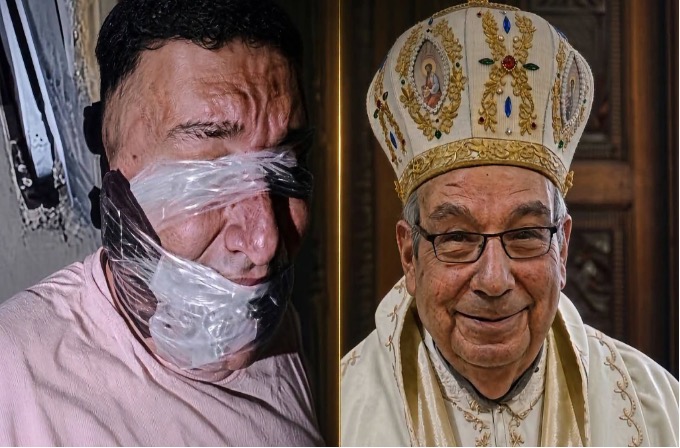
Melkite Greek Catholic Archbishop Youhanna (Jean) Abdo Arbach, 74, was assaulted on November 14, 2026 by five armed men who entered his office at the archdiocesan headquarters in the Old City of Homs, tied him up, blindfolded and gagged him, and ransacked the premises.
According to Syrian media reports citing sources close to the archbishop, the assailants beat him and stole approximately $20,000, three million Syrian pounds, his gold pectoral cross, and other valuable religious objects belonging to the Church. The forcible removal of his cross was also independently confirmed by Father Firas Lutfi, head of the Franciscans in Syria.
Father Firas Lutfi, head of the Franciscans in Syria, confirmed that at least three armed men had forced their way into the premises. Other accounts describe the archbishop being struck and humiliated during the assault.
Photographs circulated afterward showing the elderly prelate with his eyes and mouth covered by tape, illustrating the humiliating treatment to which he had been subjected.
Speaking to ACN on November 17, Archbishop Arbach confirmed that he was safe and expressed gratitude for the prayers and solidarity he had received. He declined to speculate about the perpetrators’ motives while the authorities’ investigation remained underway.
The archbishop has led the Melkite Greek Catholic Archdiocese of Homs since 2012 and has remained closely involved in humanitarian assistance and reconstruction efforts throughout Syria’s prolonged conflict.
Patriarchs Warn: These Are Not Isolated Incidents
On November 17, three of Syria’s most senior Christian leaders issued a joint statement condemning the attack and expressing profound alarm over the deteriorating security situation.
The statement was signed by Melkite Greek Catholic Patriarch Youssef I Absi, Greek Orthodox Patriarch John X, and Syriac Orthodox Patriarch Ignatius Aphrem II.
Their message went far beyond condemnation of the assault on Archbishop Arbach.
The patriarchs warned that Christians have faced repeated attacks, kidnappings and demands for exorbitant ransoms, stressing that such incidents cannot be treated as isolated criminal episodes.
They specifically referred to recent events in Al-Suqaylabiyah, a predominantly Christian town in the Hama countryside, including the abduction of Christian goldsmith Maher Sankari. His kidnappers reportedly demanded a substantial ransom and circulated footage showing him being tortured.
The patriarchs directly questioned the failure of the authorities to provide effective protection or demonstrate tangible results in investigating these incidents.
They warned that the continued violence and apparent impunity raise grave questions about the future of Christians in Syria.
Their statement also insisted that Christians must not be treated as easy targets for abuse, while reaffirming their commitment to peaceful relations with Muslim fellow citizens on the basis of full and equal citizenship.
The significance of this joint intervention should not be underestimated. Leaders of three major Christian Churches, representing different ecclesiastical traditions, have publicly challenged the authorities over a continuing pattern of insecurity and the absence of effective accountability.
State Responsibility
Although the assault involved theft, reducing it to an ordinary robbery would overlook its broader significance.
The attackers targeted a prominent Christian religious leader inside his ecclesiastical headquarters, subjected him to physical restraint and humiliation, and stole objects associated with his religious office.
The perpetrators’ identities and motives have not yet been established, and there is presently no verified evidence linking them to government forces. Nevertheless, the incident must be considered within the wider climate of insecurity affecting Syria’s Christian communities.
Since the overthrow of Bashar al-Assad in December 2024 and the establishment of the transitional government headed by Ahmed al-Sharaa, Syria has experienced recurrent violence involving religious and ethnic communities.
In June 2025, a suicide bombing at the Greek Orthodox Church of Mar Elias in Damascus killed 25 people and injured dozens more. Other incidents have included attacks on Christian individuals and institutions, kidnappings, and intimidation.
In a November 6 interview with AsiaNews, Syriac Catholic Archbishop Jacques Mourad of Homs expressed concern about increasing Islamization and discrimination against Christians under the new authorities.
The assault on Archbishop Arbach has therefore reinforced fears that the vulnerability of Christian communities is not merely a consequence of general lawlessness but is aggravated by the failure to establish reliable and impartial protection.
This distinction is fundamental. Even where attacks are committed by criminal gangs or armed groups operating independently of the government, the state remains responsible for investigating crimes, prosecuting perpetrators, protecting vulnerable citizens and preventing impunity.
The repeated failure to do so risks encouraging further violence and accelerating the departure of Christians from a country where their communities have existed since the earliest centuries of Christianity.
Syria’s Christian population has already declined dramatically after more than a decade of war, displacement and emigration. The remaining communities now face the additional uncertainty of whether they can continue to live and worship securely under the country’s new political order.
The November 17 statement by the three patriarchs constitutes an unmistakable warning. Assurances of coexistence and respect for religious diversity will carry little credibility unless accompanied by effective protection, transparent investigations and accountability.
The assault on Archbishop Arbach must therefore be judged not only by whether the stolen property is recovered or the individual attackers are arrested, but by whether Syria’s authorities demonstrate that Christians—including their religious leaders and institutions—are entitled to the same security, dignity and protection of the law as every other citizen.
_________________
Sources:
https://www.indcatholicnews.com/news/56329
https://www.pillarcatholic.com/p/what-does-the-attack-on-archbishop