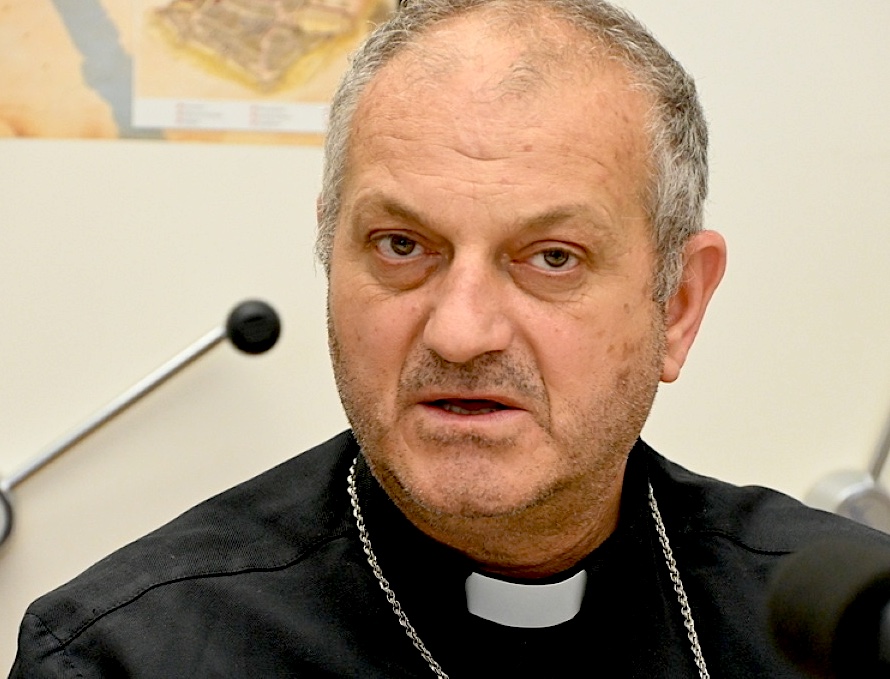

The Syriac Catholic Archbishop of Homs says Christians face shrinking opportunities, growing pressure to leave and an increasingly Islamic public sphere under Syria’s new government.
In an interview with AsiaNews, Archbishop Jacques Mourad described a country where economic recovery has stalled and relations between neighbours are deteriorating. His account draws on conditions he observes in Homs; several of his broader claims, including changes to school instruction, require independent verification.
Mourad’s diocese currently includes about 75,000 Christians, roughly a third of them Catholic. Before becoming archbishop, he served at the monastery of Mar Elian in Qaryatayn, where ISIS abducted him and held him for six months. His warning about Syria’s future comes from a bishop who has seen both armed persecution and the pressures now affecting ordinary life.
Shrinking Opportunities
Homs, Mourad said, looks much as it did two years ago. Bombed homes have not been rebuilt, many people cannot afford housing, and work remains scarce. Some Syrians returning from Turkey and Gulf countries have opened shops, but he described these as isolated efforts rather than evidence of a wider recovery. He said he hears that some displaced people remain in camps because they have tents there, although he acknowledged that he has no official figures.
The archbishop also questioned the government’s administrative capacity. In his account, experienced officials from the previous administration were dismissed without being replaced by people with comparable expertise. He said those removed included Alawites, Christians and Sunnis. The resulting weakness, he argued, has hindered the functioning of public services at the moment when reconstruction and effective administration are urgently needed.
For Christians, the economic crisis carries an additional risk. Mourad said many have already been driven out and that certain jobs, particularly in the civil service, are no longer open to them. He described discrimination extending into commerce: some customers, he said, prefer Muslim-owned businesses over Christian-owned ones. He attributed this partly to religious teaching that encourages Muslims to support other Muslims first. The interview offers his assessment of these patterns, rather than employment or trade data establishing their scale.
An Increasingly Islamic Public Sphere
Mourad said Islamisation is visible in clothing and in the operation of government offices. He cited civil servants stopping work at prayer times and Qur’anic verses displayed in public buildings. He was especially concerned about education. According to his understanding, schools have moved from one hour a week of religious instruction according to each pupil’s tradition to four hours of compulsory Qur’an study for all. That reported change would have direct consequences for Christian children, but the precise policy and its implementation need to be checked against official curricula and school practice.
Schools remain open to both boys and girls, Mourad said, and he acknowledged a greater ability to speak publicly and denounce wrongdoing than Syrians had under the previous government. Yet he warned that the justice system’s transitional arrangements leave room for violent acts and revenge. Freedom to speak offers limited reassurance, in his view, if people cannot rely on protection or equal treatment.
His deepest concern is the breakdown of trust within communities. During the war, he recalled, hardship sometimes drew people closer together. Now he sees fear spreading between neighbours. He said some people returning from Idlib regard Islam as the only true path and others as kuffār, or unbelievers, and that such attitudes are influencing society more widely. These are Mourad’s observations; they should not be taken as a description of every returnee.
The combined effect, he said, is driving more Christians to consider departure. He described many as distressed or desperate. Without the Church’s continued presence and support, he fears that Syria could lose its remaining Christian communities. The risk is gradual as well as immediate: families facing damaged homes, scarce work, exclusion from jobs and pressure on their children’s education may see no viable future in the country.
Mourad nevertheless pointed to people resisting that breakdown. The Mar Musa community, which he helped establish with Father Paolo dall’Oglio in the 1990s, continues to offer stability and refuge. In Homs, he said, young Christians and Muslims work together to help street children, people with disabilities and children from refugee camps who have missed school.
Those efforts show that cooperation remains possible. Mourad’s warning is that it needs room to survive. As Christian families weigh whether to stay, their future will depend on more than assurances of coexistence: they need access to work and education, functioning institutions, and confidence that their neighbours and the state will treat them as equal citizens.