
By Jalal Tagreeb- MEF –
Summary of “The Sword and the Tongue: Jihad’s Long Shadow over Christians in Turkey,” published by the Middle East Forum.
Jihad, Dhimmitude, and the Institutions of Subordination
The conquest of Anatolia by successive Muslim powers initiated a centuries-long transformation of a region that had once been overwhelmingly Christian. The establishment of Islamic rule introduced systems of religious subordination, taxation, enslavement, conversion, and population displacement that progressively weakened Christian communities. These practices, developed and institutionalized over centuries, formed part of the historical background to the mass destruction of Armenians, Assyrians, and Greeks during the final years of the Ottoman Empire.
Classical Islamic jurisprudence distinguished between jihad of the sword (jihad bi’l=sayf) and jihad of the tongue (jihad bi’llisan). The former encompassed armed struggle and territorial conquest, while the latter involved preaching, religious argument, and the defense and propagation of Islamic doctrine. Together, they provided military and ideological mea ns through which Islamic authority expanded and consolidated its control over conquered populations.
Under the resulting political order, Christians and Jews could generally retain their religions as protected but subordinate communities, known as dhimmis. Their status was conditional upon acceptance of Muslim supremacy and compliance with discriminatory legal and fiscal obligations. The jizya, a poll tax imposed on non=Muslim subjects, symbolized and reinforced their subordinate position. Although the system provided a framework for the continued existence of Christian communities, it denied them equality with Muslims and exposed them to varying restrictions on public religious expression, legal standing, and social participation.
The economic organization of conquest reinforced this hierarchy. Conquered territories supplied agricultural revenues, taxation, and labor, while religious distinctions determined the obligations imposed upon different populations. Conversion to Islam could remove certain burdens and facilitate social advancement, creating additional incentives for the gradual Islamization of conquered societies.
Beyond taxation, successive Islamic states employed other instruments that affected the demographic and religious composition of their territories. Enslavement of non-Muslim captives was permitted under classical Islamic law and became an enduring institution. Christian populations were exposed to slave raids, captivity, and trafficking across several regions, including the Mediterranean and territories connected to the trans- Saharan and Indian Ocean slave trades.
Under Ottoman rule, the devshirme system institutionalized the periodic recruitment of Christian boys, particularly from the Balkans. Taken from their families, converted to Islam, and trained for military or administrative service, these children entered the Janissary corps or the imperial establishment. The system simultaneously deprived Christian families of their sons and supplied the Ottoman state with personnel whose identities and loyalties were reshaped through conversion and imperial service.
Other practices included the use of eunuchs in imperial households and administrative institutions, as well as compulsory population transfers. Ottoman sürgün policies relocated communities for military, economic, and political purposes, including the consolidation of newly conquered territories and the weakening of populations regarded as potentially disloyal. Such practices established precedents for using state power to alter the demographic composition of strategically important regions.
From Legal Discrimination to Mass Violence
The nineteenth=century Ottoman reforms formally challenged the religious hierarchy inherited from earlier centuries. The Tanzimat decrees of 1839 and 1856 promised greater equality among Ottoman subjects, regardless of religion, while the traditional jizya was abolished. Nevertheless, these legal reforms did not eliminate entrenched social discrimination or ensure effective protection for Christian populations.
The vulnerability of Ottoman Christians became increasingly evident during the empire’s final decades. Between 1894 and 1896, large numbers of Armenians were killed in the Hamidian massacres, carried out by irregular forces, local groups, and elements associated with Ottoman authority. Forced conversions accompanied violence in some areas. The Adana massacres of 1909, which killed approximately 15,000 – 25,000 Armenians, further demonstrated the persistence of anti-Christian violence despite constitutional reforms and promises of equality.
The Destruction of Anatolia’s Christians, 1914–1923
Between 1914 and 1923, the Ottoman state and its successors carried out the systematic destruction of major indigenous Christian communities. The Armenian Genocide claimed an estimated one to one and a half million lives through massacres, forced deportations, starvation, and exposure. Assyrian and Chaldean Christians suffered the genocide known as Sayfo, while Ottoman Greeks experienced mass killings, expulsions, and forced population transfers, particularly in Pontus and western Anatolia. The destruction of Smyrna in September 1922, including the burning of Greek and Armenian neighborhoods, marked one of the final major episodes of this catastrophe.
The methods employed included deportation, mass confiscation of property, forced Islamization, and the absorption of Christian women and children into Muslim households and institutions. Tens of thousands of Armenians were incorporated into Muslim families, harems, and orphanages during and after the deportations. These measures reflected earlier practices through which conquered populations had been displaced, assimilated, or deprived of their communal identities.
The genocides were driven by a combination of Turkish nationalism, wartime security fears, territorial ambitions, and policies of ethnic homogenization. Islamic doctrine was not necessarily their immediate or principal cause. Nevertheless, the Ottoman authorities inherited longstanding precedents for treating Christian populations as legally subordinate and subject to displacement, conversion, and dispossession. The Young Turk leadership adapted these precedents to a modern program of demographic transformation on an unprecedented scale.
Impunity and the Unresolved Legacy
The destruction of Ottoman Christians occurred despite extensive international knowledge of the atrocities. American diplomats, missionaries, and consular officials documented massacres and deportations and transmitted detailed reports to Washington. Their testimony helped mobilize humanitarian assistance through Near East Relief, which supported hundreds of thousands of survivors.
Following the First World War, Ottoman courts=martial prosecuted and convicted several senior officials involved in organizing the atrocities, although many convictions were issued in absentia. These proceedings did not lead to a comprehensive international system of accountability. The 1923 Treaty of Lausanne, which replaced the more punitive Treaty of Sèvres, established the diplomatic settlement with the new Turkish Republic without providing adequate mechanisms for reparations, restitution of confiscated property, or prosecution of those responsible.
The result was that the destruction of Armenian, Assyrian, and Greek communities remained largely without legal redress. International political priorities prevailed over demands for accountability, while survivors and their descendants were left without comprehensive restitution for their losses.
The historical record therefore raises questions about the responsibility of Islamic religious institutions to confront the discriminatory foundations of dhimmitude, the classical interpretations of jihad, and the consequences of the jizya system. Acknowledgment of the subordinate legal position assigned to Christians and Jews, serious theological examination of Qur’an 9:29 and its traditional interpretations, and support for restitution and reparative measures are presented as necessary elements of historical accountability.
The destruction of Anatolia’s Christian communities was not an inevitable consequence of Islamic scripture, nor can it be explained by religious doctrine alone. Yet it also did not emerge in a historical vacuum. Centuries of institutionalized inequality and established practices of demographic control provided precedents that were subsequently adapted to the nationalist and wartime objectives of the late Ottoman authorities. The absence of comprehensive accountability continues to burden the descendants of the Armenian, Assyrian, and Greek communities whose societies were devastated.
__________
Source: https://www.meforum.org/dhimmitude-project/the-sword-and-the-tongue-jihads-long-shadow-over-christians-in-turkey
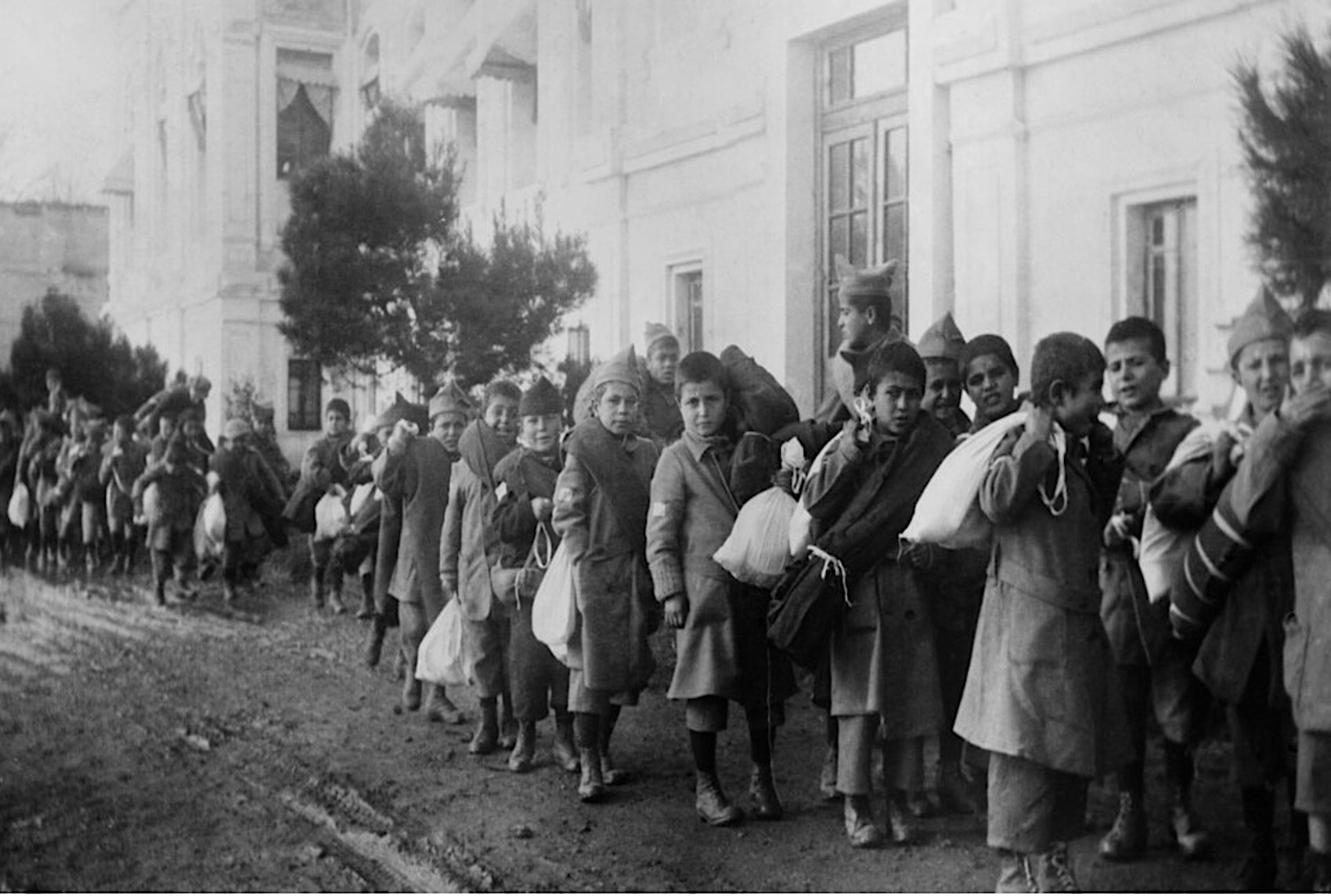
Photo: The near-destruction of non-Muslim communities in the Anatolian peninsula, which accelerated in the final decades of the Ottoman Empire, drew on practices long established under Islamic rule: enslavement, deportation, the forced levy of Christian children, and, in some instances, the castration of captives. Above, Armenian orphans being deported, ca. 1920. (Shutterstock)