
By Raymond Ibrahim –
While the UN “Human Rights Council” fixates on “transgenderism” and “Islamophobia,” nearly 400 million Christians are silently being persecuted — mostly by Muslims.
Donald Trump has once again solidified his reputation as the only modern American president to repeatedly mention and condemn the very real and horrific persecution of Christians around the world.
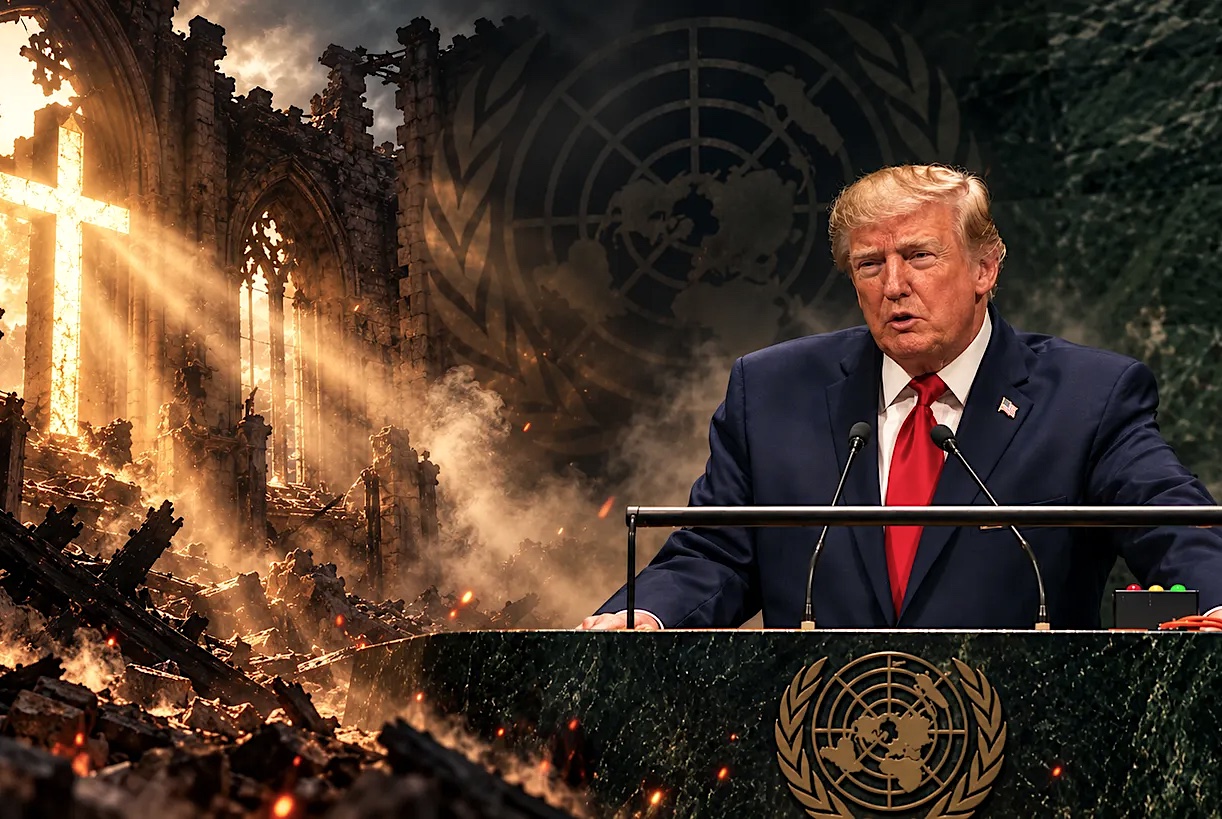
During his Sept. 22 speech before the U.N.—and in the context of condemning the “craven hypocrites of the Human Rights Council”—he said:
It is equally unacceptable that with all the genuine atrocities in the world, the UN’s top human rights officials spend their time criticizing the United States for protecting our children from transgender mutilation and transgender insanity and enforcing our immigration laws. What they do is unbelievable, what they do. It’s transgender mutilation of our children.
The craven hypocrites of the Human Rights Council have little to say about the persecution of Christians.
I mean, Christians are being persecuted all over the world. It’s not even believable. I never thought I’d say it, but it’s been happening for a long time. So this is persecution of Christians (…)
Both of Trump’s points—that the global persecution of Christians and the U.N.’s hypocrisy are “not even believable”—are truer than he may know.
In fact, what is happening on both counts is surreal.
On the first point, consider: In 2025, around the world, 388 million Christians suffered high levels of persecution and discrimination for their faith; an additional 4,849 Christians — more than 13 a day on average — were killed for faith-related reasons. Another 4,712 were detained without trial, and 3,632 churches and Christian properties were attacked, torched, or merely shut down.
That is persecution; that is what the U.N. should focus on—instead of trying to “shame” the U.S. into mutilating its children in the supposed name of “human rights.”
One fact may explain why the “craven” U.N. is so silent: the overwhelming majority of the worst persecution takes place at the hands of Muslims. Indeed, the persecution of Christians taking place in 39 of the absolute worst 50 nations—that is, a full 78%—is committed by Muslims.
Muslim persecution of Christians also has an existential quality to it. Although North Korea ranks as the worst persecutor of Christians, there is still a light at the end of that tunnel: the persecution is entirely connected to the regime of Kim Jong-un. Once it is gone, which is inevitable, North Korea may well become like South Korea, where Christianity is flourishing.
Conversely, the persecution of Christians by Muslims is perennial, existential, and far transcends this or that ruler or regime. Muslim persecution of the “other” is simply part of Islam’s history, doctrines, and socio-political makeup — hence its tenacity and ubiquity.
It is further telling that the 39 Muslim nations of the worst 50 are different in many respects—racially, socially, economically, and governmentally: some are filthy rich (Saudi Arabia), while others are unimaginably poor (Somalia); some are technologically advanced (Iran), while others are far from it (Yemen); they are represented by a variety of governments (republics, monarchies, theocracies); and various different races are represented — Arabs, Persians, sub-Saharan Africans, Pakistanis, East Asians, and Afghans. Their only commonality—the common denominator they all share—is religion.
On Trump’s second point—the U.N.’s sheer hypocrisy—the evidence is arguably more overwhelming. Consider: in 2022, the U.N. named March 15 “International Day to Combat Islamophobia.” It chose that date because an Australian man killed 51 mosque-attending Muslims in New Zealand on March 15, 2019.
This would seem to make perfect sense—except for one inconsistency: As I documented in this article, in recent years, Muslims have barged into dozens of churches where they have massacred well over 1,000 Christians.
This begs the question: If one non-Muslim attack, which claimed 51 Muslim lives, was enough for the U.N. to create an “International Day to Combat Islamophobia,” why have countless attacks on churches, which have claimed over 1,000 Christian lives, not been enough for the U.N. to establish an “International Day to Combat Christianophobia”?
This question becomes even more pressing when one realizes that, whereas the New Zealand mosque attack was, indeed, an aberration — evidenced by its extreme singularity — Muslim attacks on churches are very common (including historically). Seldom does a month pass in the Muslim world, and increasingly in the West, without several assaults on or harassments of churches taking place.
It’s also telling that those Muslims who terrorize churches often share little with each other. As seen, they come from widely different nations (African Nigeria, Arab Iraq, Asian Philippines, etc.), are of different races, speak different languages, and live under different social, political, and economic conditions. The only thing they do share in common is their religion.
Muslim attacks on churches are ideologically driven; they have long been and continue to be systemic and systematic; they are, therefore, an actual, ongoing problem that the international community needs to highlight and ameliorate.
Yet the U.N. would have us ignore all this and instead fixate on one solitary incident: a Western man killing 51 Muslims.
This, for the UN, is what truly evinces a “pattern” and is in dire need of recognition and response. And that response is to shut down all those who dare connect the dots and expose Islam’s heavily documented pattern of violence against non-Muslims — which, make no mistake, is precisely what “combatting Islamophobia” is all about.
In short, Donald Trump is to be commended for both calling out the elephant in the room, Christian persecution, and the cowardice if not treachery of the U.N.
This, of course, is a far cry from saying anything will be done on either score.
___________________