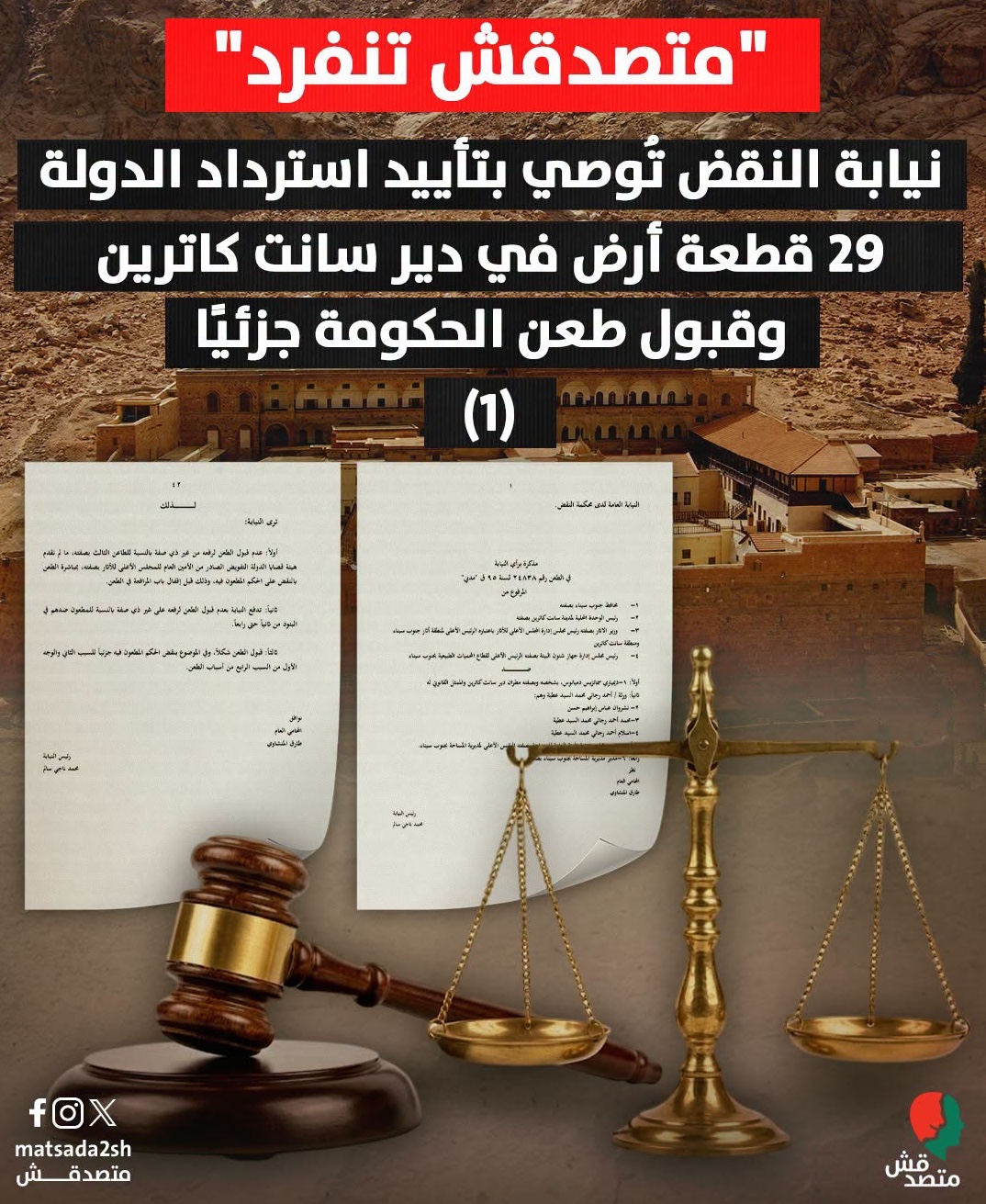

The platform Matsada’sh (“Don’t Believe It”) has obtained copies of the two memoranda submitted by the Public Prosecution before the Court of Cassation on 5 July 2026 concerning the two appeals filed by the Government and by St. Catherine’s Monastery against the judgment rendered by the Ismailia Court of Appeal in the dispute over dozens of parcels of land and real properties associated with the Monastery.
These memoranda do not constitute a final judicial ruling. Rather, they are advisory legal opinions submitted by the Public Prosecution to the Court of Cassation. The Court remains free either to adopt or reject those recommendations. The appeals are scheduled to be heard on 23 August.
According to the memoranda, the Public Prosecution recommends:
- rejecting the Monastery’s appeal in its entirety; and
- partially accepting the Government’s appeal.
Origins of the dispute
The litigation began when the Government filed Civil Case No. 24 of 2015 before the South Sinai Court of First Instance, seeking recovery of 71 parcels of land claimed to belong to St. Catherine’s Monastery. It requested that the Monastery surrender the properties, pay compensation for its use of them, and pay occupation fees for the period during which it had possessed them.
The Government argued that a number of the disputed properties belong to the State and that the Monastery’s possession of them lacked a valid legal basis.
The Monastery responded that its possession of the lands was of ancient origin rather than recent, that many of the properties are historically inseparable from the Monastery and its religious and cultural heritage, and that legal instruments, contracts, and documentary evidence support its rights with respect to a number of the disputed parcels.
Throughout the proceedings, court-appointed experts examined the legal status of each parcel, its characteristics, and its relationship to the Monastery, religious sites, and archaeological areas.
Proceedings before the lower courts
After years of litigation, the South Sinai Court of First Instance issued its judgment on 30 May 2022, ordering the eviction of occupants from 29 parcels and their restoration to the State. Both parties appealed.
On 28 May 2025, the Ismailia Court of Appeal (El-Tor Circuit) affirmed the first-instance judgment. It distinguished among the various categories of disputed properties:
- some were found to be connected with the Monastery’s religious or historical function and therefore remained in its possession;
- others were treated differently on legal grounds, being classified as archaeological or historical sites subject to the legislation governing natural protectorates.
The Government maintained that the appellate judgment had erred in rejecting some of its claims and in dismissing others on procedural grounds, whereas the Monastery argued that the judgment had failed to give full effect to its defenses concerning possession, ownership, and contractual rights relating to the disputed lands.
The appeals before the Court of Cassation
The Government filed Appeal No. 24838 of Judicial Year 95 on 23 July 2025, seeking reversal of those parts of the appellate judgment concerning properties which it contends should be recovered by the State. It alleged errors in the application of law, inadequate reasoning, and defective legal analysis.
The Government’s appeal was filed by the Governor of South Sinai, the Head of the Local Authority of St. Catherine, the Minister of Antiquities; and the Head of the Environmental Affairs Agency.
The Monastery, for its part, filed Appeal No. 24962 of Judicial Year 95, requesting reversal of those portions of the judgment that rejected its claims and defenses.
After examining both appeals, the Public Prosecution reached different conclusions regarding each. It recommended:
- accepting the Government’s appeal in part; and
- accepting the Monastery’s appeal procedurally but dismissing it on the merits, concluding that no sufficient legal grounds existed to overturn the appellate judgment in the Monastery’s favor.
Recommendation on the Government’s appeal
The Government advanced six grounds of appeal.
The Public Prosecution did not adopt all of them. Rather, it distinguished between grounds that did not justify cassation and those that disclosed legal errors warranting partial quashing of the judgment.
Accordingly, it recommended accepting the appeal procedurally and quashing the challenged judgment only with respect to the second ground and the first limb of the fourth ground of appeal.
The memorandum stresses that this recommendation:
- does not seek to overturn the appellate judgment in its entirety;
- does not recommend awarding all 71 disputed parcels to the State;
- but rather identifies specific aspects of the judgment that require reconsideration because of legal error.
Under Egyptian cassation procedure, a partial quashing annuls only the defective portion of the judgment while leaving the remainder intact.
Lack of legal standing should not prevent examination of the merits
One of the most important issues addressed by the Public Prosecution concerned those parcels for which the Court of Appeal had dismissed the Government’s claims because they had been brought by parties lacking legal standing (صفة).
The Government argued that the appellate court should nevertheless have examined the underlying questions concerning:
- the legality of the Monastery’s possession; and
- the legal basis of its title.
The memorandum agrees that, in certain instances, lack of standing should not prevent examination of the substantive dispute where the documents and facts disclose a legal relationship requiring adjudication.
The Public Prosecution therefore considered that, with respect to some parcels, the appellate court erred by declining to examine the legality of the Monastery’s possessory title, justifying partial cassation.
The memorandum identifies eight parcels affected by this recommendation and also notes that the experts failed to express an opinion concerning parcels 51 and 52.
Importantly, it emphasizes that this recommendation does not mean these parcels belong to the State. Rather, it means only that they require fresh judicial examination because they were not adjudicated according to the proper legal standards.
Reconsideration of certain religious sites
The Public Prosecution also addressed one aspect of the Government’s fourth ground of appeal concerning 28 locationsthat the appellate court had classified as religious sites, thereby rejecting the Government’s requests for eviction.
The Government argued that the appellate court erred because:
- some of these sites lacked conventional ecclesiastical features;
- some were not registered as archaeological monuments; and
- some buildings lacked relevant administrative decisions.
The Public Prosecution rejected that argument in principle.
It held that the absence of visible ecclesiastical characteristics does not necessarily deprive a site of its religious character.
Nevertheless, it concluded that the appellate court had failed adequately to examine the legal nature of certain other sites and parcels, thereby justifying partial cassation with respect to those limited issues.
The Public Prosecution did not recommend quashing the judgment in its entirety
The memorandum explains that many of the Government’s arguments merely challenged the trial court’s evaluation of evidence—matters outside the jurisdiction of the Court of Cassation.
It also found that the appellate judgment was correct with respect to parcels supported by:
- contracts;
- existing legal arrangements; or
- governmental instruments demonstrating a lawful basis for the Monastery’s possession, rather than mere unlawful occupation.
Regarding acquisitive prescription (ownership acquired through long possession), the memorandum notes that the mere passage of time is insufficient where public property or archaeological land is concerned. Each parcel must instead be assessed according to its own legal circumstances.
Accordingly, the Public Prosecution recommended neither complete victory for the Government nor giving the Monastery what it asked for. Instead, it proposed leaving most of the appellate judgment intact while reopening examination of specific issues where it considered the law had not been correctly applied. The final decision now rests with the Court of Cassation.
___________________