
By Coptic Solidarity –
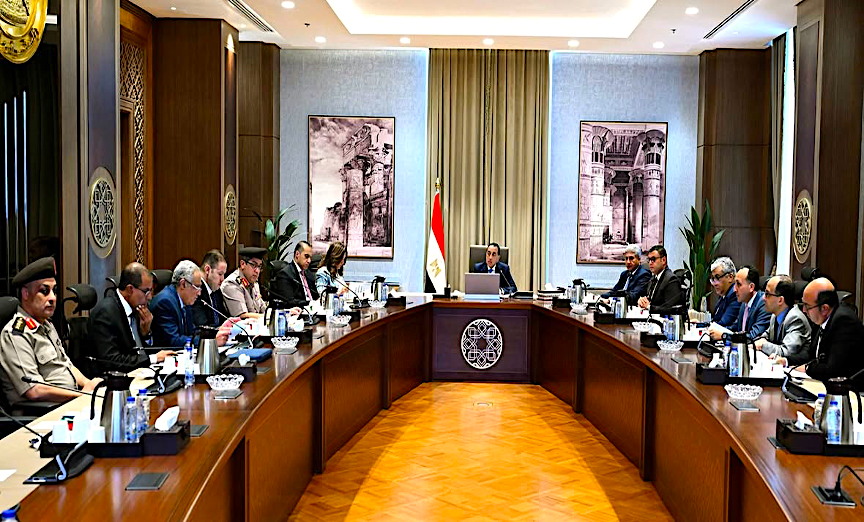
Prime Minister Dr. Mostafa Madbouly chaired, on April 15, a meeting of the main committee tasked with legalizing the status of churches and their affiliated service buildings, in the presence of senior ministers and officials from key state bodies, including the Ministries of Housing, Justice, and Local Development, as well as representatives of the Armed Forces Engineering Authority.
According to Cabinet spokesperson Counselor Mohamed El-Homsany, the committee reviewed the results of recent assessments concerning churches and affiliated buildings that had applied for legalization. Following this review, the committee approved the legalization of 191 churches and associated structures. This brings the total number of churches and affiliated buildings whose status has been regularized since the committee began its work to 3,804.
While presented as a positive administrative development, the announcement must be understood within the broader framework established by Egypt’s 2016 Church Construction Law, which subjected thousands of pre-existing churches—many of which had been operating for decades—to a retroactive legalization process. Rather than recognizing these places of worship as lawful by default, the law effectively reclassified them as irregular structures requiring state approval, thereby placing the continued functioning of entire congregations under administrative discretion.
Since the establishment of the legalization committee in 2016, an estimated 5,500 churches and affiliated buildings are understood to have applied for status regularization. Against this baseline, the approval of 3,804 cases over more than nine years—an extended timeframe that underscores the slow and discretionary nature of the process—leaves approximately 1,700 churches and buildings still pending. Many of these remain exposed to closure or restriction due to their unresolved legal status. The pace of approvals—incremental and spread over successive committee sessions—has meant that a significant number of congregations remain exposed to administrative vulnerability for extended periods.
In this context, the ongoing “legalization” process reflects not only bureaucratic regularization but also a system of conditional recognition, in which the right to maintain places of worship remains dependent on compliance with evolving regulatory and security requirements.
The committee’s repeated emphasis on compliance with civil protection requirements, particularly fire safety regulations, illustrates this dynamic. While such standards are presented as neutral technical criteria, they often function as an additional layer of control, conditioning the exercise of religious practice on administrative clearance. The review of compliance for previously approved churches further underscores that legalization is not a one-time recognition, but an ongoing process subject to reassessment.
More broadly, the system operates within a framework of unequal regulation. While churches are subjected to prior authorization, legalization procedures, and ongoing compliance requirements, the construction of mosques—or the conversion of existing buildings into mosques or prayer halls—typically occurs without comparable prior scrutiny, with state oversight—if it occurs—often coming only after the fact, through the possible involvement of the Ministry of Awqaf in assuming the site’s operation. One notable asymmetry in regulatory conditions is that a church cannot be built within less than 100 meters of a mosque, whereas a mosque may be built immediately adjacent to a church.
This disparity reflects not merely administrative difference, but a divergence in underlying regulatory logic: one system governed by pre-emptive control and conditional recognition, the other often shaped by post hoc accommodation.
The cumulative figure of 3,804 legalized churches and affiliated buildings may therefore be significant, but also revealing. It points to the scale of the issue inherited by the legalization committee—thousands of churches that had long existed without formal recognition—and highlights the extent to which the state retains authority over their continued operation.
At the same time, the absence of transparency regarding rejected cases, or the exact criteria for approval raises further questions. Without clear timelines or publicly accessible standards, the process remains opaque, leaving affected communities dependent on administrative decisions that are not always subject to effective oversight or appeal.
In this light, the government’s announcement can be read in two ways. On the one hand, it signals ongoing efforts to address a longstanding issue related to church status. On the other, it underscores the persistence of a regulatory framework in which the construction, recognition, and continued operation of churches remain subject to layers of control not equally applied to other religious institutions.
Ultimately, the issue extends beyond administrative procedures. It touches on the broader question of whether freedom of worship in Egypt is implemented as a guaranteed right or managed as a regulated and conditional exception—granted incrementally, monitored continuously, and contingent upon compliance with shifting institutional requirements.