
For Immediate Release
(Washington, DC) April 13, 2026 – Christian Newswire
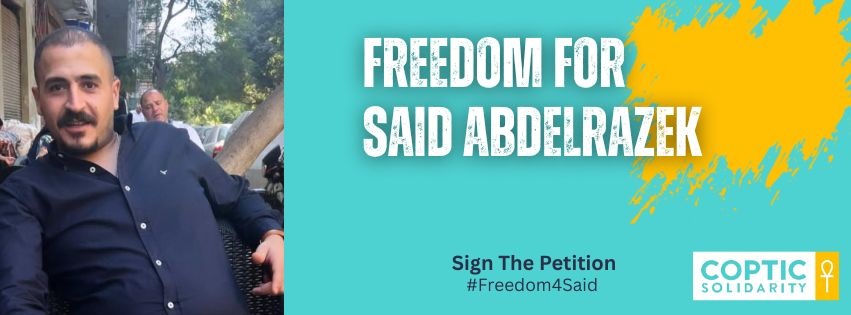
Coptic Solidarity is raising urgent alarm over the case of Said Mansour Rezk Abdelrazek, an Egyptian Christian convert who, after months of detention and interrogation by Egypt’s State Security Prosecution, has now been referred to trial before the First Criminal Terrorism Circuit Court in Badr. The proceedings are scheduled to begin on April 21, 2026.
At issue is not merely due process, but the nature of the prosecution itself: a religious conversion is being prosecuted as an act of terrorism.
By referring Mr. Abdelrazek to a terrorism court on charges such as “joining a terrorist organization,” Egyptian authorities are effectively recasting a matter of personal belief and conscience as a national security threat. This represents a profound distortion of both law and logic, raising fundamental concerns about the instrumentalization of counterterrorism mechanisms to suppress religious freedom.
The case also exposes a deeper contradiction. Egypt’s Constitution affirms that “freedom of belief is absolute,” and the country currently serves as a member of the United Nations Human Rights Council. Yet in practice, conversion from Islam is routinely penalized, and in this case elevated to a terrorism offense—revealing a stark, and systematic, gap between declared commitments and actual practice.
The prospect of a fair trial is, in any case, highly questionable. Authorities have refused to grant defense counsel access to the case file or supporting evidence, effectively preventing any meaningful legal preparation. Such restrictions strike at the core of basic fair trial guarantees. Mr. Abdelrazek is scheduled to appear before Judge Mohamed Saeed El-Sherbiny, a jurist associated with severe sentencing in high-profile and politically sensitive cases.
Mr. Abdelrazek’s case stems directly from his conversion from Islam to Christianity—a fundamental right protected under international law. Since his conversion in 2016, he has faced sustained persecution, including arbitrary detention, torture, forced divorce, separation from his child, and ongoing surveillance. The terrorism charges brought against him are widely understood to be pretextual, serving to criminalize his religious identity and peaceful expression of belief.
The case is further aggravated by a clear breach of international protection norms. The United Nations High Commissioner for Refugees (UNHCR) had previously determined that Mr. Abdelrazek is in need of international protection due to a credible risk of persecution. In addition, a court in the Russian Federation issued a binding order on July 17, 2024, prohibiting his deportation. Despite these safeguards, he was forcibly returned to Egypt, where he was subsequently detained.
“This is not only a case of arbitrary detention—it is the direct consequence of unlawful refoulement carried out in defiance of both international protection mechanisms and a binding judicial order,” Coptic Solidarity’s president stated.
With the trial imminent and defense access to evidence denied, the risk of severe sentencing following proceedings that fall far short of international standards is significant. More fundamentally, the case underscores a broader and deeply troubling pattern: religious conversion is being reframed as a security offense, placing individuals at risk of prosecution not for any act of violence, but for the exercise of conscience.
Coptic Solidarity Calls for Immediate International Intervention:
Coptic Solidarity is calling on the international community to act without delay. It urges the United Nations—including the Working Group on Arbitrary Detention and relevant Special Rapporteurs—to intervene, and calls on the United States, European Union member states, Canada, and Australia to urgently raise the case at the highest diplomatic levels.
Should Egypt proceed with this trial, the organization urges foreign governments to send official representatives to monitor the April 21 proceedings, as a critical and minimal safeguard against further violations.
Australia, in particular, has a potentially decisive role, given Mr. Abdelrazek’s pending humanitarian visa application and the presence of his fiancée there. Prompt action could provide a viable pathway to protection in line with international obligations.
“Mr. Abdelrazek’s only ‘crime’ is choosing his faith,” Coptic Solidarity stated. “Failure to act risks normalizing the treatment of religious conversion as terrorism.”