
The Damascus Governorate has ignited a fierce debate over civil liberties and religious pluralism following the issuance of a comprehensive decree that effectively bans the consumption and service of alcohol across the vast majority of the Syrian capital. The new regulations restrict the sale of alcoholic beverages to just three specific neighborhoods—Bab Touma, Al-Qassaa, and Bab Sharqi—and impose strict “sealed-container” only policies.
Stringent Spatial and Legal Mandates
The decree does not merely limit where alcohol can be sold; it imposes a rigorous set of physical and legal hurdles for establishments within the permitted zones:
- Buffer Zones: Permitted shops must be located at a minimum distance of 75 meters from any place of worship (including both mosques and churches), schools of all levels, and cemeteries.
- Government Proximity: A strict 20-meter radius ban is enforced around police stations (mukhtars) and all official government buildings.
- Licensing Requirements: Establishments must possess an original commercial building license to be eligible for an alcohol permit.
- The “No-Glass” Pledge: Shop owners are required to sign a notarized pledge before a public notary, swearing that they will not serve alcohol “by the glass” (cup) inside the shop. All sales must be in sealed containers for consumption elsewhere.
- Severe Penalties: Any violation of these terms will result in the permanent cancellation of the license and the immediate, final closure of the establishment.
In an official statement, the Damascus Governorate justified the move as a response to “a series of complaints and requests from the local community”. The authorities characterized the ban as a necessary step to “eliminate phenomena that violate public decency” and maintain social order.
Local Opposition: “Ghettoization” and Social Discord
The Bab Touma Neighborhood Committee issued a sharp rebuke, stating that the decision creates “discriminatory classifications” among Damascus residents. The committee argued that by concentrating all alcohol-related activity into three historically Christian-majority neighborhoods, the state is forcing these areas to bear a “symbolic and social burden” that does not reflect their reality and is not shared by the rest of the city.
The statement warned that such “classification of neighborhoods” threatens the civil peace and the long-standing diverse social fabric that has characterized Damascus for centuries.
Unified Protest in Bab Touma
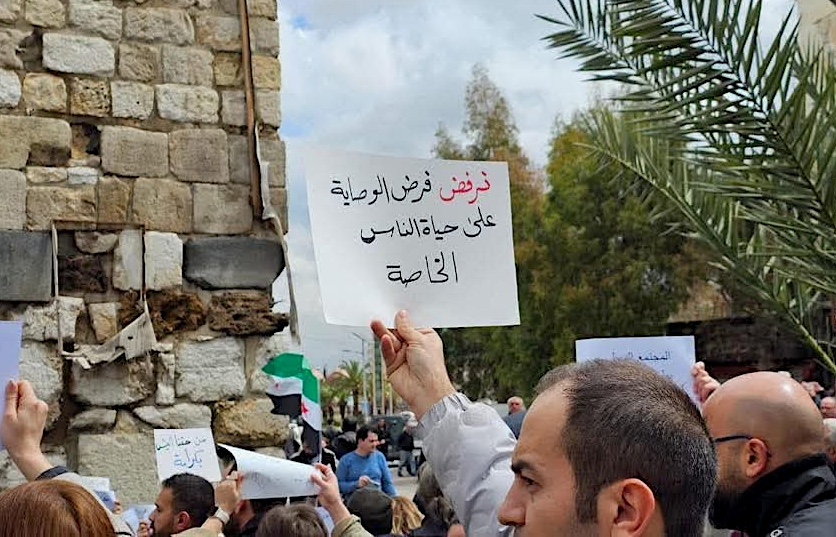
In a rare show of public defiance, hundreds of citizens—including both Muslims and Christians—held a “silent protest” in the heart of Bab Touma. Protesters held placards calling for the state to:
- Respect personal freedoms and individual choices.
- Uphold constitutional rights that apply to all Syrians equally.
- Cease the issuance of decrees that are perceived as offensive to the Christian community and that undermine the principle of equal citizenship.
The Bab Touma Committee and the protesters are demanding an immediate rescission of the decree, asserting that the rights of citizens are indivisible and that no single area should be forced to shoulder burdens avoided by the rest of the metropolis.