
By Raymond Ibrahim – Coptic Solidarity –
Some in America may have heard about the overt persecution of Christians in the Muslim world—churches bombed, worshippers slaughtered, mobs chanting jihadist slogans as they burn ancient sanctuaries. What they are far less aware of are the quieter, more insidious forms of discrimination that are not only tolerated but embedded in the very structures of Muslim-majority societies. These abuses are not violent, not headline-worthy, and not obvious. Yet they are no less real—and often more effective.
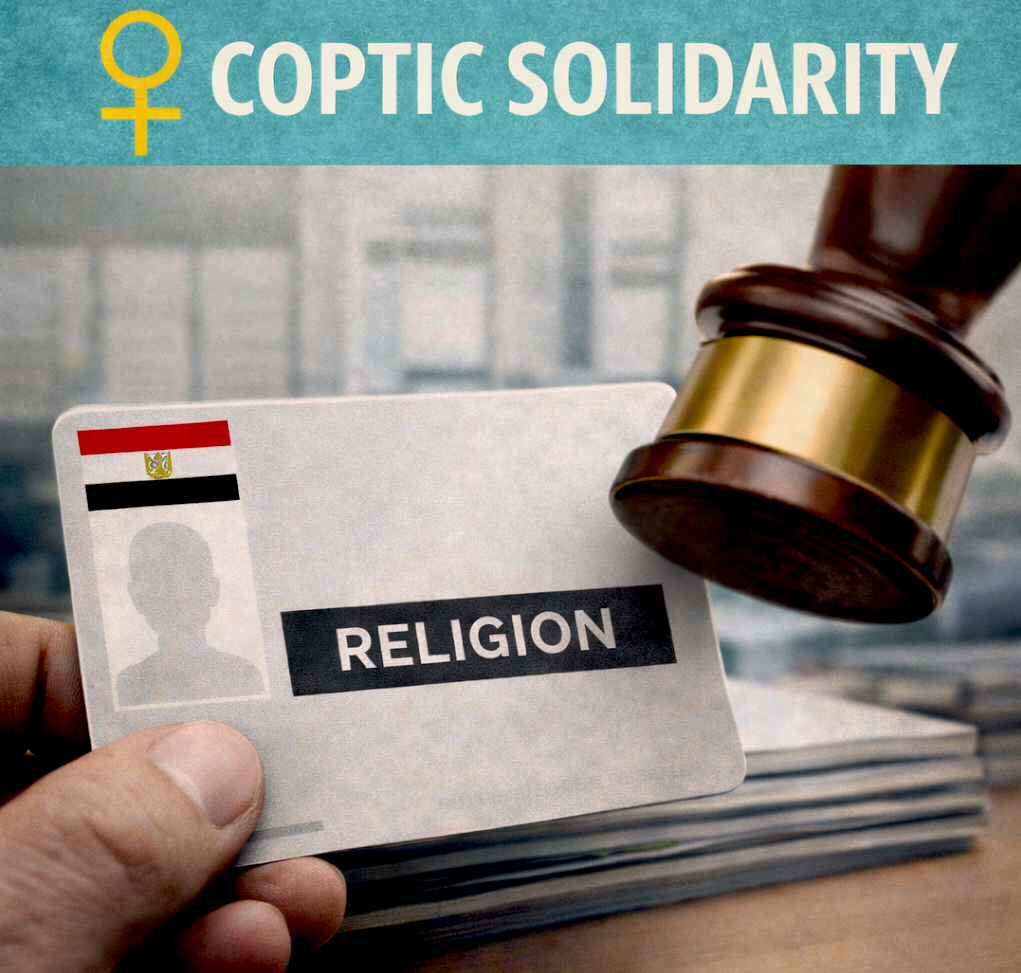
One such example is the requirement in most Muslim nations, for example Egypt, that citizens declare their religion on their national identification cards (here’s a recent Arabic report on it). To Western eyes, this may seem like an administrative curiosity, perhaps even a benign cultural difference. In reality, it is a foundational mechanism of inequality.
In Egypt, religion is not merely a private matter of belief. It is a legal identity that determines one’s rights, limitations, and vulnerabilities. A Muslim and a Christian are not simply adherents of different faiths; they are subjects of different legal expectations. Marriage, inheritance, child custody, and even freedom of conscience, are all filtered through the religious designation stamped onto a state-issued card.
Otherwise, why the necessity of indicating a citizen’s religion in Egypt—if not because it does make difference?
This system is especially revealing when it comes to conversion. A Christian who becomes Muslim can easily and instantly change his religion on his ID. A Muslim who converts to Christianity, however, is effectively forbidden from doing so.
Because sharia bans Muslims from apostatizing—and because sharia is enshrined in Article 2 of Egypt’s constitution—the state refuses to recognize the conversion, forcing converts to remain Muslim, even if just “on paper.”
Again, why does the state need to know a citizen’s religion at all? The answer lies not in modern bureaucracy but in premodern theology. Islamic law is religion-based. It presumes different rules for Muslims and non-Muslims, different social standings, and different legal outcomes. Even where sharia is only partially enforced, its assumptions endure. The ID card is simply the modern, laminated expression of an older system of classification—one that requires knowing who belongs where.
Yet this ID card business is only the beginning. Far more disturbing is how this same religious hierarchy manifests in everyday life—particularly in the phenomenon of the abduction and forced marriage of Coptic Christian girls in Egypt (latest example here).
For decades, Coptic families have reported a recurring pattern: young Christian girls are abducted, pressured or coerced into converting to Islam, and married off to Muslim men—often within days. When families appeal to the police, they are frequently dismissed, stonewalled, or outright threatened. In some cases, police officers have actively assisted the abductors, returning the girls to their captors under the pretext that they “converted willingly.”
Western observers often recoil at such claims, dismissing them as conspiracy theories or exaggerations. But the reality is far more mundane—and more damning. The abuse persists not because it is spectacular, but because it is normalized. The system quietly favors the Muslim male over the Christian family. Once a girl is declared Muslim—often under duress—Islamic law comes into play and there is little left to do. After all, by Muslim logic, is the once infidel girl not better off being Muslim—the true faith—even if coerced “for her own good”?
There are no mass executions here, no ISIS-style videos. Instead, there is paperwork, silence, and procedural indifference. The girl’s new “choice” is accepted at face value. Her parents’ protests are treated as sectarian troublemaking. The police move on.
In both the ID-card requirement and the abduction of Coptic girls, the same principle operates: religion is not a personal matter but a public status, and that status determines who the state protects and who it ignores. The abuse is subtle, bureaucratic, and therefore largely invisible to Western audiences trained to recognize only the most blatant forms of oppression.
And that invisibility is precisely what allows it to endure.
The West, obsessed with its own imagined sins, remains largely blind to these realities. It lectures endlessly about tolerance while failing to notice systems that openly encode religious inequality. It condemns “Islamophobia” while ignoring the quiet suffering of Christian minorities whose very existence contradicts the narrative of Muslim-world pluralism.
Persecution does not always announce itself with fire and swords. Sometimes it comes with an ID card, a police report that goes nowhere, and a girl who never comes home.