
For Immediate Release
(Washington, DC ) February 6, 2026 – Standard Newswire
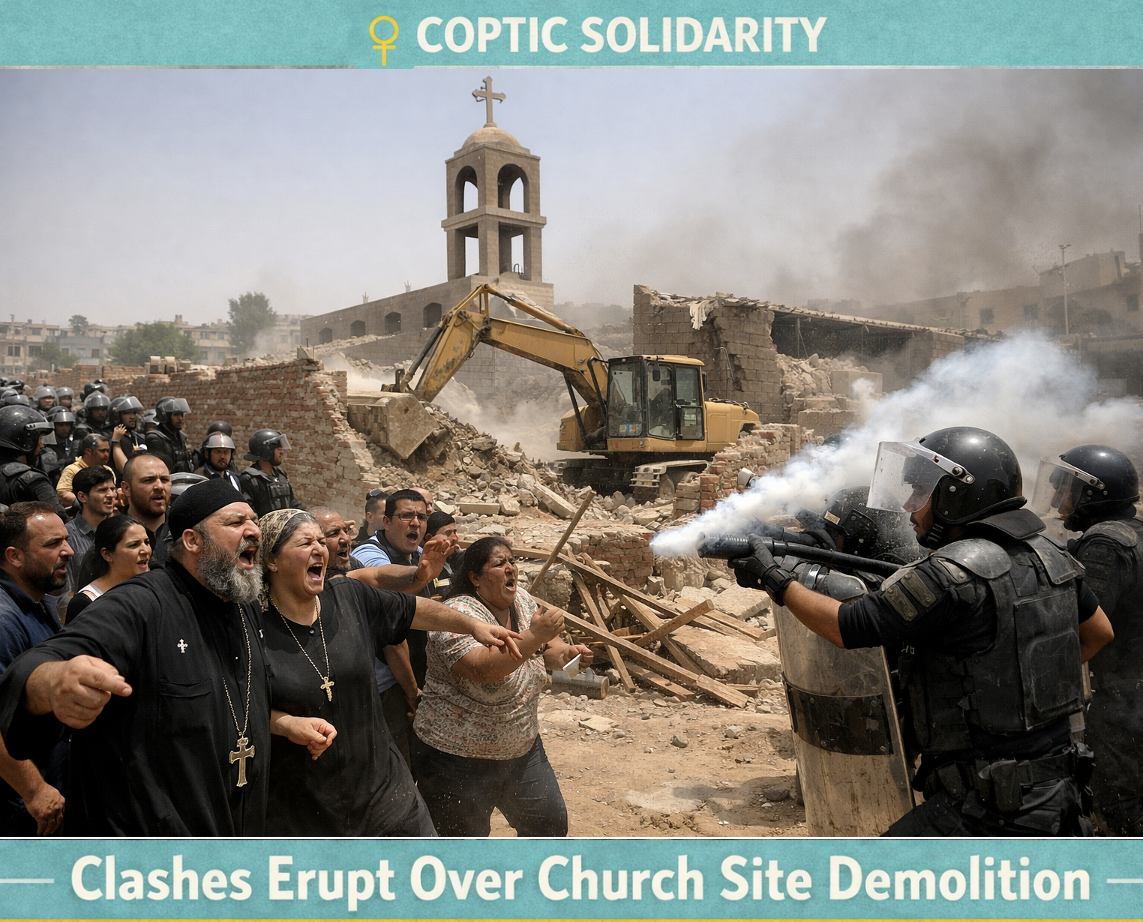
Coptic Solidarity strongly condemns the manner in which state executive authorities handled the incident involving the demolition of alleged “encroachments” on a plot of land allocated for the construction of a new church in the Zohour 15 May area, as well as the brutal assaults carried out by police and state security forces against local Christians on Tuesday, 3 February.
The area witnessed protests by local Christians expressing their rejection of the demolition of a fence erected by church officials around land that had been officially allocated for this purpose. Coptic Solidarity demands the immediate release of the 13 individuals detained in connection with this case and the dismissal of all charges brought against them—charges of which they were not informed when they appeared before the prosecution.
It must be asked whether, had a similar situation involved a mosque, the authorities would have responded in the same manner. In practice, large numbers of mosques and prayer halls have been constructed in violation of applicable regulations and are not subjected to enforcement at all.
In February 2024, the New Urban Communities Authority allocated a plot of land in the Zohour 15 May area for the construction of the Church of the Virgin Mary and Pope Kyrillos. This area is home to residents of the Zarayebneighborhood, who were relocated there after their homes were destroyed by floods in 2020. The allocation constituted the first step in a series of procedures required for church construction, in accordance with the Church Construction Law.
During the construction of the fence around the allocated land—measuring 1,950 square meters—those supervising the project included additional surrounding desert land within the enclosure. This took place in full view of the authorities, who raised no objection at the time. The 15 May City Authority later issued a decision to remove the alleged violations. However, residents state that they were neither notified of this decision nor consulted regarding the claimed encroachment.
On Tuesday morning, residents were surprised by the arrival of police forces to demolish the fence. According to testimonies collected by researchers from the EIPR over the past two days, residents stood peacefully in front of the fence and chanted “Crescent and Cross, one hand,” hoping the security forces—comprising personnel from Cairo Security, Central Security Forces, and other units—would refrain from carrying out the demolition. Instead, security forces fired tear gas canisters to disperse the gathering and enforce the decision, chasing residents away from the area.
A total of 58 people were arrested, including women, men, and children—and some passers-by with no involvement in the protest. Father Athanasius Rizk, the priest overseeing the church and supervising its construction, was also arrested before being released in the early hours of Wednesday.
Testimonies further report that several women were subjected to physical and verbal abuse during their arrest. When men attempted to intervene to protect them, they too were beaten and verbally abused. All those arrested were transferred to the Central Security camp in Tora, after which they were divided into two groups: the first group of 19 individualswas taken to the Helwan Prosecution, while the remaining detainees were later released in batches at various locations.
The group of 19 was brought before the Helwan Prosecution on Tuesday evening, which ordered their detention for 24 hours pending police investigations. Father Athanasius Rizk was released; in his testimony, he confirmed that he had not been officially notified of any demolition decision.
On Wednesday evening, the 15 May Public Prosecution ordered the release of five women on the guarantee of their place of residence and ordered the detention of 13 men for four days pending investigation. At the Thursday session, their detention was renewed for 15 days. According to lawyers present, the detainees were not informed of the charges against them, in violation of the Criminal Procedure Code, which requires investigators to identify the accused at their first appearance and formally inform them of the charges.
The authorities bear full responsibility for discussing the matter with the church and , if warranted, issuing formal warnings and demolition notices, including granting a reasonable grace period to remove any alleged violations prior to enforcement. The history of arbitrariness in church construction in Egypt did not end with the issuance of the Church Construction Regulation Law No. 80 of 2016. Memories of systematic discrimination associated with church construction remain vivid and must be taken into account when officials address issues burdened with longstanding grievances experienced by Egyptian Christians, both in Cairo and elsewhere.
The needs and concerns of Christians in the area must be respected. They must be protected from further violations, and their right to the safe and unobstructed practice of their religious rituals within their church must be fully guaranteed.
Coptic Solidarity is an organization seeking to help Copts of Egypt and other persecuted minorities. We support those in Egypt working for the protection of the fundamental rights of all Egyptian citizens, and advocate in cooperation with the affiliated organizations in Canada and in Europe (Solidarité Copte). For more information, contact coptadvocacy@copticsolidarity.org.