
By Raymond Ibrahim – Coptic Solidarity –
In Egypt, the construction and renovation of mosques has reached staggering levels—over 13,900 since 2014, costing nearly 25 billion pounds—while churches remain drastically insufficient for Christians’ needs, and heavily restricted. The numbers alone reveal a striking imbalance in religious infrastructure, illustrating the lived reality of discrimination against Egypt’s Coptic Christians.
As of mid-January 2026, Egypt’s Ministry of Endowments continues its expansive campaign to build and maintain mosques across the country. On Friday, January 16, 2026, the ministry reported activity on 48 mosques: eight newly established, 35 replaced or renovated, and five maintained or further developed.
Looking at the broader picture, since July 1, 2025, a total of 482 mosques have been opened. Of these, 372 were newly built or replaced and renovated, while 110 underwent maintenance and development. This reflects a steady effort to modernize and expand Egypt’s religious infrastructure.
Since Abdel Fateh al-Sisi assumed the presidency in 2014, the cumulative total of mosques that have been opened, replaced, renovated, maintained, or furnished has now reached 13,971, with expenditures estimated at approximately 24.886 billion Egyptian pounds. This marks a significant increase from February 2025, when 13,045 mosques had been reported since 2014 at a total cost exceeding 21 billion pounds. In just the past year, approximately 926 additional mosques were added or refurbished, with spending increasing by nearly 4 billion pounds.
The expansion is nationwide; the Ministry has emphasized wide geographical diversity, ensuring Egypt’s religious infrastructure grows in both urban centers and rural areas. Back in 2023, the Central Agency for Public Mobilization and Statistics (CAPMAS) noted that Egypt’s total number of mosques had reached 151,194. The latest efforts only reinforce this trajectory, demonstrating the government’s sustained commitment to expanding and maintaining the nation’s houses of worship.
Nor do these gargantuan figures include the ubiquitous “prayer halls.” Virtually every government office, school, university, sports club, or factory contains a hall or room dedicated to Islamic prayer. Added to mosques and prayer halls, they raise the number of Muslim worship spaces to an astronomical level. They are also notorious for disturbing neighbors—especially Christians—with blaring loudspeakers that broadcast the call to prayer five times a day, including predawn, with no consideration for the sick or elderly.
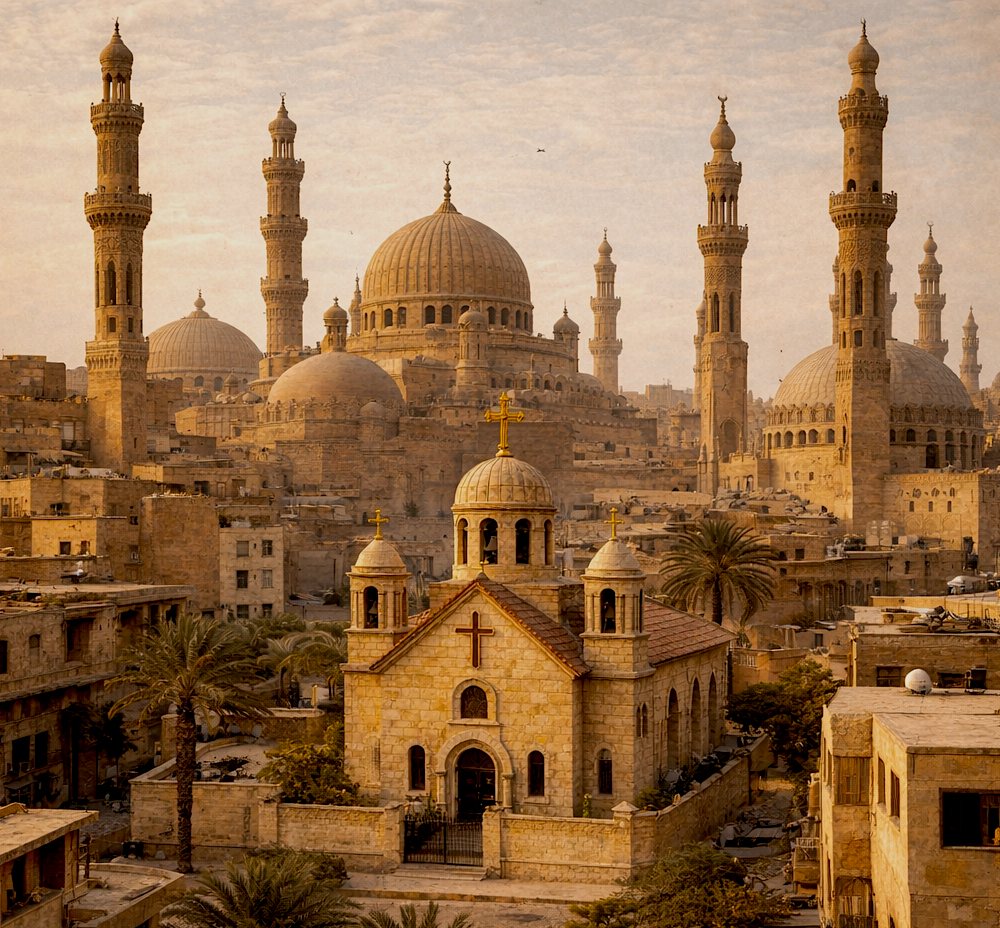
Here one may justly inquire: what about the religious places of worship that, for centuries before Egypt’s conquest by Muslim Arabs, once dotted the nation’s landscape—namely, Christian churches? How do they fare?
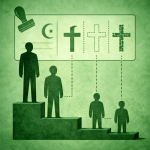
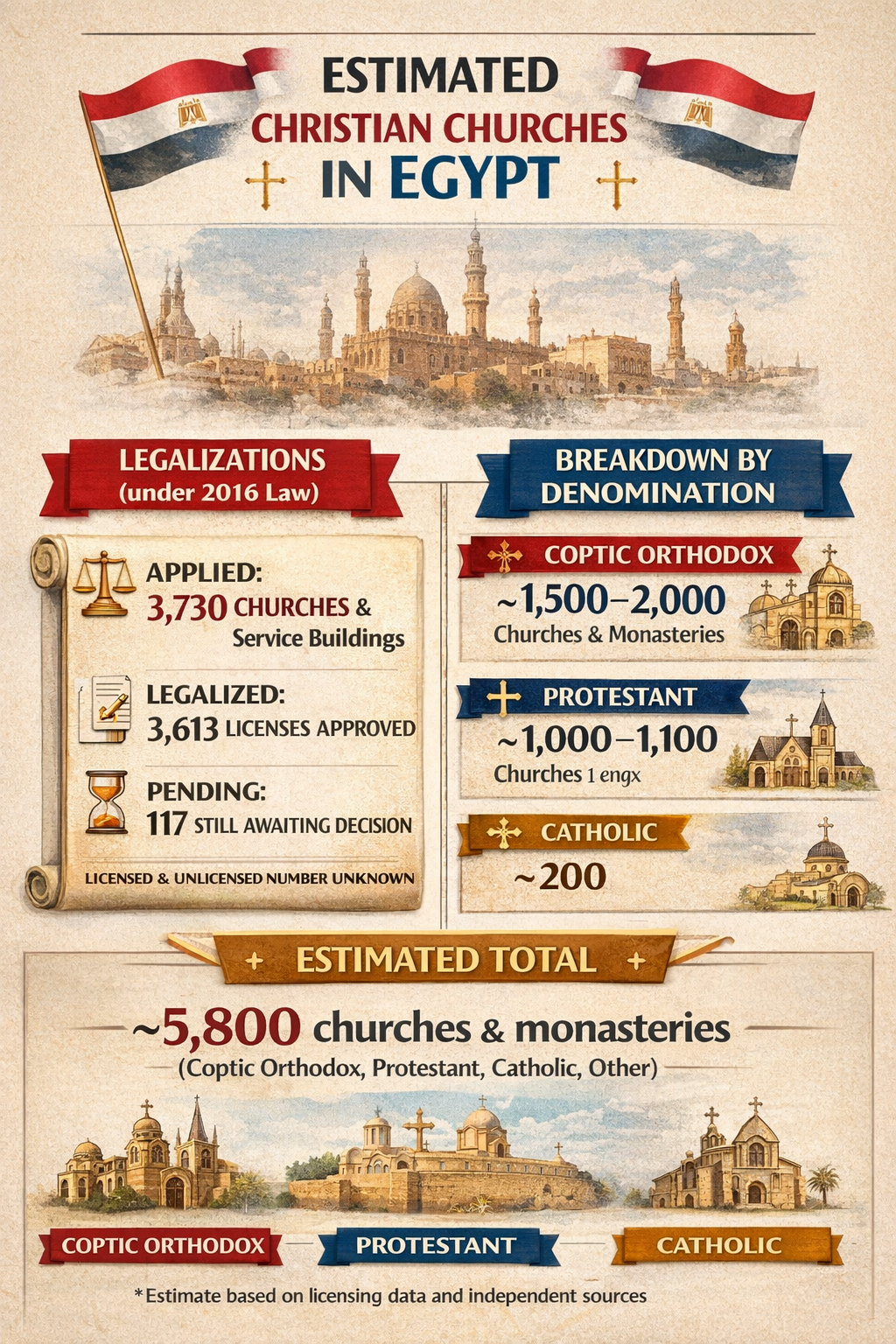
The total number of churches and monasteries for all Christian denominations in Egypt—including those “licensed” under the 2016 Law for Building and Restoring Churches—is estimated at around 5,800,* half of which belong to the Coptic Orthodox, who comprise roughly 85% of Egypt’s Christian population. The disparity is staggering; it alone underscores the extreme discrimination Christians—whom Sisi regularly presents as “our beloved and equal brothers”—face in Egypt. Considering that Christians of all denominations make up 12-15 percent of Egypt’s population of 114 million, there is roughly one mosque or prayer hall for every 40 Muslims, but only one church or monastery for every 2,400 Christians. This represents a staggering 1:60 ratio, highlighting the scale of discrimination.
Beyond the ease of building mosques, the government also fully subsidizes many—if not most—of Egypt’s mosques. Over 21 billion pounds were spent in just the last decade building and renovating mosques. Additionally, 22 billion Egyptian pounds are annually allocated to Al-Azhar, which operates a parallel educational system—from kindergarten to university—serving over 2.8 million students.
Conversely, Egypt makes it immensely difficult for Christians to open or maintain churches, and the government does not contribute a single penny to their survival. Churches are even required to pay their utility bills, whereas mosques do not, as the government happily covers them.
Egypt’s religious landscape today tells a story that words alone cannot capture. Over 150,000 mosques, and 1,3-1,5 million prayer halls serve the country’s Muslim population with government support, while fewer than 6,000 churches serve a Christian minority with no assistance.
To reiterate, for every 40 Muslims, there is one mosque or prayer hall; but for every 2,400 Christians, there is one church or monastery.
This staggering 1:60 ratio is ample proof of the systemic discrimination Coptic Christians face in practicing their faith freely and equally.
(*) Figures provided by Coptic Solidarity’s Adel Guindy.