
By Raymond Ibrahim – Coptic Solidarity –
A series of recent archaeological discoveries is shedding fresh—if inconvenient—light on a largely forgotten reality: Christianity once flourished in regions where it has all but vanished.
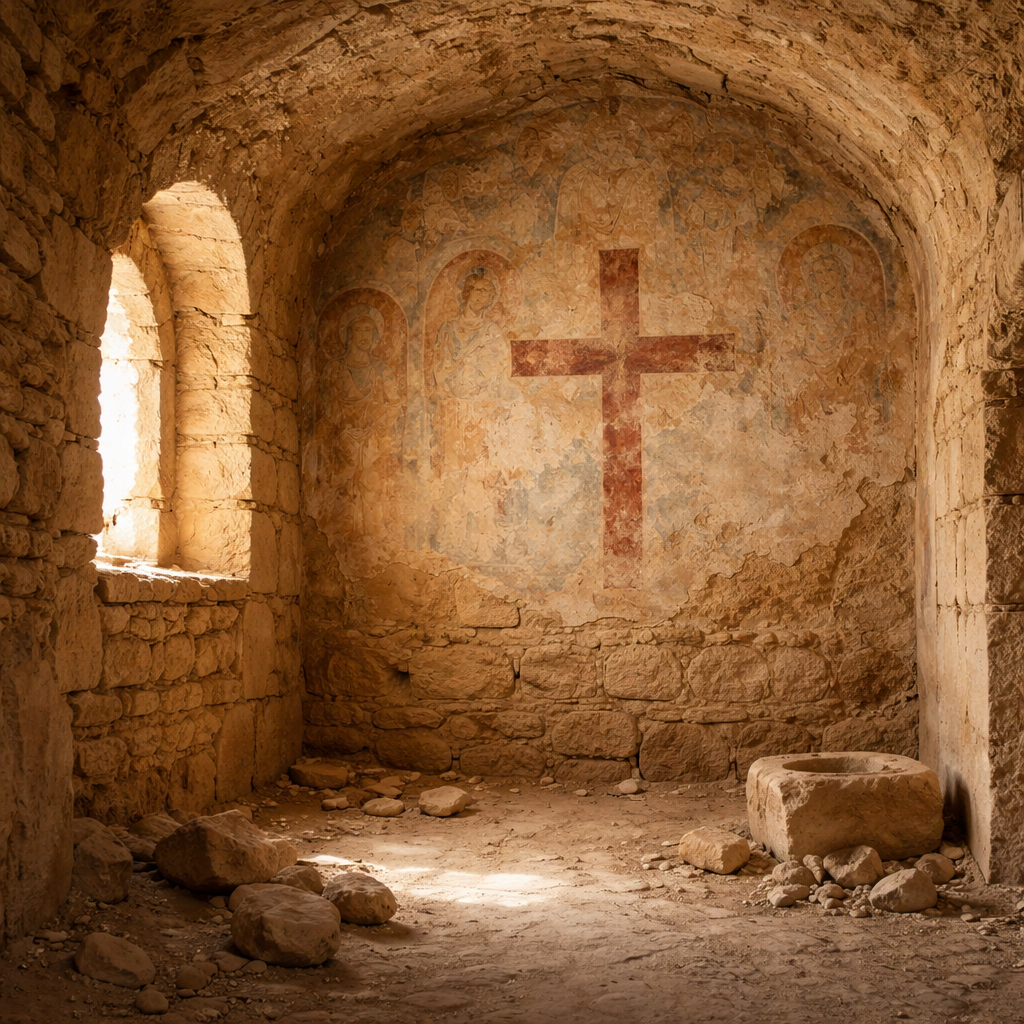
In Egypt, archaeologists have just unearthed a 1,600-year-old Christian monastic site, complete with wall paintings and a Greek inscription. A few weeks before it, another, equally as old, monastic complex was also discovered in Egypt.
These are not isolated finds. They are part of a growing pattern: the steady unearthing of monasteries, churches, and Christian inscriptions across the Middle East—silent witnesses to a time when Christianity was not marginal, but dominant.
And yet, as these discoveries accumulate, so too do efforts to reinterpret them—not as evidence of a dramatic civilizational rupture, but as proof of something far more palatable.
Take, for example, yet another recent find—in the Arabian Peninsula, no less, the birthplace and home of Islam: in 2022, archaeologists in the United Arab Emirates unearthed the ruins of yet another Christian monastery. Radiocarbon dating suggested that its Christian community may have thrived there around the year 534 — meaning nearly a century before the rise of Islam in AD 622 (year one of the Muslim calendar).
“It is an extremely rare discovery,” said Prof. Tim Power of the UAE University, who was part of the team that unearthed the monastery. “It is an important reminder of a lost chapter of Arab history.”
To be sure, historians have long known that both Christians and Jews lived throughout the Arabian Peninsula prior to the advent of Islam, though having archaeological backing is obviously substantial. This is, moreover, the second such monastery to be unearthed in the UAE. All in all, six ancient monasteries have thus far been discovered along the shores of the Arabian Gulf.
Ultimately, all of these findings confirm that what happened to the Arabian Peninsula is what happened to the broader Middle East and North Africa. In the seventh century, the entire region was overwhelmingly Christian majority. Once the jihad against the People of the Book (Christians and Jews) was proclaimed, c. 630, all of these formerly Christian regions were swallowed up and Islamized. In the words of Bernard Lewis:
We tend nowadays to forget that for approximately a thousand years, from the advent of Islam in the seventh century until the second siege of Vienna in 1683, Christian Europe was under constant threat from Islam, the double threat of conquest and conversion. Most of the new Muslim domains were wrested from Christendom. Syria, Palestine, Egypt, and North Africa were all Christian countries, no less, indeed rather more, than Spain and Sicily. All this left a deep sense of loss and a deep fear [emphasis added].
The finding of all these monasteries is further unsurprising when one considers how utterly Christian the Middle East was. According to John Cassian, a Christian monk from modern-day Romania who visited Egypt in late furth century—about two-and-a-half centuries before the Arab invasion, “the traveler from Alexandria in the north to Luxor in the south would have in his ears along the whole journey [about 600 miles, or 1000 kilometers, on foot], the sounds of prayers and hymns of the monks, scattered in the desert, from the monasteries and from the caves, from monks, hermits, and anchorites.”
Today, Egypt—which, prior to its invasion and subsequent conquest by Islam, was arguably one of the most thoroughly Christian nations in the world—has only a few monasteries, and even these are not beyond pressure. In 2025, a controversial court ruling placed the land of Saint Catherine’s Monastery—the oldest continuously operating Christian monastery in the world—under state ownership, raising fears that the monks’ community could ultimately be dispossessed of property they had held for centuries. The dispute escalated to the point of international diplomatic intervention, even as development projects began transforming the surrounding sacred landscape.
That an even worse fate befell the Christians of historic Arabia seems to be self-evident. After all, Isam’s prophet himself singled out the Peninsula on his deathbed when he ordered that “There are not to be two religions in the [Arabian] Peninsula.” This has always been interpreted to mean that only Islam can be practiced on the Peninsula (hence why modern day fatwas continue to call for the destruction of any church found in the Peninsula).
Despite this, the unearthed monastery in the UAE is being cited as — you guessed it — “a monument to tolerance and multi-faith society.” As the report relays,
The find also sheds light on a time when Christianity and Islam coexisted and reveals more about the Christian Arab population that went on to thrive in East Arabia…..After the rise of Islam, Prof. Power said there was a period of about 300 years where the two religions coexisted.
Really? In fact, the first three centuries of Islam — when most of its conquests took place — were, as mentioned, remarkably violent. The centuries-long record is irrefutable; and monasteries were among the first to be attacked and plundered.
Even so, “a narrative of violent conquest doesn’t work,” says Power, because “There was no sign of devastation or violence or burning. There was incremental cultural and social change as Christianity faded out and Islam became dominant. It is a monument to tolerance and multi-faith society.”
And there you have it. Despite the fact that contemporary historical records make clear that monasteries, churches, and entire Christian regions were, in the name of jihad, wiped out or brutally subjugated over the centuries, when it comes to Arabia, the Christian population seems to have “faded out” peacefully. Why? Because “there was no sign of devastation or violence or burning” to the building.
According to this “logic,” because no signs of violence appear on a building — 14 centuries after the fact — its inhabitants must have been treated well. This is tantamount to telling a battered housewife that her testimony is no good because, after all, police found no signs of violence to her home.
News flash to Power: all sorts of nasty things, including violence and outright slaughter, can be inflicted on a people, without any telling signs appearing in their residence — especially when the inspection occurs 14 centuries after the fact.
So much for common sense. All that apparently matters in the case of the UAE monastery is that something has been found that, after much straining and sophistry, can make Islam look good.
Time will tell how the many Coptic monasteries being unearthed in now Muslim Egypt will be spun.