
By Adel Guindy – Coptic Solidarity –
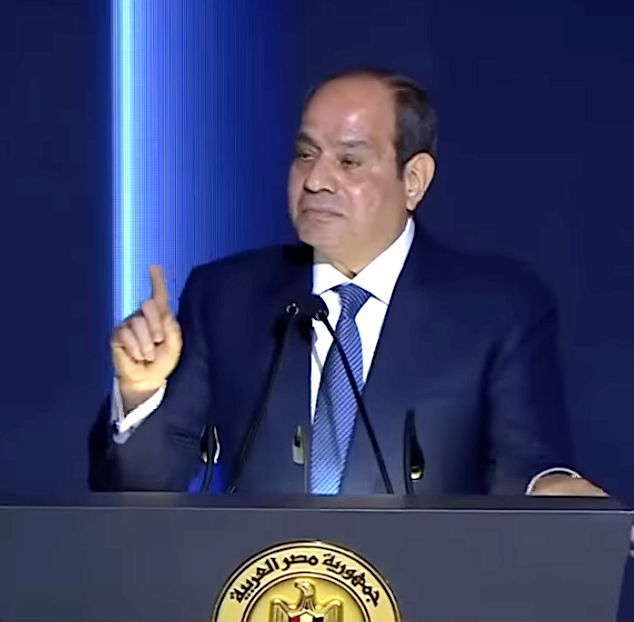
Many comments were made about President Sisi’s address on Police Day (24 January). Some even went so far as to describe it as “heralding a new phase.”
What was actually said?
The speaker spent only a short time reading from a formal, routine prepared text, while the bulk of the speech — as usual — consisted of off-script digressions. And this is what matters, because it reveals mentality, psychology, and intention.
In fairness, some of what was said is unobjectionable in principle.
What concerns us here, however, is to focus on several striking points.
Let us also dispense with the absurd interludes involving ministers, each of whom stands stammering like a dull schoolboy the moment his name is mentioned, attempting — in vain — to guess the “correct” answer to the startling question suddenly put to him.
…
The prominent speaker advised his audience to leave “the non-Muslim” — and even “the one without religion” — alone.
Why?
Because everything is written (maktūb, pre-ordained). Accordingly, those who are ‘rescued’ are already rescued, and those destined to ‘perish’ are already doomed. He expressed deep pity for the non-religious person as “a poor soul who does not know God.”
He repeated, with emphatic warning: “Those who are rescued — what? — are rescued… and those who perish — what? — perish…”
[And if, at this point, someone were to ask — in a moment of existential or philosophical reflection — about the relationship between the determinism of what is written and the freedom of choice, they are free to choose among the well-known schools of Islamic thought throughout history.]After laying down what he considers the appropriate rules for dealing with individuals or groups with respect to their faith (or lack thereof) and their fate in the Hereafter, Mr. El-Sisi turned to speak about “responsibility,” particularly that of state officials.
Here he stressed that the official must carry out their work and duties out of concern for their Hereafter, since they are accountable before God (alone.) He repeatedly emphasized that he personally “establishes the argument” (yuqīm al-ḥujja) against other officials “before the Lord of humankind,” and explained that “in this world we are servants of God, and in the Hereafter we are slaves of God.”
[Here he appears to follow what may be described, for the sake of simplification, as a conditional predestinarian outlook: there exists an inevitably perishing category, and, on the other hand, a rescued category. Rescue, however, is conditional — generally on steadfast adherence to faith, observance of religious obligations, and ensuring that the balance of good deeds outweighs the bad.]
Accordingly, those deemed rescued are urged to “take the necessary means” (al-akhḏ bi-l-asbāb) to secure their fate and are therefore advised not to waste time resisting or attempting to rescue those already destined to perish, but simply to leave them to their hopeless condition.
None of this discourse is new. With all its religious arrogance and condescension, it is familiar and well known.
So what, then, is the problem?
The problem is that this is not the discourse of a preacher in a mourning tent, nor of a corner prayer-hall speaker, nor even of a mosque imam urging worshippers in a Friday sermon to care for their Hereafter.
Rather, it is the discourse of an autocrat bearing the title “President of the Republic” in a state whose population is multi-faith — and, moreover, articulated in the twenty-first century.
His Excellency– or, shall we say, ‘His Eminence’– is not speaking about citizens’ rights to freedom of belief, grounded in freedom of conscience as a fundamental human right; nor about equality of rights and duties; nor about constitutional guarantees, international conventions, political accountability, or legal responsibility.
Instead, he speaks with fervor — apparently sincere — out of concern for the Hereafter of the believing and the rescued, for whom he considers himself personally responsible.
Thus, there is no citizenship, no equality, no rights or duties — only two categories of people, with no third: those rescued and those perished. This is a crude evasion, barely masking an explicit classification of citizens — indeed, of human beings — into believers and unbelievers.
From this, we can clearly understand why the Egyptian state generally appoints to positions of responsibility only those deemed to be among the “believers,” and why the appointment of “non-believers” within state institutions is exceedingly rare — tolerated only at the bare minimum and under extreme necessity, merely to limit accusations of discrimination.
…
After His Excellency/Eminence had ranged freely through this discourse-cum-sermon, he returned to the matter of responsibility and drew a curious distinction. All officials are advised that if they recognize their failure or incapacity, they should leave their post.
This sounds commendable.
But as for himself, the matter appears different: “success is a favor of our Lord,” whereas “failure comes from the justice of our Lord.” (???)
He then reiterated that no one can change what is written, that no one can do anything except what is written, and that everyone must accept what is written. He even went so far as to advise his listeners: “Do what is written!”
[So the human being is expected to choose what is already written? There is no need to attempt solving this absurd riddle.]
In all this convoluted counsel, it is unclear whether we are dealing with a shrewd manipulator seeking to condition the public to accept everything that befalls them — and everything he does — as “written,” and therefore beyond criticism or objection; or with someone who genuinely believes himself to be an instrument of divine providence, such that opposing him amounts to opposing the Lord of the universe.
…
He then suddenly recalled the events of 3 July 2013, describing how the statement he issued at the time, as Minister of Defense, was filled with gentleness and appeals to consensus, giving the Muslim Brotherhood — and “Dr. Mohamed Morsi, God have mercy on him” — the opportunity to return to the ballot box. “If they won by your will (O Egyptians!), then so be it; they would return to power without issue.” But it was their “blindness of insight” (ʿamā al-baṣīra) that prevented them from choosing correctly.
[Was this blindness of insight also written in advance?]Some ask whether this constitutes a message of reconciliation and a direct invitation to “the Group” to return. Perhaps — especially given the Brotherhood’s conciliatory response the following day.
But the truth is that the Brotherhood — as an ideology and as committed individuals — never truly left either the political scene or power. Indeed, had they — as an organization — remained to govern directly, they could scarcely have done more than what has already been done, and continues to be done under President El-Sisi’s rule, through sweeping waves of Islamization of education, media, politics, culture, the police, the judiciary, and foreign policy.
…
The alarming conclusion is that Egypt is sliding into a deeply pathological political condition — one in which those claiming exclusive rational authority appear themselves captive to the system they created and preside over. Comparable dynamics have been observed elsewhere, most notably in the Iran of fanatic clerical rule.