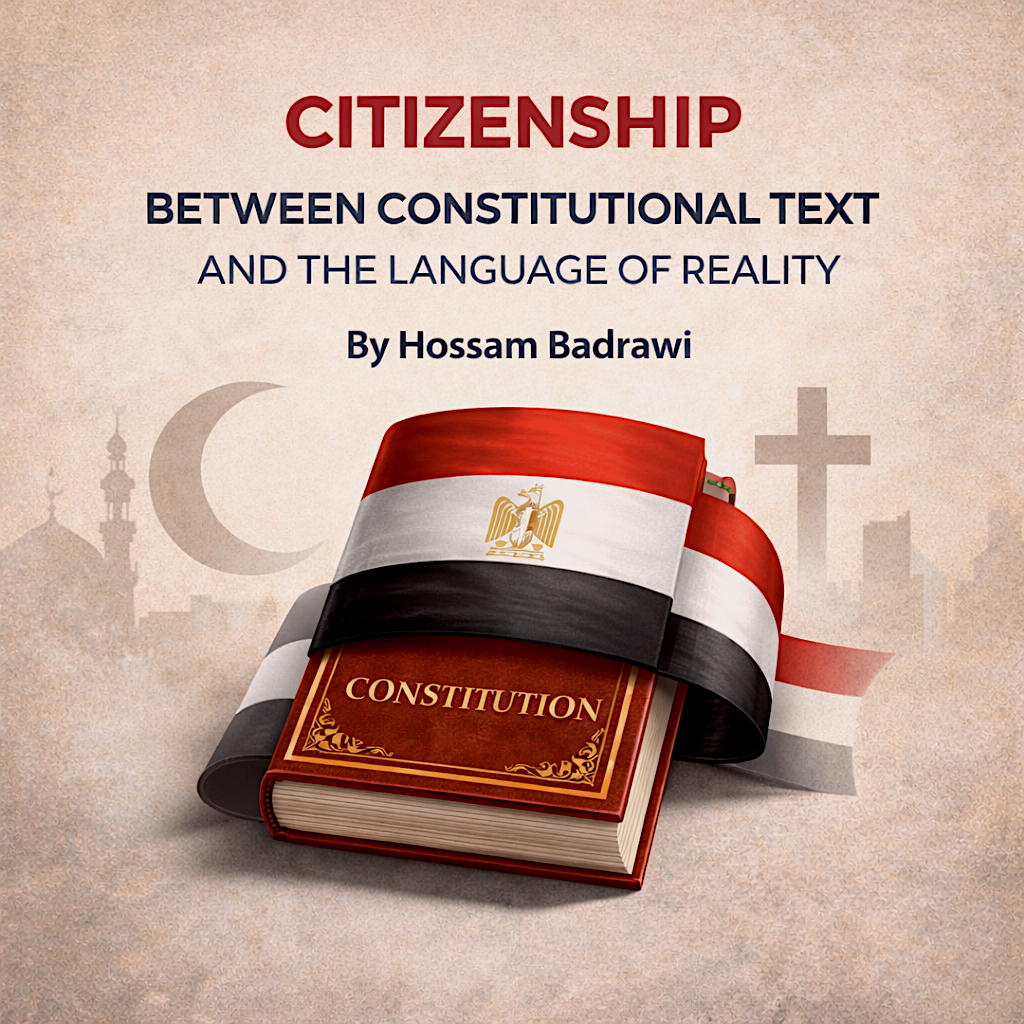

By Hossam Badrawi –
Citizenship is neither an administrative status nor a rigid legal classification. It is an ethical relationship between the individual and the homeland, founded on mutual recognition: the state’s recognition of the dignity of its citizens, and the individual’s recognition of their free belonging to this collective entity. When this relationship is disrupted, the defect lies not only in legal texts, but in the awareness that precedes them and follows them.
Constitutions are written to regulate reality, but they do not create it on their own. Reality becomes sound only when constitutional values are transformed into a daily culture, reflected in language, public discourse, and the way society views those who are different. Any careless infringement of the language of citizenship, or any implicit classification among members of the same nation, is therefore not an innocent linguistic error, but an indicator of a deeper flaw in the understanding of belonging itself.
From this perspective, talking about citizenship becomes an intellectual necessity before it is a political demand—a continuous attempt to recalibrate the compass, so that the homeland remains a unifying entity that defines its people only as citizens: equal in rights, diverse in convictions, and partners in destiny.
Citizenship is not a slogan raised on special occasions, nor a constitutional article written and then forgotten. It is an existential, legal, and ethical bond that makes a person a citizen because they belong to the homeland—not because they belong to a religion, a group, or a majority. Before it is a legal text, citizenship is a deep sense of equal belonging, manifested in language, practice, and in how the state and society view the individual.
The greatest threat to the concept of citizenship is not explicit discrimination alone, but rather covert discrimination that seeps through familiar words and ostensibly good intentions, while carrying within it an unspoken division of the national body.
It is from this standpoint that I—like others—paused at what our colleague, the writer Ibrahim Awad, raised in his critique of the use of the expression “our Christian brothers” in state language and official discourse. This critique deserves serious consideration, not as a linguistic debate, but as a matter of conceptual awareness.
This expression, despite the goodwill and respect it may appear to convey, implicitly carries an imprecise understanding of citizenship. It assumes—unintentionally?—that there is an unnamed “original” entity, and another entity defined by its religious identity, as though Egyptians come together in a single national entity only as “brothers” within a broader framework, rather than as intrinsic components of one homeland.
Egyptians are not “brothers within an entity”; they are the entity itself.
They are united not by religion, but by the homeland.
The majority does not grant them the right to exist, because existence precedes the majority.
Language here is not a marginal detail. Language shapes awareness and reveals what is entrenched in the collective mind more than intentions ever do. When we insist on linguistic precision, we are not indulging in cultural luxury; we are safeguarding a core constitutional principle: citizenship.
The Egyptian Constitution—like those of modern states—does not grant rights on a religious basis, nor does it treat freedom of belief as a favor bestowed by one group upon another, or as a privilege granted by a majority to a minority. It clearly establishes that citizenship is the foundation of rights and duties, and that freedom of belief is an inherent right of the citizen—one that admits no guardianship and no restriction.
Here it is essential to emphasize a truth that is often overlooked: Freedom of belief in the modern state is not religious tolerance, nor a social concession. It is a constitutional right that precedes any religious or social interpretation and stands above it.
Moreover, the concept of citizenship, in its human essence, does not stop at the boundaries of adherence to the three monotheistic religions. Today’s world includes nearly eight billion people, more than half of whom do not belong to Islam, Christianity, or Judaism. Their humanity has not been negated, nor have their rights been diminished by their societies because of that fact.
Egyptians, like other peoples of the world, may have diverse intellectual and doctrinal identities and differing understandings of existence, yet they remain full citizens with undiminished rights. Citizenship is not measured by the type of belief, nor by its level of social acceptance, but by belonging to the homeland and adherence to its law.
The most dangerous forms of discrimination are not those practiced loudly, but those exercised quietly—under banners of reassurance and in the name of preserving social harmony. When rights are treated as concessions, and when those who differ are required to continually prove their good intentions, we move from a state of citizenship to a society of guardianship.
If we want citizenship to be a living reality rather than a mere constitutional article, we must revisit our language, our discourse, and our daily practices. Citizenship is not tested in texts, but in the small details that shape people’s consciousness and sense of belonging.
Citizenship is not about merely living together; it is about living as equals—without labels, without classifications, and without anyone’s permission.
In my view, the concept of citizenship within governmental awareness and in the language of some officials is in crisis.
Citizenship is neither granted nor withdrawn; it is presumed by virtue of human belonging to the homeland. When we distinguish between citizens by treating some as guests or as “brothers” of the Egyptian entity, we introduce a form of discrimination that makes belonging itself conditional on belief rather than on loyalty to the nation.
In this sense, religion is transformed from a spiritual experience into a civil access card, and from a relationship between the individual and their Creator into a relationship between the citizen and the official at the civil registry.
What is missing, at its core, is a philosophical understanding that freedom of belief is not merely a legal matter, but a question of human consciousness. A person’s freedom to believe or not believe, and to choose for themselves the meaning of existence, is what makes them fully human.
When the state intervenes—directly or indirectly, or through repeated use of certain expressions—in this internal space, it does not merely violate the law; it intrudes into the realm of consciousness.
In a true civil state, religion belongs to God and the homeland belongs to everyone. When religion becomes a condition for full citizenship, we are confronted with a system that reduces the human being to their belief and measures belonging by an official standard reference of faith rather than by national participation.
This is the slippery slope that begins in the name of protecting belief and ends in the exclusion of human beings.
A strong civil state does not fear diversity; it organizes it through justice.
And a confident society does not fear difference; it protects it through the rule of law.
______________