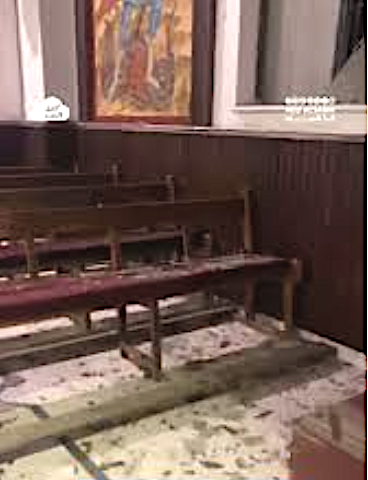

Explosion during Feast of the Cross damages St. George Cathedral; Christian monitors report subsequent anti-Christian threats as official Syrian media omit the church from their account.
An explosive device was thrown at St. George Greek Orthodox Cathedral in Hama, Syria, on the evening of Sunday September 13, causing material damage to the cathedral but, fortunately, no casualties were reported. Christian monitoring organizations report that two masked men riding a motorcycle carried out the attack as the community was marking the Feast of the Exaltation of the Holy Cross.
The Greek Orthodox Archdiocese of Hama confirmed that an explosion took place beside the cathedral and caused material damage, while reporting that no one was injured.
SyriacPress, citing the Assyrian Monitor for Human Rights, reported that two masked individuals riding a motorcycle threw a bomb near the cathedral. The Monitor condemned the incident as an attack on a place of worship intended to spread fear and called for an urgent and transparent investigation, accountability for the perpetrators, and protection for churches and their congregations.
The attack came as Christians were observing the Feast of the Exaltation of the Holy Cross.
A detailed incident record published by Western Syria Development similarly reports that two masked men on a motorcycle threw the device into the courtyard of St. George Greek Orthodox Cathedral, causing damage inside the building. The organization classifies the incident as an attack on religious property and says that video documentation of the incident exists.
Open Doors UK & Ireland, reporting information from local Christian sources, added that children had been playing in the cathedral courtyard shortly before the explosion.
According to its account, the explosion occurred at approximately 7:30 p.m. Video footage reportedly shows a masked person on a motorcycle placing or throwing a suspicious object near a vehicle immediately outside the cathedral. The cathedral serves a community of approximately 1,000 parishioners, although no service was underway at the moment of the explosion.
A cathedral priest told Open Doors that the church had received no previous warning or threat and knew of no dispute that might explain the incident.
The identity and affiliation of the perpetrators have not been established, and no organization has been reliably identified as responsible.
Anti-Christian Threats Follow the Attack
The incident was followed by anti-Christian reactions online.
The Syrian Christian Observatory reported that after it publicized the cathedral attack, an individual responded with an explicit threat against Christians:
“Worse and more bitter is yet to come, O worshippers of the Cross.”
Open Doors separately reported hostile online reactions to the attack, including comments describing Christians as infidels and expressing approval of what had occurred.
The comments are significant because they reveal an openly hostile anti-Christian environment surrounding the incident—and because both the attack and the subsequent threat invoked, directly or through their timing, the Christian symbol of the Cross.
The Official Account Omits the “Cathedral”
The treatment of the attack by official Syrian media raises an additional concern.
The Syrian Arab News Agency (SANA), citing a security source, acknowledged that a “stun grenade” had exploded in Hama’s al-Madina neighborhood, causing material damage but no casualties. Its report did not identify St. George Cathedral, mention that a Christian place of worship had been struck, or provide the accounts of masked motorcycle assailants reported by Christian sources.
That omission prompted criticism from the Syrian Christian Observatory, which accused Syrian media of effectively erasing both the church and the Christian identity of the target from the story.
The contrast is striking. The Greek Orthodox Archdiocese confirmed an explosion and damage at its cathedral. Christian monitors identified the location as St. George Cathedral and reported masked assailants arriving on a motorcycle. Independent Christian sources documented the timing during the Feast of the Cross and the subsequent threatening reactions. Yet in the official account, the incident became simply an explosion involving a stun grenade somewhere in the al-Madina neighborhood.
Identifying a targeted church does not constitute sectarian incitement. Erasing the identity of the church from reporting about an attack against it makes it more difficult to document the threats facing Syria’s Christian communities and to demand accountability when those threats turn into violence.
The perpetrators of the Hama attack remain unidentified. What is already clear is that St. George Cathedral was attacked, its property was damaged, and a potentially far more serious tragedy was narrowly avoided. The Syrian authorities should conduct a transparent investigation, identify and prosecute those responsible, and provide credible protection for Christian places of worship—not reduce an attack on a cathedral to an anonymous explosion in a neighborhood.