
By Rana Mamdouh – MadaMasr –
The dispute over ownership of St. Catherine’s Monastery and its surrounding lands, claimed by the Greek Orthodox Church, has returned to the forefront after the Egyptian government—represented by the Ministers of Foreign Affairs and Justice—initiated a new round of negotiations last Sunday. During those talks, the government presented a new draft agreement to Archbishop Symeon, Archbishop of Sinai and Abbot of St. Catherine’s Monastery.
According to a source close to the Monastery, who spoke to Mada Masr on condition of anonymity, the proposed agreement contains several key provisions. Foremost among them is the recognition of the Monastery as an Egyptian religious legal entity, while granting its Abbot and monks—who hold Greek, American, and Lebanese citizenship—renewable three-year residence permits.
The proposal would also grant the monks the right to possess the Monastery and its religious institutions—that is, the right to reside there and conduct religious services—while requiring them to lease the surrounding gardens and lands from the Egyptian government under long-term agreements at a symbolic rent. The agreement does not recognize the monks’ ownership of any of the Monastery’s lands, according to the source.
Archbishop Symeon, who was elected eight months ago as head of St. Catherine’s Monastery, refused to sign the agreement, according to the same source. Instead, he requested additional time to present the proposal to the Brotherhood before taking a final position.
The same source, along with another individual close to the Monastery who spoke independently to Mada Masr, confirmed that Egypt’s Ministers of Foreign Affairs and Justice met with Archbishop Symeon for more than seven hours, from 11:00 a.m. until 6:00 p.m. last Sunday.
According to both sources, the meeting had a single objective: to persuade Archbishop Symeon to sign the agreement in exchange for a presidential decree formally ratifying his election and appointing him as Abbot, following the precedent established by former President Anwar Sadat when he formally recognized the late Archbishop Damianos as Metropolitan of the Monastery.
According to the first source, the proposed agreement does not provide Egyptian nationality either to Archbishop Symeon or to any of the monks residing in the Monastery, many of whom have lived there for decades. Instead, it limits them to renewable three-year residence permits.
The source noted that this departs from longstanding practice. After the President formally ratified the election of the previous Abbot, Archbishop Damianos, former President Anwar Sadat issued a second presidential decree granting him Egyptian nationality only two months later.
According to the same source, since Archbishop Symeon was elected on 14 September of last year, the Egyptian state has issued no official recognition whatsoever of his position. As a consequence, he has been unable to access the Monastery’s Egyptian bank accounts or conduct transactions with any government institutions in South Sinai.
The source added that Archbishop Symeon currently holds a Greek diplomatic passport, allowing him to travel to and from Egypt for up to two years. The other monks, however, hold only tourist residence permits valid for twelve months. Because renewal procedures take approximately three months each year, they effectively enjoy legal residence for only nine months annually.
The source believes the Egyptian government is tightening the pressure on the Archbishop and the Brotherhood in order to compel them to accept an agreement that, in his words, would deprive them of their rightful ownership of the Monastery’s lands, which they have faithfully held in trust for centuries.
The second source similarly described the agreement as an arbitrary measure by the Egyptian authorities. He argued that the government’s refusal to grant Egyptian nationality to the new Archbishop, coupled with its insistence on treating monks—some of whom have devoted more than forty years of their lives to the Monastery—as temporary visitors, effectively paralyzes the administration of the Monastery and severely restricts the ability of the Archbishop and the Brotherhood to conduct normal monastic life.
According to both sources, the proposed agreement confirms the Egyptian authorities’ continuing intention to formalize state ownership of the Monastery and its lands, despite the fact that the Monastery has remained continuously inhabited since its foundation in the sixth century—creating a unique legal and historical situation that predates the emergence of the modern Egyptian state.
The new proposal renews the Egyptian authorities’ determination to formalize state ownership of St. Catherine’s Monastery and its lands. The Monastery has remained continuously inhabited since its establishment in the sixth century, creating a unique historical situation that predates the emergence of the modern Egyptian state.
Behind the drive to transfer ownership of the Monastery’s lands to the Egyptian state is the government’s determination to move forward with the implementation of the “Great Transfiguration Project” (Al-Tajalli Al-A’zam). According to sources close to the Monastery, the new proposal is also supported by the Greek government, which is pursuing the development of an electricity interconnection agreement with Egypt that would supply power for domestic consumption and for re-export to Europe.
In May of last year, the Ismailia Court of Appeal ruled that the Egyptian state owns St. Catherine’s Monastery and its lands, while granting the monks only the right of religious use and possession within a limited area and placing all actions relating to those properties under the direct supervision of the Egyptian authorities.
The Court also held that the Monastery’s spiritual affiliation with the Greek Orthodox Patriarchate does not confer any legal privileges within Egypt.
The Court divided the disputed lands between the Monastery and the Egyptian government into four categories.
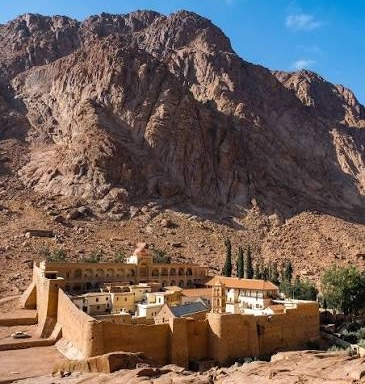
The first category consists of the land on which the Monastery stands, together with certain churches and holy sites. The Court granted the monks and the Archbishop only the right of religious possession, allowing them to reside there and conduct religious services, while affirming that these properties remain state-owned and are subject to the supervision of the Supreme Council of Antiquities.
The second category consists of lands outside the Monastery itself. The Court stripped the Monastery of ownership of these lands and incorporated them into the St. Catherine Nature Reserve, placing them under the authority of the Egyptian Environmental Affairs Agency.
The third category consists of agricultural lands, which the Court designated as “lands subject to eviction.” It ordered the monks to vacate them, ruling that they had occupied them unlawfully.
Finally, the fourth category consists of parcels containing small churches and monastic facilities that are covered by preliminary agreements between the Monastery and the local authority of St. Catherine City. The Court held that these agreements do not transfer ownership but merely establish reciprocal contractual obligations.
The two sources close to the Monastery added that the Greek government supports the Egyptian proposal and is exerting pressure on the Archbishop and the Brotherhood to accept it, despite the fact that, in their view, it requires the Monastery to relinquish ownership of its lands.
They also stated that representatives of the Egyptian government came to the Monastery last Sunday after reaching an agreement with the Greek government.
For its part, the Facebook page Friends of St. Catherine’s Monastery, which is familiar with the views of a number of the Monastery’s monks, described the draft agreement as “a catastrophic formula that destroys the Monastery’s historic rights and deprives the monks of ownership.”
The page argued that the Egyptian and Greek governments are placing their political and economic interests ahead of the spiritual and historical value of one of the world’s oldest continuously inhabited monasteries, where religious services continue to this day.
It added:
“The Monastery has been sold in the marketplace of political and economic interests in exchange for the energy agreement that Athens seeks to conclude with Cairo.”
Last Saturday, the Greek newspaper ProtoThema published a report stating that a resolution of the Monastery’s crisis was imminent and that the Abbot had reached an agreement with the Egyptian government ahead of the anticipated court ruling on the appeals filed by both parties concerning ownership of the Monastery’s lands.
According to the Greek newspaper, the central element of the agreement is the Egyptian government’s recognition of the Monastery as a legal entity under Egyptian law. This would entail legal obligations on the part of the Egyptian state to protect monastic life and ensure the uninterrupted functioning of the Monastery.
According to the terms of the proposed agreement, as reported by the newspaper, the arrangement essentially reproduces the provisions of the court judgment by granting the monks the right of religious possession to reside in the Monastery and conduct religious services within the Monastery grounds, including the main Monastery buildings and the surrounding land containing a number of churches and holy sites, while affirming that these properties remain state-owned and subject to the supervision of the Supreme Council of Antiquities.
With respect to the lands from which the Court ordered the monks evicted—currently used as the Monastery’s gardens and agricultural lands—the agreement includes an offer by the Egyptian government to lease them back to the Monastery under long-term leases at a symbolic rent.
The agreement also provides that the final settlement may not be challenged again before the courts.
The report, written by Greek journalist Nikos Meletis, states that Greece is not participating directly in the negotiations currently taking place between the Monastery and the Egyptian state.
It adds that the Greek government is nevertheless following the negotiations closely. Greek Prime Minister Kyriakos Mitsotakis has raised the matter in his contacts with Egyptian President Abdel Fattah el-Sisi, while Greek Foreign Minister Giorgos Gerapetritis is overseeing the discussions at the governmental level. At the same time, the Secretary General for Religious Affairs, Giorgos Kalantzis, remains in contact with the Monastery and its legal team.
The report further states that the Greek government has already reached a preliminary understanding with Egypt regarding the Monastery.
The source close to the Monastery interpreted this as evidence of the pressure being exerted jointly by the Egyptian and Greek governments on the Monastery to sign an agreement requiring it to relinquish ownership of its lands without guarantees sufficient to preserve monastic life.
According to the source, Egypt seeks to consolidate its control over the Monastery’s lands in order to proceed with implementation of the Great Transfiguration Project, while the Greek government—having enacted legislation last year granting the Monastery legal personality under Greek law and enabling it to administer its assets from Athens—is giving priority to political considerations and economic interests associated with its energy agreement with Egypt.
In August 2025, Greece enacted legislation recognizing St. Catherine’s Monastery as a Greek public legal entity under the name “The Autonomous Greek Orthodox Monastery of the Holy Mount Sinai in Greece.”
The institution falls under the supervision of the Greek Ministry of Education and Religious Affairs and is intended to administer the Monastery’s movable and immovable assets. Its governing board consists of five members: the Archbishop, two monks, and two public figures appointed from Greece. It enjoys broad powers, including the management of property, donations, and real estate.
n April 2024, the European Parliament and the Council of the European Union approved the inclusion of the GREGY electricity interconnection project between Egypt and Greece in the sixth list of Projects of Mutual Interest (PMI). These are priority energy infrastructure projects linking the European Union with non-member countries, including Egypt, Tunisia, the United Kingdom, and Switzerland.
As a result of this designation, the cross-border component of the project benefits from priority treatment in the EU permitting process, coordinated regulatory procedures among the participating countries and authorities, and eligibility to apply for funding under the CEF Energy programme—the European Union’s funding mechanism for strategically important energy, transport, and communications infrastructure projects. The designation also enhances the confidence of European banks and financial institutions in the project.
Under the GREGY project, Egypt would export 3,000 megawatts of low-cost, clean electricity to Greece. Greece would consume approximately 1,000 megawatts, re-export another 1,000 megawatts to neighboring European Union countries, and use the remaining 1,000 megawatts to produce green hydrogen, most of which would also be exported to EU member states.
The Greek Ministry of Environment and Energy has described GREGY as “the most important strategic energy project in the region” and “the cornerstone for establishing green energy corridors linking the South with the North.”
The Egypt-Greece electricity interconnection project consists of two components.
The first is the domestic component, which does not benefit from European Union privileges. It includes all infrastructure required to transmit electricity to the conversion station and then to the starting point of the undersea cable. This component includes the construction of solar and wind power stations, battery storage facilities, and upgrades to the electricity grid in the Wadi El-Natrun region by more than 7,000 megawatts, before transmitting 3,000 megawattsthrough Egypt’s national grid to the Mediterranean coast at Sidi Barrani, in Marsa Matrouh Governorate.
The second component is the cross-border section, which receives European Union support. It begins at Sidi Barrani and extends via a submarine electricity cable to the Mesogeia area of Agios Stefanos, Greece, where it connects to the Greek electricity grid and subsequently to the wider European electricity network.
At the time of publication, neither the Egyptian Ministry of Foreign Affairs nor the Ministry of Justice had issued any official statement concerning the proposed agreement or the meeting attended by the two ministers, members of the Egyptian government delegation, with the Archbishop of St. Catherine’s Monastery and representatives of the Greek government.
For his part, Fathi Ragheb, legal counsel for the Monastery, stated that he was not aware of the contents of the new negotiations between the Monastery and the Egyptian government.
He told Mada Masr that the Monastery is awaiting the ruling of the Ismailia Court of Appeal (El-Tor Circuit) on the petition for reconsideration that it filed against the judgment issued by the same court in May 2025. The hearing is scheduled for 23 August.
________________
Source: