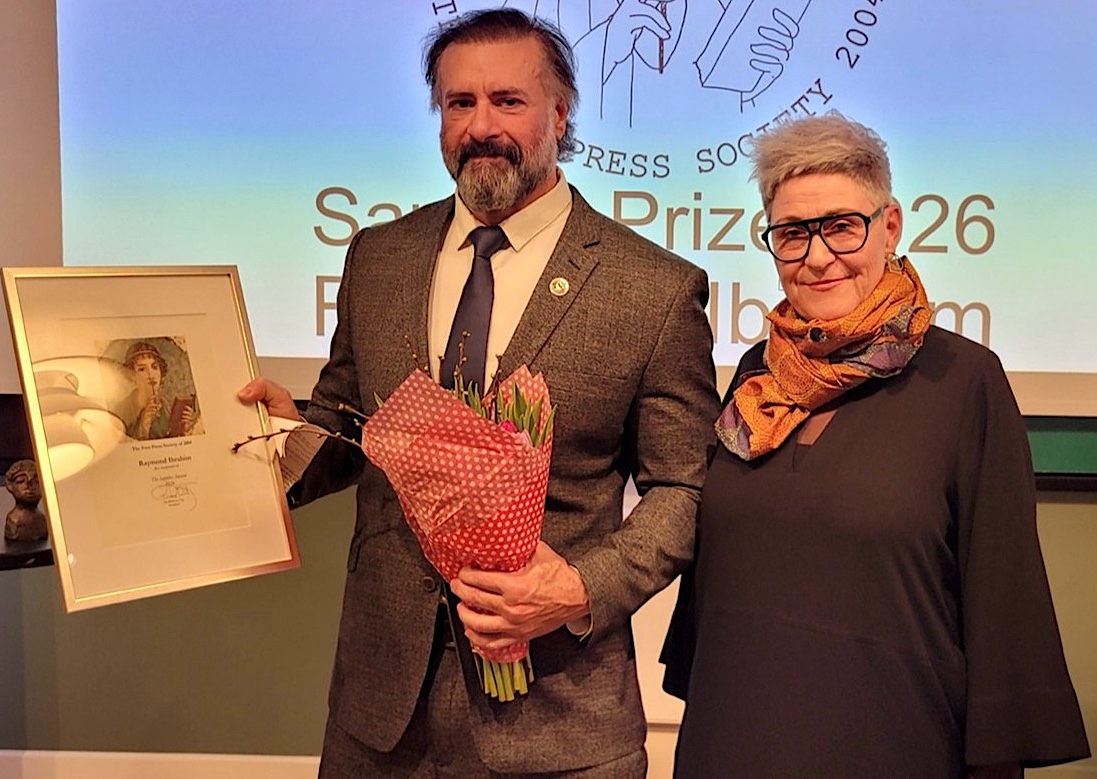

Raymond Ibrahim—bestselling author, historian, and Visiting Fellow at the Danube Institute—has been awarded the prestigious Sappho Prize, the Freedom of Expression Award presented by the Danish Free Press Society (Trykkefrihedsselskabet).
Now in its 20th year, the prize has previously been awarded to such defining intellectual figures as British political commentator Douglas Murray, the late conservative philosopher Sir Roger Scruton, and British activist Tommy Robinson. However, as Chairman of the Free Press Society Aia Fog noted in her opening remarks, the award, named after the controversial ancient poetess, ‘is not a popularity prize’. Each laureate has demonstrated immense intellectual courage in the face of fierce criticism, systemic opposition, and, in some cases, even death threats, refusing to bow to ideological pressure. ‘The Sappho prize recognizes [this] courage and serves as an encouragement to stand firm,’ stated the Chairman.
Raymond Ibrahim is no exception. The Coptic American historian received the honour for over two decades of research examining the specifically religious underpinnings of Christian persecution—both contemporary and historical—primarily common in Muslim-majority regions. It is no coincidence that this sensitive topic remains one of the most underreported issues of our time. Despite grounding his claims in classical Arabic texts, authentic historical primary sources, and well-documented reports, Ibrahim has faced repeated attempts to silence his work. Today, Christians have become the world’s most persecuted religious community; for them, the challenge is not a mere academic debate, but a matter of life and death. Nevertheless, the West continues to treat the issue as marginal, attributing the violence to socio-economic grievances, ignoring its religious element, while branding scholars like Ibrahim as ‘Islamophobic’.
‘Despite grounding his claims in classical Arabic texts, authentic historical primary sources…Ibrahim has faced repeated attempts to silence his work’
Throughout his life, Ibrahim has been guided by the pursuit of truth—the very motivation that led him to the field of history. As he articulated: ‘Before we talk about how we got here, we have to know where we came from.’ This requires an honest confrontation with history, even when the facts are painful or disrupt established narratives. In this spirit, Ibrahim’s keynote address delved right into the most divisive religious questions regarding Islam.
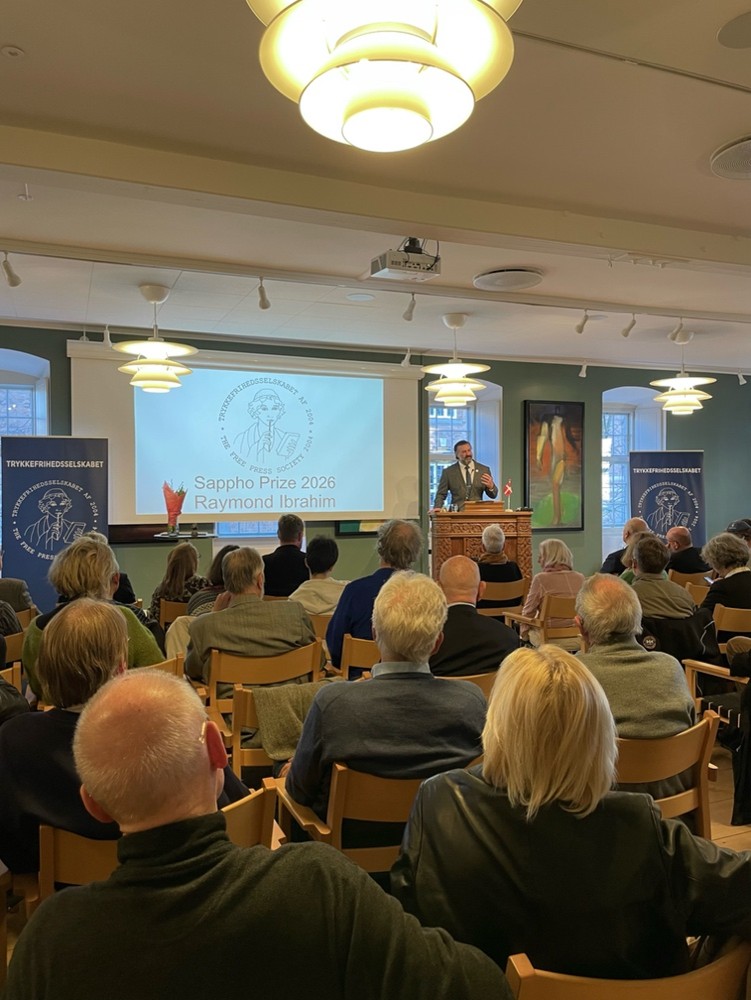
He argued that mainstream Western academic discourse systematically ignores the enduring Islamic doctrines on Jihad, or the principle of al-walā’ wa-l-barā’ (loyalty and enmity). The latter, rooted in Sura 60:4 of the Quran, fundamentally defines the relationship between the faithful Muslims and the non-Muslim ‘infidels’. Ibrahim maintains that despite their sacred framework, these tenets reflect 7th-century tribal mindsets that are inherently incompatible with Western culture.
But even beyond theology, as Ibrahim sees, a similar double standard prevails in historical interpretation. In discussions of the ‘Dark Ages’, it is often omitted that the era was preceded by the shock of the early Muslim conquests. By 732 AD, just a century after Muhammad’s death, the Christian world had lost nearly 80 per cent of its territory, while four of the five ancient Christian patriarchates—Alexandria, Antioch, Jerusalem, and Constantinople—fell under Islamic rule. Today—he argues—the Crusades are taught without context, though they were, in fact, a belated response to four centuries of Islamic expansion, aimed at liberating the Holy Sites and besieged Christian communities.
Ibrahim also challenged the myth of the ‘Golden Age of Spain’ as a false historical narrative. While acknowledging the era’s architectural legacy and its relative scientific advancement compared to a then-fractured Europe, in his view, it was far from a paradise of peaceful coexistence (convivencia). Primary sources recount brutal repressions—such as the ‘Martyrs of Córdoba’—while Christian communities were forced to take refuge in the northern mountains until the Reconquista.
According to Ibrahim, the cruelty of the Barbary pirates and the Ottoman conquests has similarly been obscured by historical relativism. In the 16th and 17th centuries, Barbary slave raids resulted in the enslavement of over 1.25 million Europeans, while countries in the Balkans and Central Europe, including Hungary, still carry the collective memory of the Ottoman occupation. Moreover, even the United States’ first overseas war was a direct consequence of Barbary aggression. Ibrahim cited a telling 1786 letter by Thomas Jefferson, who recounted a meeting with the Ambassador of Tripoli: the liberal, philanthropic American approach was met with the religious obligation to make war upon infidels. This example provides a lesson that still carries a message relevant to this day.
Reflecting on his own experiences with the ‘cancel culture’ of the academic mainstream, Ibrahim recalled facing hostility as early as his student years at Georgetown University. Although his 2007 book, The Al-Qaeda Reader, brought him initial prominence, invitations began to vanish as he started to talk about ‘inconvenient’ details. He faced major boycott attempts by activist groups—most notably CAIR—in Seattle, and at the US Army War College in Pennsylvania following the success of his book, Sword and Scimitar. Ultimately, these attempts backfired; the resulting scandals drew massive audiences, reinforcing Ibrahim’s commitment to the truth. He now believes that the term ‘hate speech’ is primarily used as a weapon to suppress reality, highlighting that the fact that something might offend someone does not mean it cannot be true. Furthermore, it is rather concerning that collective conflict-avoidance has become the guiding principle of modern society.
In his closing remarks, Ibrahim reminded the audience that ‘culture is not just food and clothing’. He called this the great lie of multiculturalism—the reduction of culture to superficial traits. Yet at its core, culture is religion and the worldview that stems from it.
‘At its core, culture is religion and the worldview that stems from it’
This message resonated deeply with those gathered in Copenhagen, where the social and integration challenges of mass Muslim migration have become a fixture of daily life. From the windows of the centuries-old Vartov building—closely tied to the influential Danish Christian poet and theologian Nikolaj Frederik Severin Grundtvig and now serving as the venue for the ceremony—Aia Fog pointed to the heavy granite blocks placed in the square. In Denmark, these are known as ‘Quran-stones’: they serve to protect pedestrians or, as we saw at the time, peaceful democratic protesters from potential vehicular terrorist attacks by Islamic fundamentalists. This is one of the main reasons that the work of the Free Press Society and scholars like Ibrahim remains crucial, and why so many Sappho Prize laureates are from thinkers who have dared to take a stand. For a discourse based on facts, freedom of speech is indispensable. It is this conviction that drives the organization’s as well as Raymond Ibrahim’s work, along with the hope that all of this may lead to a positive change in the future. As Raymond Ibrahim concluded, invoking the words of Jesus Christ: ‘The truth shall set you free.’
____________________