
By Chrysa Makri – ParaPolitika –
The case is stuck at “ground zero”: “On the one hand, there are moves to seize the monastery’s property, and on the other, it is not being allowed legal representation, because the Presidential Decree on the basis of which Saint Catherine’s Monastery would be represented before the Egyptian courts has not been issued,” sources cited by ParaPolitika note.
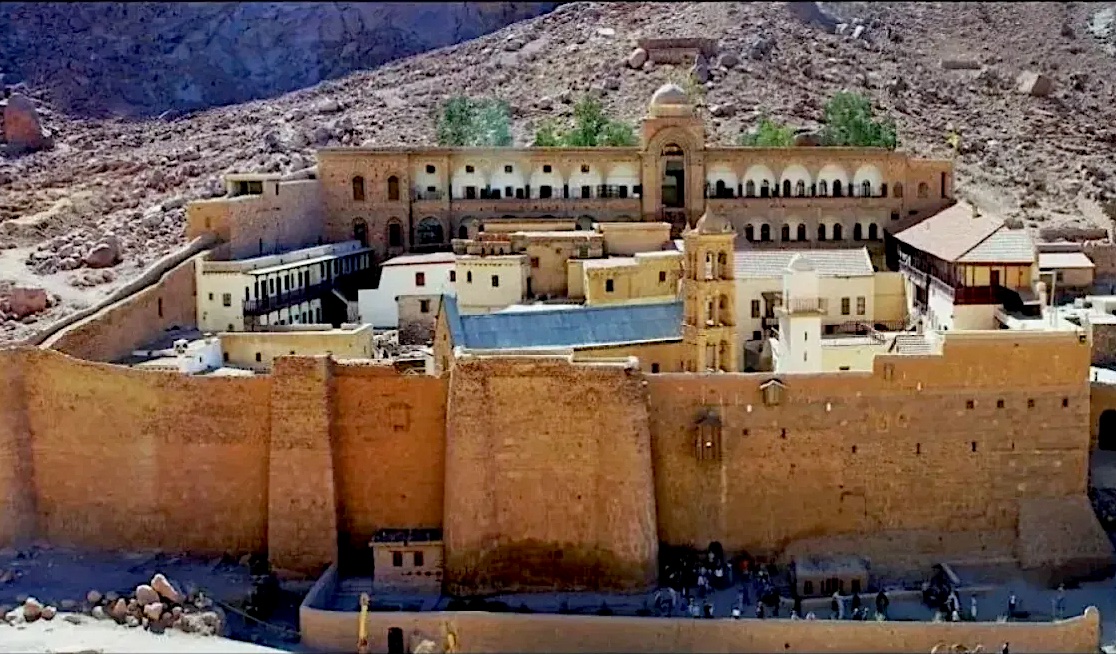
A climate of anxiety reportedly prevails within the monastic community of Saint Catherine’s Monastery in Sinai, as more than seven months have passed since the court ruling and the reciprocal assurances given by the Greek and Egyptian governments, yet the case remains stuck at what sources describe as “ground zero.”
The Egyptian court decision mandates a change in the monastery’s ownership status and the confiscation of its property, with the aim of converting it into a museum. More specifically, the ruling determined that the monastery would pass into the hands of the Egyptian state, while the monks would be characterized merely as “guests.”
Concern over Saint Catherine’s Monastery
Diplomatic sources contacted by parapolitika.gr confirm that “there is nothing new to report,” despite repeated assurances that “an agreement is expected soon.” Legal sources handling the case, in close cooperation with the newly elected Archbishop of Sinai, Symeon, express deep concern to ParaPolitika regarding the future of the monastic community and the monastery itself.
Two months after the enthronement of Archbishop Symeon—whose election was intended to facilitate progress on the issue—and despite assurances given by the Egyptian government in Athens regarding the immediate issuance of a Presidential Decree ratifying his election, this decree has still not been issued. Nor have permanent residence permits been granted to the monks of the Sinai community at the monastery.
As a result, the monks are effectively confined within the monastery, and the monastery itself is unable to obtain lawful legal representation vis-à-vis the Egyptian state—before courts, public authorities, and anywhere else such representation is required. Individuals close to the monastery describe this situation to ParaPolitika as “paradoxical.”
“On the one hand, there are moves to take the monastery’s property, and on the other, its legal representation is being blocked by the failure to issue the Presidential Decree on the basis of which Saint Catherine’s Monastery would be represented before the Egyptian courts. In Egypt, a lawyer cannot appear without a duly ratified and notarized power of attorney,” the same sources explain.
Tourism development plans around the monastery
According to well-informed sources cited by ParaPolitika, the Egyptian government intends to proceed with tourism development plans for the wider area surrounding Saint Catherine’s Monastery. A strong indication of this intention is the decision by the governor of South Sinai to file an appeal (cassation) against the court ruling, seeking that even the monastery’s religious spaces be assigned to the Egyptian state.
After fifteen centuries of uninterrupted history—and after surviving periods of intense pressure, including during the era of the Muslim Brotherhood—Saint Catherine’s Monastery appears to be facing one of the most severe challenges of its existence. Under the presidency of Abdel Fattah al-Sisi, tourism development is presented as a central policy priority.
Plans for developing the area as a major tourist destination reportedly include large hotel complexes and the promotion of visits by more than 30,000 tourists to the Greek Orthodox pilgrimage site, which houses approximately 2,000 icons dating from the 4th and 5th centuries, as well as priceless relics and manuscripts of immense religious and historical value.
Legal uncertainty and international guarantees
The monastic community, which holds documentation based on four international frameworks—including UNESCO conventions and United Nations protections—is turning to the Greek state for support. According to the same sources, an out-of-court settlement currently appears remote, while resolution through litigation is being pushed into a distant and uncertain future.
The handling of the case itself is also criticized. “There is great confusion,” sources say.
“There is ownership; it is historical ownership; it has existed for 1,600 years and is documented through hundreds of legal titles—Ottoman firmans, documents attributed to the Prophet Muhammad, and international treaties. As for the religious character of the pilgrimage, it has never been questioned—not even by the contested court decision, which explicitly states that there is no issue regarding the religious nature of the monastery. From this point onward, the case is heading to the Higher (Cassation) Court,” the same sources emphasize.
Close associates of Archbishop Symeon note that while an out-of-court agreement would in principle be preferable because it would shorten the process, it also carries risks—particularly if such an agreement is concluded between governments rather than directly with the monastery itself.
As they warn: “If tomorrow—and it is entirely possible—the Muslim Brotherhood were to return to power in Egypt, such an agreement would not be respected, because it would be political in nature.”
The goal of the Sinai monastic community, as conveyed by sources cited by ParaPolitika, remains clear: to secure an out-of-court agreement under which Egypt formally recognizes and respects the monastery’s ownership, as it has existed continuously for more than 1,600 years.
_________
Translated from: