
Christian communities across Syria have canceled or significantly restricted Holy Week observances following a wave of attacks targeting Christian towns, businesses, and religious symbols, amid growing fears over security and the lack of effective protection.
The most serious incidents occurred in the predominantly Christian town of Al-Suqaylabiyah in the Hama countryside, where groups of Sunni Muslim assailants launched coordinated attacks on local residents and property. According to local accounts, what began as a dispute at a liquor store quickly escalated into a broader wave of violence, as groups of radicalized young men from nearby areas gathered, looted shops, and destroyed a statue of the Virgin Mary in a public square.
Some attackers reportedly attempted to assault young women and threatened residents with further violence. Syriac Catholic Archbishop Jacques Mourad described the assailants as arriving “in large numbers, armed and on motorcycles,” firing shots into the air and creating what he called a “climate of fear and terror.”
Crucially, Mourad alleged that members of the security forces and police were among the attackers, and that authorities failed to respond promptly to protect the community—raising serious concerns about complicity or, at minimum, a breakdown of law enforcement.
Additional incidents underscored the broader nature of the targeting. In Tartus province, attackers vandalized a Christian cemetery in Al-Rawda, smashing crosses on tombstones—an act widely recognized as targeting the religious identity and historical presence of the community.
Cancellations Across Multiple Cities
In the wake of these attacks, churches across Syria—including in Damascus, Aleppo, and areas surrounding Suqaylabiyah—canceled Palm Sunday processions and limited Holy Week observances to indoor prayers.
These measures were driven both by immediate security concerns and by a desire to express solidarity with affected communities. In Aleppo, church leaders explicitly framed cancellations as a collective response to the violence rather than isolated precautionary steps.
The cancellations stand in contrast to official messaging. The Syrian government, now under the control of the jihadist group Hayat Tahrir al-Sham (HTS) since late 2024, has publicly claimed to be ensuring the protection of churches and religious gatherings. State media reported that services proceeded under security measures and emphasized the government’s commitment to safeguarding religious freedom.
However, accounts from church leaders and local residents point to a stark disconnect between these assurances and conditions on the ground.
Church Leaders Warn of Strained Coexistence
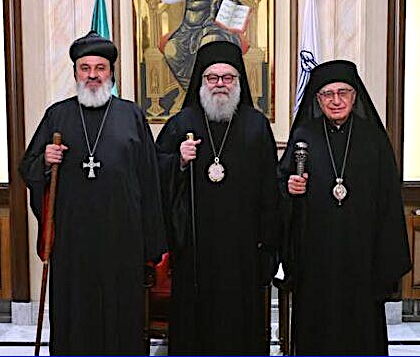
In a joint statement issued on March 29 in Damascus, the Patriarchs of Syria’s major Christian churches—including Greek Orthodox Patriarch John X, Syriac Orthodox Patriarch Ignatius Aphrem II, and Melkite Greek Catholic Patriarch Youssef Absi—condemned the attacks in Suqaylabiyah and warned of their broader implications.
They emphasized that the situation reflects serious threats to peaceful coexistence and called for urgent measures to restore security, control the spread of weapons, and uphold the principles of citizenship, equality, and fundamental freedoms.
The Patriarchs also recommended limiting religious celebrations to prayer services within churches, underscoring the gravity of the situation.
A Widening Gap Between Claims and Reality
The events surrounding Holy Week 2026 highlight an increasingly visible gap between official narratives and the lived experience of Christian communities in Syria.
While HTS leadership has sought to present itself internationally as a stabilizing authority capable of protecting minorities, multiple reports since 2025 indicate rising insecurity. These include targeted violence, threats against civilians, and restrictions on public expressions of Christian identity.
According to humanitarian and monitoring groups, dozens of Christians were killed in sectarian incidents in 2025 alone, including a suicide attack on a church in Damascus that left scores of casualties.
Beyond direct violence, structural developments have added to concerns. The interim constitutional framework adopted in 2025 designates Islamic jurisprudence as a principal source of legislation—raising questions about the long-term protection of equal rights for religious minorities.
Although the situation in Al-Suqaylabiyah has reportedly calmed, church leaders caution that underlying tensions remain unresolved.
For many Syrian Christians, the cancellation of Holy Week processions—among the most visible expressions of communal religious life—marks not only a response to immediate threats, but a broader contraction of public religious space.
Absent consistent protection and accountability, these developments risk entrenching a pattern in which the ability of minority communities to practice their faith openly depends less on legal guarantees than on fluctuating local conditions and shifting power dynamics.
_________________
Sources include: